

Graycliff Exploration (CSE: GRAY) / (OTC: GRYCF) announced that exploration drilling has commenced at its 100%-owned Shakespeare Gold Project near Sudbury, Ontario. This is important news, especially as drilling has already started, not in a few months, now.
It’s my understanding that Graycliff’s largest shareholder owns multiple drill rigs and provided one to the Company at very low cost. That suggests to me that the current cash balance could support a decent amount of drilling.
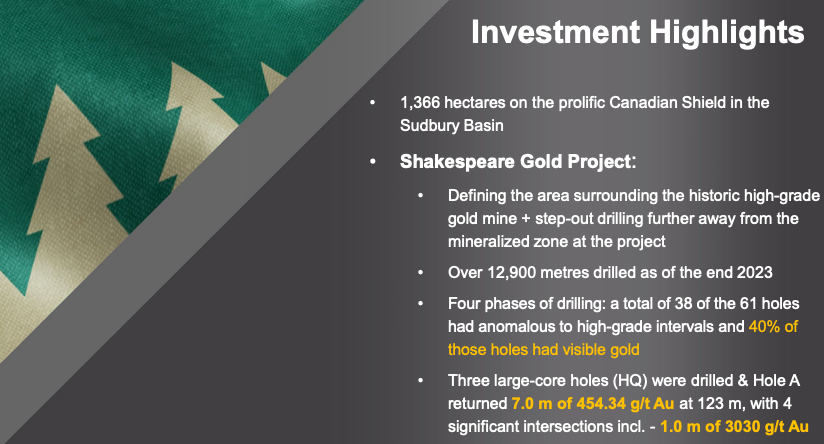
This marks the first drill program at Shakespeare since 1Q/23, building directly on metallurgical assay results (three holes) announced in June/July. Drilling is currently underway on a large-diameter (HQ) core hole positioned directly behind Hole A. Readers are reminded that Hole A was the Monster interval of 454 g/t gold over 7.0 meters.
Without going on and on and on about how good that intercept is, suffice it so say it’s a Top 1% result anywhere in the world. The few holes that are better on the [gram x meter] scale are almost entirely from multi-billion dollar juniors or at producing mines.
I estimate less than 10% of juniors enjoy a single 200+ gram-meter hit in their lifetimes, vs. Graycliff’s spectacular 3,180 reading (most deposits are not particularly high-grade).
We may never see another 3,180 [ g x m] outcome, but future results in the 100s of [g x m] (if meant to be) should be well received, not panned as a disappointment compared to Hole A. Of course, the market decides what’s liked, not me.
If Graycliff was valued in the C$10s of millions, then the risk/reward would be more balanced headed into this drill program. Instead, the Company is valued at ~C$6M.
The new (fourth) metallurgical hole is designed to sample material directly below Hole A, collecting additional representative core for initial “mineralogical, extraction, and concentration testing.”
According to the PR, the new drilling incorporates results from the recently announced metallurgical test core assays, plus extensive historical work. Recall, there’s been significant drilling over four prior phases (61 holes, over 12,900 m).
Management states that 62% of holes intersected Au mineralization, with 40% of those displaying visible Au. Once the 4th metallurgical hole is complete, Graycliff will immediately transition to other high-priority targets to further define and expand the main zone. Chairman James Macintosh commented,
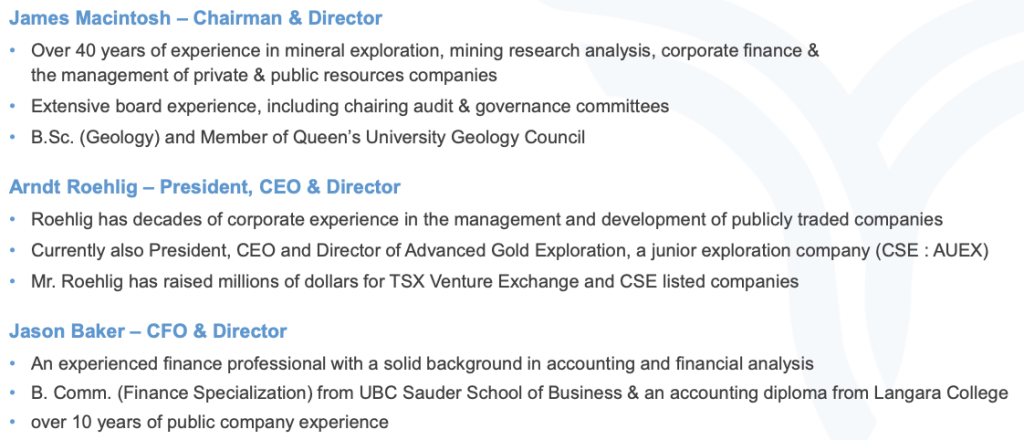
“With the first tranche of our LIFE financing closed, we are thrilled to get the drills turning again at Shakespeare. Coming off assay results like 1.0 meter of 3,030 g/t gold, the strength of the mineralizing system here is undeniable. Graycliff presents an exceptional value proposition with under ~19 million shares outstanding, a tight ~$6M market cap, and a fully funded exploration program.”
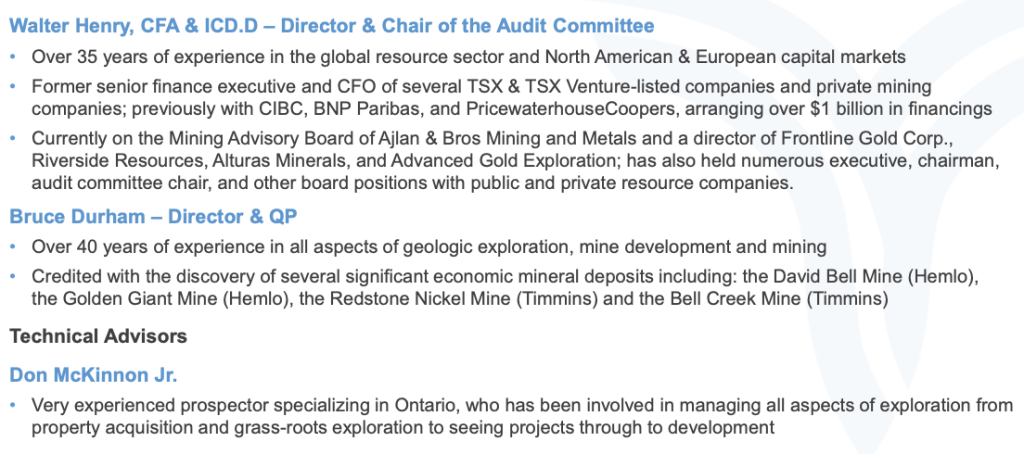
Graycliff has an excellent team, especially for a company valued so cheaply. Director Bruce Durham was a key member of various exploration teams credited with the discovery of significant mineral deposits including the David Bell and Golden Giant gold mines in Hemlo, Ontario and the Redstone Nickel and Bell Creek gold mines in Timmins.
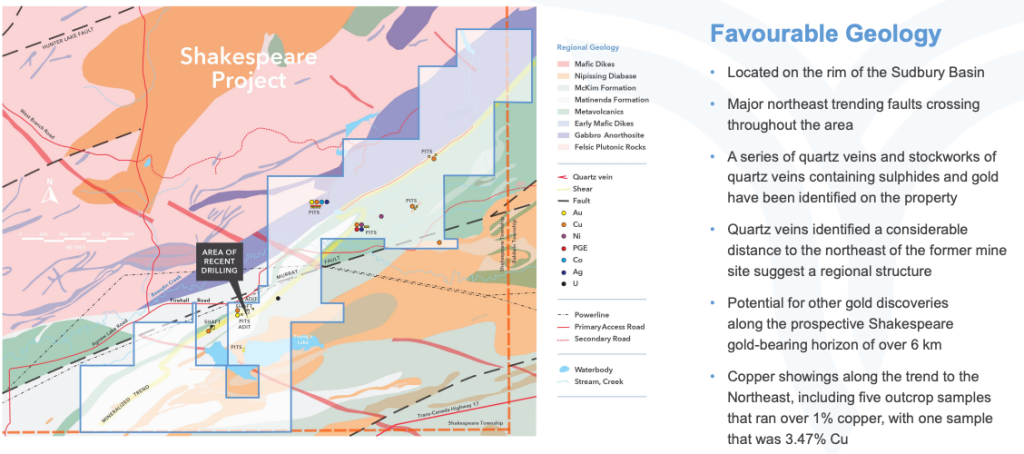
Mr. Durham also worked with two of Canadian mining’s most iconic figures, promoter Murray Pezim and Hemlo prospector Don McKinnon. Working with Chairman Macintosh, also a geologist, Durham is focused on finding high-grade Au, near surface, and across an identified, promising, 6 km horizon at the former Shakespeare Au mine.
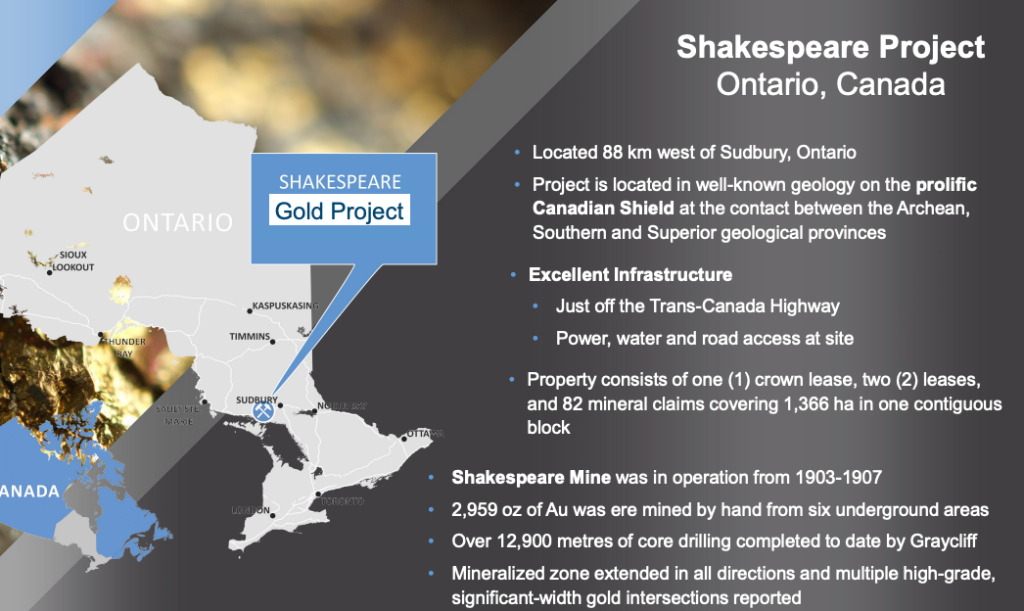
The past-producing Shakespeare mine is 88 km west of Sudbury on the Canadian Shield. It operated from 1903 to 1907, producing ~3,000 troy ounces from six underground stopes. The current project has been expanded to 1,366 hectares.
I’ve spoken several times at length with Mr. Macintosh. He’s both knowledgeable and quite experienced (40+ years), but given Mr. Durham’s impressive track record, I thought it would be useful to interview him on the Shakespeare opportunity.
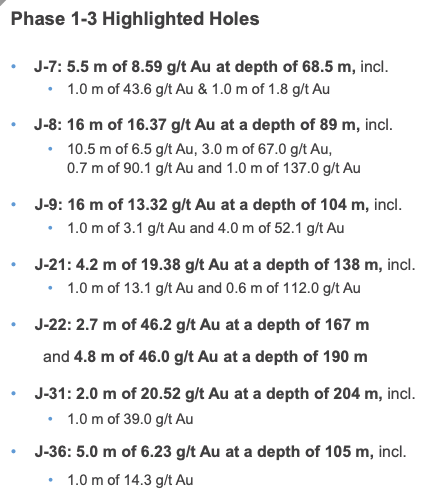
Notice strong historical results, like 16 m of 16.4 g/t Au, [shallow], 89 meters
Thank you for your time Bruce, much appreciated. Everyone wants to know what makes Shakespeare special?
My pleasure. Look, no one can say that Shakespeare will be special in terms of becoming a viable deposit, a lot more drilling is needed. My friends and colleagues consider me to be conservative in my views on the prospects of early-stage properties. Your readers should remember this is still a very high risk opportunity.
I’ve been closely involved with dozens of prospects over the years. One would be hard pressed to find a project anywhere in the world, in a C$6M company no less, that has the drill result we announced. Is it a one-hit wonder I’m asked? Sure, it could be, but I see no reason to assume it is.
It might be a one-hit wonder in the sense that a better one won’t be found, but Graycliff doesn’t need to keep drilling blockbusters. A string of good-to-very good holes would be sufficient to methodically, prudently, advance the project towards a potentially viable resource.
Not every hole will be good, but each delivers important info. I’m excited that drilling is underway, we could start to see assays in August.
You say there’s no reason to assume this is a one-hit wonder. Can you add a bit more context?
Sure. Isn’t every deposit essentially a one-hit wonder until additional strong results emerge? If the results were great, but not so extraordinary, would investors have been as concerned about this being a one-hit wonder? I understand the concern if one fears Hole A’s assays are a mistake, an error, but I see no evidence of that.
I was speaking with a very well known geologist (I won’t name drop), but we agreed that as a rule of thumb, when one sees coarse visible gold it’s often a good sign. We have that here.
For those possibly underwhelmed by holes B & C vs. hole A, what are a few takeaways that help advance the project?
What’s important is overall grade, not grades reported in a single hole. Hole A certainly had a lot of gold, two orders magnitude higher than the highest grade mines. Hole B was high grade, well above the average grade for gold mines in Canada.
For Hole C we targeted an area where the grade was expected to be lower. In carrying out metallurgical test work we need a representative mix of low. medium, and high grade material to see variations in mineralogy and specifics.
Extremely high-grade intervals are critically important, they suggest a likelihood of finding areas of high-to-very-high-grade mineralization once we eventually see it up close. High grades like in holes A & B indicate that high grades are going to be more prevalent than originally thought.
Besides HUGE drill Hole A, what else regarding the Shakespeare prospect has your attention?
Although not in a major camp like Timmins or Hemlo, I’m intrigued with the past production from 120 years ago. Back then, only very high-to-ultra-high grade ore (by today’s standards) would have been mined. The historic mine was not large, but not tiny either. It was developed on six levels.
I like the idea of possibly doing a bulk sample, something the board is carefully considering. If one could pull out good grades, say 8+ g/t, a bulk sample could actually deliver meaningful cash flow with gold at $4,100/oz. It wouldn’t take that many ounces to move the needle on a C$6M company.
The reason a bulk sample is worth considering is that the high grade would enable ore to be profitably shipped 100s of km to a third party for toll-milling. Note, executing on a bulk sample program takes a lot of work above and beyond just funding it.
Presumably, multiple companies would be interested in funding a bulk sample initiative. However, to be clear, this would be next year’s business at the earliest. Drilling is the main focus for 2026.
Thank you Bruce, very insightful commentary. I look forward to drill results as soon as next month!
Disclosures/disclaimers: The content of this article is for information only. Readers fully understand and agree that nothing contained herein, written by Peter Epstein of Epstein Research [ER], (together, [ER]) about Graycliff Exploration, including but not limited to, commentary, opinions, views, assumptions, reported facts, calculations, etc. is not to be considered implicit or explicit investment advice. Nothing contained herein is a recommendation or solicitation to buy or sell any security. [ER] is not responsible under any circumstances for investment actions taken by the reader. [ER] has never been, and is not currently, a registered or licensed financial advisor or broker/dealer, investment advisor, stockbroker, trader, money manager, compliance or legal officer, and does not perform market-making activities. [ER] is not directly employed by any company, group, organization, party, or person. The shares of Graycliff Exploration are highly speculative, and not suitable for all investors. Readers understand and agree that investments in small-cap stocks can result in a 100% loss of invested funds. It is assumed and agreed upon by readers that they will consult with their own licensed or registered financial advisors before making investment decisions.
At the time this article was posted, Graycliff Exploration was an advertiser on [ER]. Peter Epstein owned shares in the company, acquired in the open market.
Readers understand and agree that they must conduct due diligence above and beyond reading this article. While the author believes he’s diligent in screening out companies that, for any reason whatsoever, are unattractive investment opportunities, he cannot guarantee that his efforts will (or have been) successful. [ER] is not responsible for any perceived, or actual, errors including, but not limited to, commentary, opinions, views, assumptions, reported facts & financial calculations, or for the completeness of this article or future content. [ER] is not expected or required to subsequently follow or cover events & news, or write about any particular company or topic. [ER] is not an expert in any company, industry sector or investment topic.
Comments
Log in or sign up to join the conversation.