

A-Level Further Mathematics: Mastering Advanced Math for STEM Success
The A-Level Further Mathematics qualification provides students with a demanding yet esteemed certification, which includes essential pure mathematics components, and students can select additional study modules that include Mechanics, Statistics and Decision Mathematics. Students who want to study maths, physics and engineering should choose this programme.
The course includes complex number and matrix and advanced calculus studies. The programme establishes a fundamental mathematical knowledge base which extends beyond the requirements of the A-Level Maths programme.
Studying this subject with A-Level Mathematics enables students to develop advanced problem-solving competencies while their analytical abilities improve and their chances of success in competitive STEM university programmes increase. The programme requires full commitment from students, but it offers complete mathematical training to students who achieve high levels of dedication.
What is Further Mathematics A-level?
A-Level Further Mathematics serves as an advanced educational programme which students pursue together with or after completing A-Level Mathematics. The program provides an in-depth analysis of matrices, complex numbers and discrete mathematics systems.
The programme supports STEM students by developing their skills in mathematics, problem-solving and analytical thinking. The programme holds high academic value for universities that offer mathematics, physics and engineering degree programmes.
What You’ll Learn in A-Level Further Mathematics?
The course structure divides 50% of the curriculum into core pure mathematics content, while the remaining 50% consists of applied modules that students can choose.

Core Pure Mathematics
The students research sophisticated subjects which include complex numbers and matrices, advanced calculus, polar coordinates, hyperbolic functions and the mathematical proof method called induction.
Optional Modules
Depending on the school or exam board, students can choose from Further Mechanics, Further Statistics, or Discrete/Decision Mathematics, which covers algorithms, graph theory, and other applied problem-solving methods.
Key Details of Studying Further Mathematics
Structure: The course is usually split evenly, with 50% core pure mathematics and 50% optional modules, such as Further Mechanics, Further Statistics, or Decision Mathematics.
Content: It builds on algebra and calculus while introducing advanced topics like complex numbers, matrices, polar coordinates, hyperbolic functions, and differential equations.
Challenge: Known as one of the most demanding A-Levels, it requires strong algebra skills and typically a high GCSE maths grade.
University Relevance: It is highly regarded for STEM degrees, including mathematics, physics, engineering, and computer science, giving students a competitive edge.
Assessment: Students are evaluated through three or more written exams, depending on the exam board (e.g., Edexcel, Cambridge International).
Preparing for A-Level Further Mathematics: 6 Tips for Success
Prerequisites: A-Level Further Mathematics requires a very strong foundation in A-Level Mathematics, particularly in areas such as algebra and calculus, as these topics form the basis for many advanced concepts.
Study Commitment: The course typically requires around 360 hours of study, although the exact time may vary depending on the student’s pace and learning style.
Practice Regularly: Work through a wide variety of challenging problems to strengthen logical reasoning and improve problem-solving skills. Consistent practice helps build confidence with complex topics.
Use Past Papers: Solving previous exam papers helps you become familiar with exam formats, question styles, and effective time management.
Stay Organised: Keep detailed notes, review topics regularly, and follow a structured study schedule to manage the demanding content successfully.
Seek Help When Needed: Ask A-level maths tutors, join study groups, or use reliable online resources to clarify difficult concepts and deepen your understanding.
Core Maths vs Further Maths: What You Need to Know
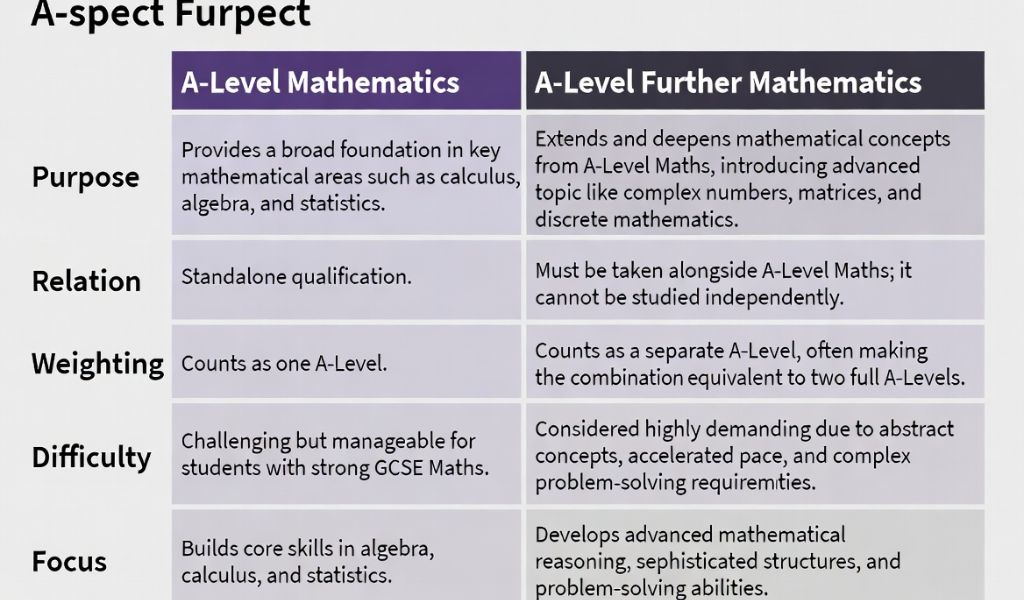
Why Take A-Level Further Mathematics?
University Admissions: Further Mathematics is highly regarded for competitive degrees in mathematics, engineering, physics, and computer science at top universities, including Oxbridge and Imperial. It strengthens applications and demonstrates strong quantitative ability.
Popularity & Performance: Entries for Further Mathematics grew significantly in 2025, rising by about 7.5% compared with 2024, showing sustained interest in advanced maths study. Overall A-Level results saw top grades (A*/A) at around 28.2% across all subjects in 2025, reflecting strong performance trends among dedicated students.
Career Opportunities: The qualification builds deep analytical thinking and problem-solving skills, making it valuable for careers in finance, data science, actuarial work, software engineering, research, and other highly quantitative fields.
Exams & Exam Boards for A-Level Further Mathematics
Assessment Format
Further Mathematics is almost entirely exam-based, with students sitting multiple written papers at the end of the two-year course. These exams cover both core pure mathematics and optional modules, testing problem-solving, reasoning, and advanced mathematical understanding.
Exam Boards
In the UK, the main boards offering this qualification are Pearson Edexcel, AQA, and OCR. Each board provides slightly different paper structures and optional modules, allowing schools and students some flexibility in tailoring the course to their strengths and interests.
Optional Modules in A-Level Further Mathematics
A key feature of Further Mathematics is the flexibility to choose optional modules, allowing students to tailor the course to their interests and strengths. These modules complement the core pure mathematics content and introduce applied mathematical techniques.

Further Mechanics: Explores advanced topics in forces, motion, energy, and kinematics, ideal for students interested in physics or engineering.
Further Statistics: Builds on probability and data analysis, covering hypothesis testing, regression, and advanced statistical methods; useful for economics, data science, or research-focused degrees.
Discrete/Decision Mathematics: Introduces algorithms, graph theory, and decision-making models, emphasising logical reasoning and problem-solving for computing, logistics, and operations research.
Choosing the right modules can strengthen university applications and provide insight into specific STEM fields, helping students develop both analytical and practical skills.
Ending
A-Level Further Mathematics is a rigorous and highly rewarding course designed for students with a strong aptitude and passion for mathematics. By covering both core pure topics and optional applied modules, it deepens mathematical understanding and develops advanced problem-solving and analytical skills beyond standard A-Level Maths.
The qualification is particularly valued by top universities, especially for competitive STEM degrees in mathematics, engineering, physics, and computer science. Its challenging content prepares students for both academic & career success with Mixt Academy and quantitatively demanding fields such as finance, data science, actuarial work, and software engineering.
Success in Further Mathematics requires dedication, consistent practice, and effective study strategies. For motivated students, it not only strengthens university applications but also provides a strong foundation for lifelong mathematical fluency and analytical thinking, making it an excellent investment in future STEM opportunities.
FAQs About Further Mathematics A-level
Do I need A-Level Maths before Further Mathematics?
Yes! Further Mathematics builds directly on A-Level Maths concepts, so you must study both at the same time. It cannot be taken as a standalone course.
What does it take to get an A* in A-level Further Maths?
Achieving an A* is challenging but possible. It usually requires around 85% across all papers (exact boundaries vary by board). Strong core pure maths skills and excellent performance in your chosen optional modules are essential, alongside consistent practice and smart exam preparation.
Is Further Mathematics more difficult than regular A-Level Maths?
Yes! It is considered more demanding due to its abstract concepts, faster pace, and higher-level problem-solving requirements.
Why should I take A-Level Further Mathematics?
It’s worth it! Despite its difficulty, it provides a significant advantage for university applications in STEM fields and equips you with advanced analytical and problem-solving skills valued in quantitative careers.
Comments
Log in or sign up to join the conversation.