

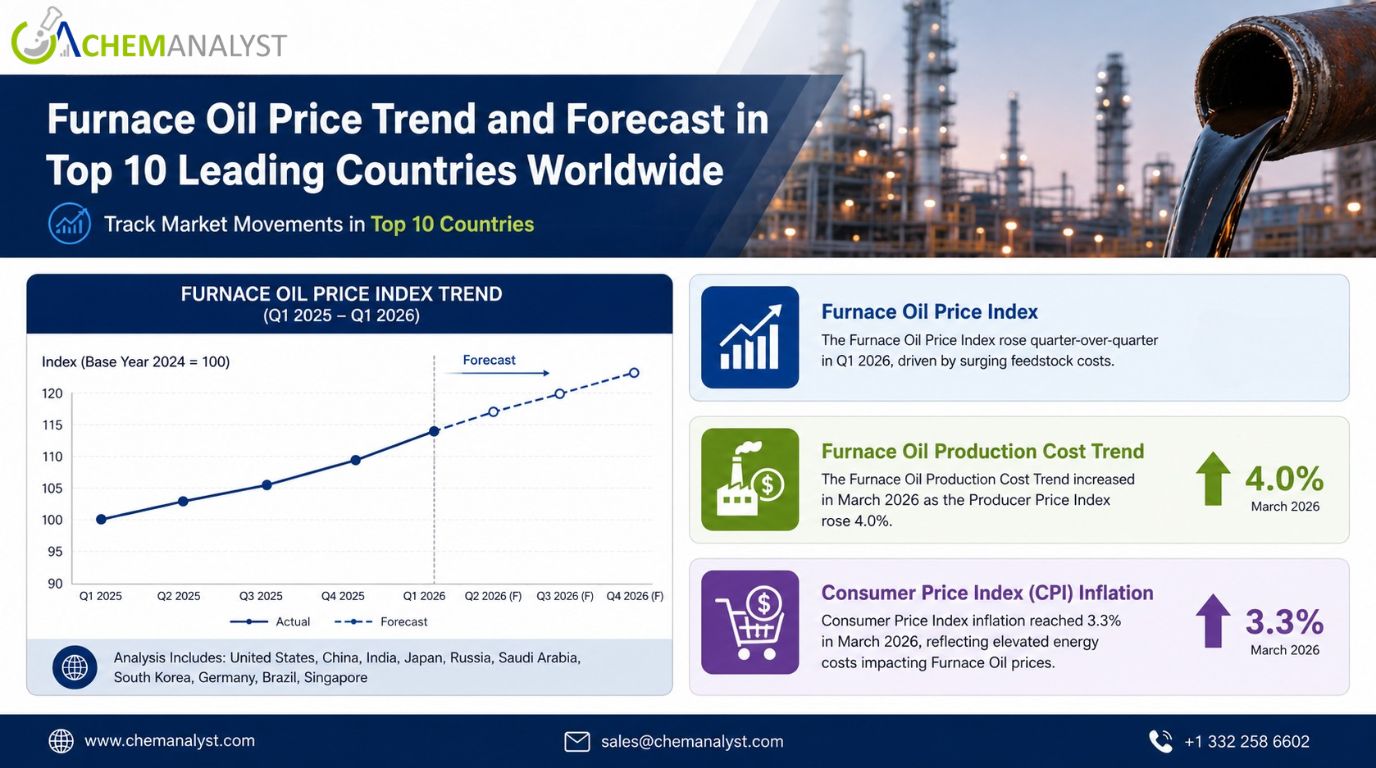
The global Furnace Oil Price market experienced notable upward momentum during the first quarter of 2026 as rising crude oil values, inflationary pressures, and higher refining costs pushed production expenses higher across major economies. Industries dependent on heavy fuel oils for heating, power generation, marine fuel, and industrial operations continued to face increasing procurement costs amid tightening supply dynamics and elevated feedstock prices.
According to ChemAnalyst Furnace Oil Price: - https://www.chemanalyst.com/Pricing-data/furnace-oil-2348
Furnace oil remains a crucial industrial fuel across sectors such as cement, steel, chemicals, power generation, shipping, and manufacturing. As global energy demand stabilizes and crude oil markets remain volatile, Furnace Oil Price fluctuations are increasingly influencing industrial production economics worldwide.
In Q1 2026, North America, Europe, and Asia-Pacific all reported quarter-over-quarter increases in the Furnace Oil Price Index, reflecting higher crude oil feedstock costs and persistent inflation-driven operational expenses.
What is Driving Furnace Oil Prices in 2026?
Several macroeconomic and industry-specific factors contributed to the rise in Furnace Oil Price levels during early 2026:
Rising crude oil feedstock costs
Higher refinery operating expenses
Increasing transportation and logistics charges
Inflationary pressures across industrial economies
Strong industrial fuel demand from manufacturing sectors
Supply chain constraints in petroleum product distribution
The combination of elevated energy prices and persistent inflation has created a cost-heavy environment for refiners and downstream fuel suppliers globally.
North America Furnace Oil Price Trend
United States Furnace Oil Price Analysis
In the United States, the Furnace Oil Price Index increased quarter-over-quarter during Q1 2026, primarily driven by surging feedstock costs linked to rising crude oil benchmarks. The increase in petroleum refining expenses significantly impacted furnace oil production economics across the region.
The Furnace Oil Production Cost Trend also moved upward in March 2026 as the Producer Price Index (PPI) rose by 4.0%. Higher producer inflation elevated operational costs for refiners, including labor, maintenance, fuel processing, and transportation expenses.
The U.S. industrial sector continued to maintain strong demand for heavy fuel oils, particularly from:
Manufacturing facilities
Industrial boilers
Power generation plants
Marine transportation operators
Asphalt and construction industries
Additionally, refinery maintenance activities in some regions tightened product availability, contributing further to upward Furnace Oil Price pressure.
Read the LinkedIn Article: - https://www.linkedin.com/pulse/furnace-oil-price-trends-2026-rising-feedstock-costs-push-singh-bb3jc/
Key Factors Influencing U.S. Furnace Oil Prices
Rising Crude Oil Costs
Crude oil remained the dominant cost component in furnace oil manufacturing. Increased global crude prices directly impacted refinery feedstock procurement costs.
Inflationary Industrial Costs
The March 2026 increase in the Producer Price Index added pressure to industrial fuel processing economics, increasing the overall Furnace Oil Production Cost Trend.
Transportation and Logistics
Higher diesel and freight costs elevated domestic distribution expenses across the United States fuel supply chain.
APAC Furnace Oil Price Trend
China Furnace Oil Price Analysis
China witnessed a significant increase in the Furnace Oil Price Index during Q1 2026 as crude oil feedstock costs surged amid strong regional energy demand and fluctuating global oil benchmarks.
The Furnace Oil Production Cost Trend in China increased in March 2026 as the Producer Price Index grew by 0.5%. Although the PPI growth was moderate compared to Western economies, higher energy and refining expenses still contributed to elevated furnace oil production costs.
China remains one of the world’s largest industrial fuel consumers, with furnace oil demand supported by:
Manufacturing industries
Shipping and marine fuel demand
Heavy industrial operations
Power and utility sectors
Chemical processing plants
Strong industrial activity and recovering export-oriented manufacturing further strengthened demand for petroleum-derived industrial fuels.
Major Drivers of China Furnace Oil Prices
Crude Oil Feedstock Inflation
Imported crude oil prices remained elevated during Q1 2026, increasing refinery acquisition costs for Chinese producers.
Industrial Fuel Demand
China’s large-scale industrial infrastructure continued to consume significant quantities of furnace oil for process heating and energy generation.
Refinery Margin Pressures
Higher refining and energy expenses reduced operational margins, encouraging producers to increase selling prices.
Europe Furnace Oil Price Trend
Germany Furnace Oil Price Analysis
Germany reported a quarter-over-quarter rise in the Furnace Oil Price Index during Q1 2026, largely supported by increasing crude oil feedstock prices and higher refining expenses.
The Furnace Oil Production Cost Trend surged in March 2026 as inflation reached 2.7%, significantly elevating operational costs for fuel refiners and industrial suppliers.
European energy markets continued to face challenges from:
Elevated energy transition costs
Inflationary industrial expenses
Volatile crude oil markets
Regulatory compliance costs
High transportation expenditures
Germany’s industrial base, including automotive manufacturing, engineering, chemicals, and heavy industries, sustained stable demand for industrial heating fuels despite rising prices.
Key Drivers in Germany’s Furnace Oil Market
Inflationary Refining Costs
Higher inflation increased labor, maintenance, utility, and operational expenses for refiners across Germany.
Energy Market Volatility
European energy market instability continued to affect petroleum product pricing throughout the quarter.
Industrial Consumption
Heavy industrial operations maintained consistent furnace oil procurement despite rising costs.
Global Furnace Oil Supply Chain Outlook
The global furnace oil supply chain remains closely tied to crude oil production dynamics, refinery utilization rates, shipping costs, and geopolitical energy developments.
Several trends are expected to shape Furnace Oil Price movements throughout 2026:
Tightening Refinery Margins
As refiners continue to face higher energy and compliance costs, operating margins may remain compressed, potentially supporting additional price increases.
Crude Oil Volatility
Any fluctuations in global crude oil benchmarks will continue to directly impact furnace oil pricing structures.
Industrial Demand Recovery
Continued growth in industrial manufacturing and infrastructure activities could strengthen fuel demand globally.
Shipping and Marine Fuel Demand
Marine transportation remains a major consumer of heavy fuel oils, particularly in emerging economies and international trade corridors.
Furnace Oil Market Challenges in 2026
Despite strong demand, the global furnace oil industry faces several structural and economic challenges.
Environmental Regulations
Governments worldwide are increasing emissions regulations on heavy fuel oils to support decarbonization and cleaner energy adoption.
Transition Toward Cleaner Fuels
Industries are gradually exploring alternatives such as natural gas, LNG, biodiesel, and renewable energy sources to reduce carbon footprints.
Supply Chain Disruptions
Shipping delays, refinery maintenance shutdowns, and geopolitical instability continue to create uncertainty in petroleum product markets.
Refinery Operational Costs
Inflationary pressures on labor, utilities, and equipment maintenance continue to increase production costs globally.
Furnace Oil Price Forecast for 2026
Industry analysts expect Furnace Oil Price levels to remain elevated during the remainder of 2026 due to ongoing feedstock volatility and persistent industrial demand.
Short-Term Outlook
In the short term, prices are likely to remain firm as:
Crude oil markets stay volatile
Industrial fuel demand remains stable
Inflationary pressures continue
Refinery operating costs increase
Medium-Term Outlook
Over the medium term, the market could witness moderate stabilization if:
Global crude oil supply improves
Inflation eases in major economies
Transportation costs normalize
Refinery output increases
However, geopolitical developments and energy market disruptions may continue to create pricing uncertainty.
Impact of Furnace Oil Prices on Industries
The rise in Furnace Oil Price levels directly affects several downstream industries.
Manufacturing Sector
Higher fuel costs increase production expenses for factories and industrial facilities relying on thermal energy systems.
Shipping Industry
Marine fuel cost increases impact freight rates and international trade logistics.
Power Generation
Power plants using heavy fuel oils face rising operational costs, potentially affecting electricity pricing.
Construction Materials
Cement, asphalt, and steel industries experience increased energy expenses during production processes.
Why Monitoring Furnace Oil Price Trends Matters
Tracking Furnace Oil Price trends is essential for procurement managers, manufacturers, energy traders, and industrial buyers seeking to manage operational costs effectively.
Market participants closely monitor:
Crude oil benchmark movements
Producer Price Index changes
Inflation data
Refinery utilization rates
Industrial demand indicators
Global shipping costs
Real-time market intelligence allows businesses to optimize procurement strategies and reduce exposure to sudden fuel cost fluctuations.
Conclusion
The global Furnace Oil Price market demonstrated strong upward momentum during Q1 2026 as rising crude oil feedstock costs, inflationary pressures, and increasing refinery expenses impacted major economies including the United States, China, and Germany.
North America witnessed strong pricing support from elevated producer inflation and industrial demand. China’s market remained influenced by rising crude oil import costs and expanding manufacturing activity, while Germany faced mounting refining expenses amid broader European inflationary pressures.
As industrial demand remains resilient and global energy markets continue to experience volatility, Furnace Oil Price trends are expected to remain a key focus area for industries worldwide throughout 2026.
Businesses operating in manufacturing, power generation, marine transportation, and industrial processing sectors will need to closely monitor furnace oil pricing movements to manage costs and maintain operational efficiency in an increasingly volatile energy landscape.
Contact US:
Email-Id: - [email protected]
Contact No: - +1 (332) 258-6602
Address: - 420 Lexington Avenue, Suite 300
New York, NY
United States, 10170
Comments
Log in or sign up to join the conversation.