


GLP-1s are evolving from a pharmaceutical growth story into a broader consumer story, touching such areas of the economy as clothing sales.
In collaboration with Centric Market Intelligence, LSEG found a widening divergence in apparel search behavior, promotional activity and sold-out rates across size groups and genders, suggesting the rise of the GLP-1 consumer may be starting to reshape apparel demand.
A recent survey by Ipsos shows there’s a rising number of Americans that say they have used or know someone who has used prescription weight loss drugs (GLP-1s). Ipsos found in June 2026 that 13% of Americans have ever personally used a GLP-1, while 26% (roughly one in four) said they or someone in their immediate circle had recently used a prescription weight-loss drug. Women were more likely than men to report ever using one, 16% vs. 9%. (Source: Axios/Ipsos American Health Index, June 22, 2026).
The GLP-1 market is largely dominated by two companies: Eli Lilly (LLY) and Novo Nordisk (NVO). Both have experienced significant growth since 2023, although the acceleration has been particularly pronounced at Lilly.
To put the scale of that growth into perspective, Eli Lilly’s Mounjaro and Zepbound generated approximately $5 billion in combined revenue in 2023. Just two years later, sales had surged to more than $36 billion (Exhibit 1). Together, the two GLP-1 medications accounted for approximately 56% of Lilly’s total 2025 revenue.
Exhibit 1: Eli Lilly GLP-1 Revenue – Mounjaro and Zepbound (USD millions)

Novo Nordisk has also delivered substantial growth across its GLP-1 portfolio, led by Ozempic and Wegovy. Looking ahead, LSEG consensus estimates point to continued expansion, with analysts currently forecasting 11.5% revenue growth for Novo Nordisk’s GLP-1 diabetes portfolio in 2026. That portfolio is expected to account for approximately 56.1% of Novo Nordisk’s total 2026 revenue estimate (Exhibit 2).
Exhibit 2: Novo Nordisk: GLP-1 Revenue in Consolidated DKK Millions

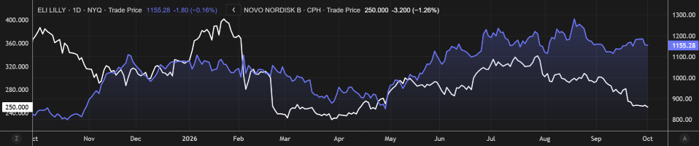
The divergence between the two companies is also evident in their recent share price performance, with Lilly outperforming Novo Nordisk over for most of this year (Exhibit 3).
Exhibit 3: Eli Lilly vs. Novo Nordisk – One-Year Share Price Performance
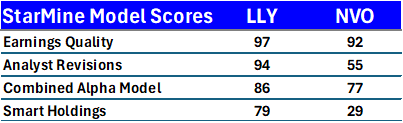
StarMine model scores provide additional perspective on the quality of earnings and investor sentiment surrounding the two companies (Exhibit 4). Both Lilly and Novo Nordisk currently rank in the top decile of the StarMine Earnings Quality model, indicating that their recent earnings have characteristics historically associated with greater persistence. Both companies also score strongly on StarMine’s Combined Alpha Model, which aggregates the signals from StarMine’s quantitative models into a single measure.
The signals are particularly constructive for Lilly. The company scores 94 out of 100 on the StarMine Analyst Revisions Model, placing it in the top decile and reflecting positive changes in sell-side analyst estimates. Buy-side institutional sentiment is also favorable: Lilly has a StarMine Smart Holdings score of 79, implying relatively constructive positioning among institutional investors.
Exhibit 4: StarMine Model Scores: Eli Lilly vs. Novo Nordisk
The magnitude of the growth helps explain why industries well beyond healthcare are paying attention. As GLP-1 adoption has expanded, its potential effects are increasingly being examined across the broader consumer economy. Apparel is one area where those effects may be starting to emerge, where changing body sizes can affect search behavior, product demand, markdowns and wardrobe replacement. The question is no longer simply how rapidly the GLP-1 market is growing, but whether the changing GLP-1 consumer is beginning to reshape the way Americans shop for clothes.
Consumer behavior: Is interest in plus-size apparel changing?
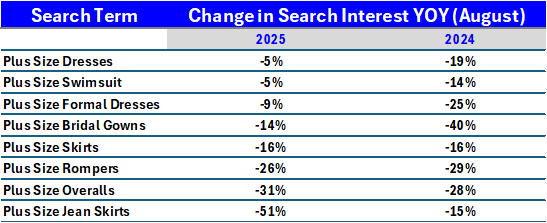
While GLP-1 adoption has accelerated, consumer interest in plus-size apparel has shifted as well. In collaboration with Centric Market Intelligence, LSEG found that online search interest across several plus-size apparel categories has declined. Searches for plus-size dresses are down 5% from a year ago and 19% from two years ago (Exhibit 5). Some categories have experienced even sharper declines, including bridal gowns and formal dresses. The largest two-year declines include plus-size jean skirts (-51%), overalls (-31%) and rompers (-26%).
Exhibit 5: Online Search Interest – Plus-Size Apparel
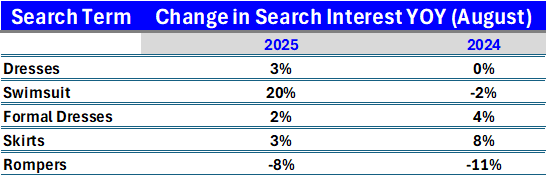
The trend looks notably different for non-plus-size apparel, where several categories have experienced an increase in online search interest. Swimsuits stand out: searches are up 20% from a year ago, a notable reversal from the 2% decline recorded two years ago (Exhibit 5). Skirts have also gained momentum, with searches rising 3% from a year ago and 8% compared with two years ago.
Not every category follows this divergence. Searches for rompers have declined across both plus- and non-plus-size apparel, suggesting that broader fashion trends, rather than sizing alone, may be contributing to weaker interest in that category.
Taken together, the data reveal a notable divergence in online search behavior: interest across several plus-size categories has weakened, while searches for a number of comparable non-plus-size categories have strengthened. While the data do not establish GLP-1 use as the cause, the shift coincides with a period of rapidly increasing GLP-1 adoption and warrants a closer look at whether similar patterns are emerging in apparel pricing, promotions and inventory.
Exhibit 6: Online Search Interest – Non-Plus-Size Apparel
Pricing: Promotions are diverging by size
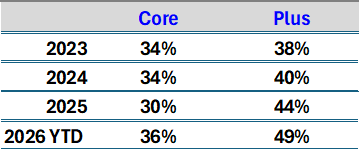
Centric pricing data suggest that promotional intensity is changing unevenly across size groups. Because 2026 is year-to-date while 2023-2025 are full-year periods, the comparisons should be viewed directionally; the prior-year figures include the important November-December holiday promotional period. For women’s apparel, plus-size discount penetration, defined as the percentage of merchandise on sale, increased from 38% in 2023 to 49% in 2026 YTD. That is above the 44% average in 2025 and above the 37% long-term apparel average. Core women’s apparel, by contrast, has remained below the long-term average. The widening gap suggests retailers are relying more heavily on promotions to move plus-size merchandise (Exhibit 7).
Exhibit 7: Women’s Apparel Discount Penetration – Plus vs. Core, 2023-2026 YTD
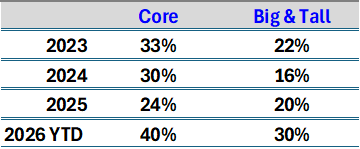
Men’s apparel shows a different pattern. Big & Tall discount penetration rose from 22% in 2023 to 30% in 2026 YTD, but has consistently remained below core apparel. Core men’s discount penetration, meanwhile, increased sharply to 40% in 2026 YTD from 24% in 2025, moving above the 37% long-term apparel average. The contrast suggests that promotional behavior is not uniform across genders or size groups (Exhibit 8).
Exhibit 8: Men’s Apparel Discount Penetration – Big & Tall vs. Core, 2023-2026 YTD
The gender divergence is particularly noteworthy given differences in reported GLP-1 adoption. The Ipsos survey cited earlier found that women were more likely than men to report having used a GLP-1, at 16% versus 9%. Against that backdrop, the greater divergence between plus and core discounting in women’s apparel may warrant particular attention. Differences in shopping frequency, promotional sensitivity, assortment strategies and GLP-1 adoption could all be contributing to the contrasting patterns between women’s and men’s apparel.
Inventory: Sold-out rates point to different patterns by gender
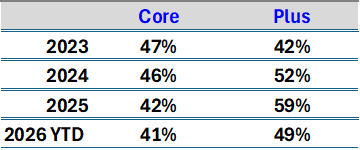
Sold-out rates provide another lens into changing apparel demand. Among women, the data show a notable divergence between plus and core-size activewear. The sold-out rate for plus-size activewear increased from 42% in 2023 to 52% in 2024 and peaked at 59% in 2025. Although it has moderated to 49% in 2026 YTD, it remains above its 2023 level and eight percentage points higher than the 41% sold-out rate for core sizes (Exhibit 8).
The divergence is particularly notable because core-size activewear sold-out rates have moved in the opposite direction, declining steadily from 47% in 2023 to 41% in 2026 YTD. Combined with the higher promotional activity observed in plus-size apparel, the data suggest that discounting may be helping support demand and inventory sell-through. The timing also coincides with rapidly increasing GLP-1 adoption; however, the data alone do not establish GLP-1 use as the cause of the shift.
Exhibit 9: Women’s Activewear Sold-Out Rate: Core vs. Plus, 2023-2026 YTD
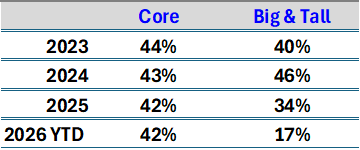
The pattern is markedly different in men’s activewear. Big & Tall sold-out rates initially increased from 40% in 2023 to 46% in 2024, before falling sharply to 34% in 2025 and 17% in 2026 YTD (Exhibit 9). By comparison, core-size sold-out rates have remained relatively stable, moving from 44% in 2023 to 42% in 2026 YTD.
As a result, the gap between the two groups has widened considerably. Big & Tall sold-out rates were three percentage points higher than core sizes in 2024; by 2026 YTD, they are 25 percentage points lower. This could signal weakening demand for Big & Tall activewear, changes in inventory or assortment levels, or some migration toward core sizes. Retailers have also been vocal about the changing demand patterns. H&M, for example, confirmed that lower demand prompted it to discontinue 3XL and 4XL in certain assortments. Destination XL has also acknowledged what it describes as a “genuine structural shift” associated with GLP-1 adoption as a meaningful portion of its customers are using GLP-1 medications, with some temporarily pausing apparel purchases as they lose weight and intending to return once they reach a stable size.
The retailers’ commentary reinforces what is emerging in the data; changing body sizes are beginning to influence not only what consumers search for and purchase, but also how apparel retailers think about sizing, inventory and assortment strategy.
Exhibit 10: Men’s Activewear Sold-Out Rate: Core vs. Big & Tall, 2023-2026 YTD
The gender difference extends beyond promotions. Women’s plus-size activewear continues to show relatively strong sell-through, even as promotional activity has increased, while men’s Big & Tall activewear sold-out rates have fallen sharply. Given that reported GLP-1 use is higher among women than men, the contrasting patterns raise an important question about whether the apparel effects associated with GLP-1 adoption may be emerging differently across consumer groups.
It is also important to place these trends within the broader apparel environment. Consumers have faced several years of elevated prices and pressure on discretionary spending, while retailers have also adjusted inventory levels. As a result, sold-out rates should be viewed alongside broader apparel trends rather than as a standalone measure of demand.
Among women’s core sizes, both activewear and total apparel sold-out rates have declined since 2023. Activewear fell from 47% in 2023 to 41% in 2026 YTD, while total apparel declined from 53% to 45% over the same period (Exhibit 11). Against that broader moderation, women’s plus-size activewear stands out: its 49% sold-out rate in 2026 YTD remains above both core activewear and core total apparel.
Exhibit 11: Women’s Core Sold-Out Rates – Activewear vs. Total Apparel, 2023-2026 YTD

Men’s core-size trends have been more stable. Activewear sold-out rates eased from 44% in 2023 to 42% in 2025 and remained at 42% in 2026 YTD. Total apparel, meanwhile, held near 38%–39% from 2023 through 2025 before rising to 42% in 2026 YTD (Exhibit 12).
Exhibit 12: Men’s Core Sold-Out Rates – Activewear vs. Total Apparel, 2023-2026 YTD

Taken together, the data suggest the GLP-1 effect on apparel is more nuanced than consumers simply moving into smaller sizes. Women, who report higher GLP-1 usage than men, show some of the clearest shifts. Online search interest has declined across several plus-size categories, while interest in certain non-plus categories, including skirts, dresses and swimsuits, has strengthened. At the same time, women’s plus-size apparel has become increasingly promotional, with a greater share of merchandise offered on sale. Yet demand has not disappeared: plus-size activewear continues to post relatively strong sold-out rates, suggesting promotions may be helping support sell-through.
The findings also underscore the importance of value in today’s consumer environment. With shoppers remaining selective about discretionary purchases, promotional activity can help move merchandise even as underlying shopping patterns evolve. Rather than signaling the disappearance of the plus-size consumer, the data point to a changing apparel market in which size demand, promotional intensity and purchasing behavior are increasingly diverging across consumer groups.
What retailers are saying: GLP-1 effects are becoming visible
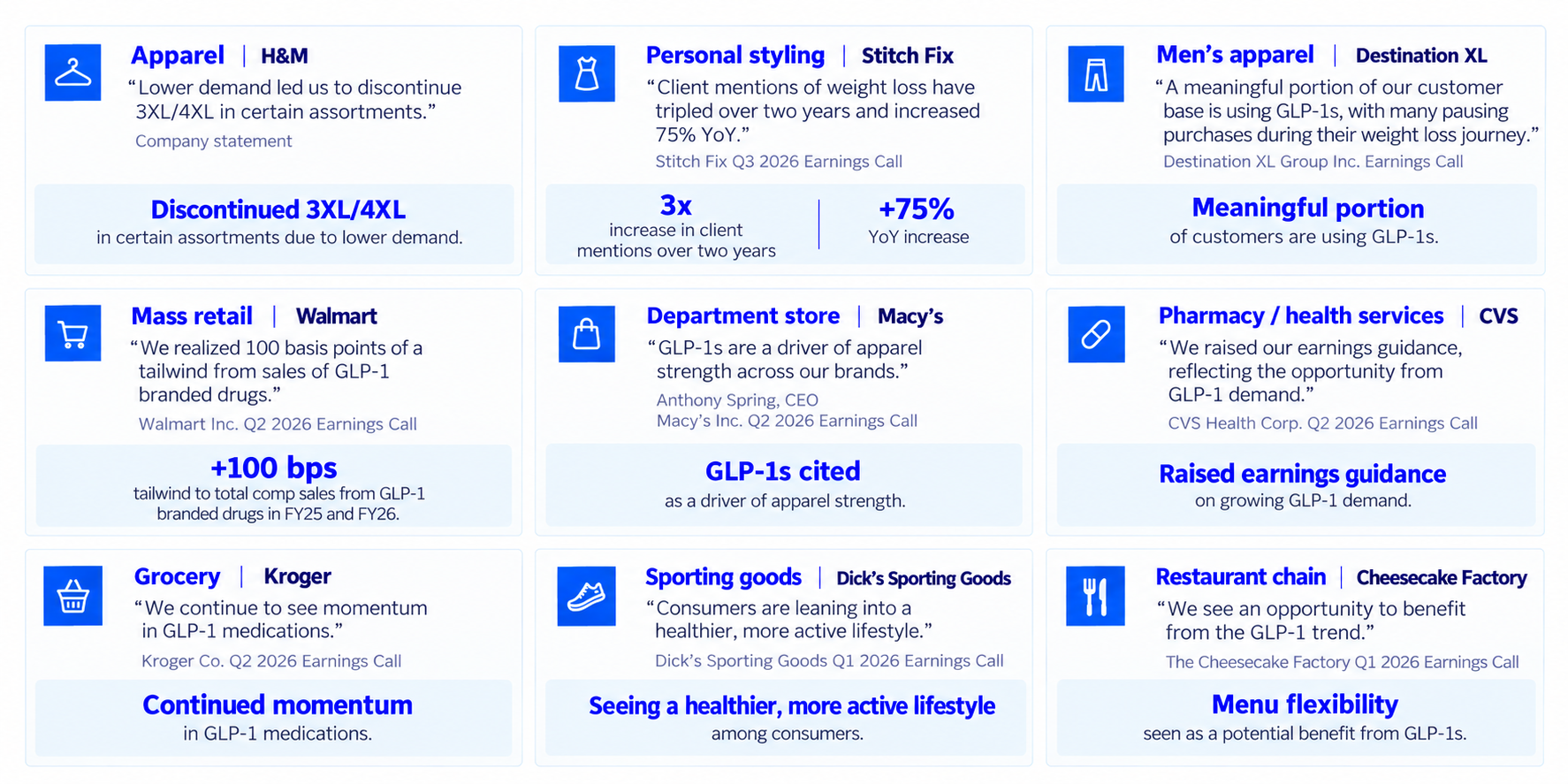
Using LSEG Workspace transcripts and unbiased summaries, company commentary increasingly supports the view that GLP-1s are influencing consumer behavior well beyond healthcare, with companies beginning to see measurable effects across apparel demand, shopping patterns and product strategy. Apparel retailers are seeing changes in sizing, shopping cadence and styling needs, while mass retailers and pharmacies are benefiting directly from prescription demand.
Stitch Fix (SFIX) has identified consumers undergoing body transformation as a specific target segment. On its Q3 2026 earnings call, the company said client mentions of weight loss in Fix request notes had tripled over two years and increased 75% year over year. Management said its styling model can serve clients at multiple stages of a changing body size. (Source: Stitch Fix Q3 2026 Earnings Call.)
Destination XL has described GLP-1 adoption as a structural shift in its customer base. Management said a meaningful portion of customers using GLP-1 medications temporarily stop buying apparel while losing weight, but a majority intend to return once they reach a stable size. The company is actively studying how GLP-1-related behavior is changing the way its core customer shops. (Source: Destination XL Group Inc. Q2 2026 Earnings Call.)
Macy’s (M) has also cited GLP-1s as one potential contributor to apparel strength. CEO Tony Spring said strong apparel performance at Macy’s and Bloomingdale’s reflects several factors, including return-to-work demand, fashion trends and GLP-1s. (Source: Macy’s Inc. Q2 2026 Earnings Call.)
Dick’s Sporting Goods (DKS) offers an important counterpoint. Management said it has seen consumers lean into healthier and more active lifestyles, but does not have data establishing a specific correlation with GLP-1 use. (Source: Dick’s Sporting Goods Q1 2026 Earnings Call.)
The broader retail impact is also showing up in pharmacy and health-and-wellness sales. Walmart (WMT) said GLP-1 branded drugs provided approximately 100 basis points of tailwind to U.S. comparable sales in both FY25 and FY26, although it expects a smaller benefit in FY27 as prescription growth is offset by price/mix pressure. (Source: Walmart Inc. Q2 2027 Earnings Call.)
CVS Health (CVS) has highlighted GLP-1 demand as a growing opportunity centered on affordability, access and convenience. On its Q2 2026 earnings call, CVS said it is supporting patients using GLP-1s for weight loss across its healthcare ecosystem as demand continues to grow. (Source: CVS Health Corp. Q2 2026 Earnings Call.)
Costco reported that pharmacy sales grew nearly 20% in fiscal Q4 2026 and highlighted its GLP-1 and fertility programs as part of efforts to increase member value and convenience. The company did not quantify how much of the pharmacy growth came specifically from GLP-1s. (Source: Costco Q4 2026 Earnings Call, September 24, 2026.)
Taken together, retailer commentary reinforces the central finding of the data: GLP-1s are becoming relevant across the consumer value chain, but the impact on apparel is not one-directional. Retailers are responding through assortment decisions, promotions, styling services and inventory management as consumers move through changing sizes and shopping needs.
Exhibit 13: Retailers and Restaurants Say GLP-1s Are Influencing Consumer Behavior



Comments
Log in or sign up to join the conversation.