
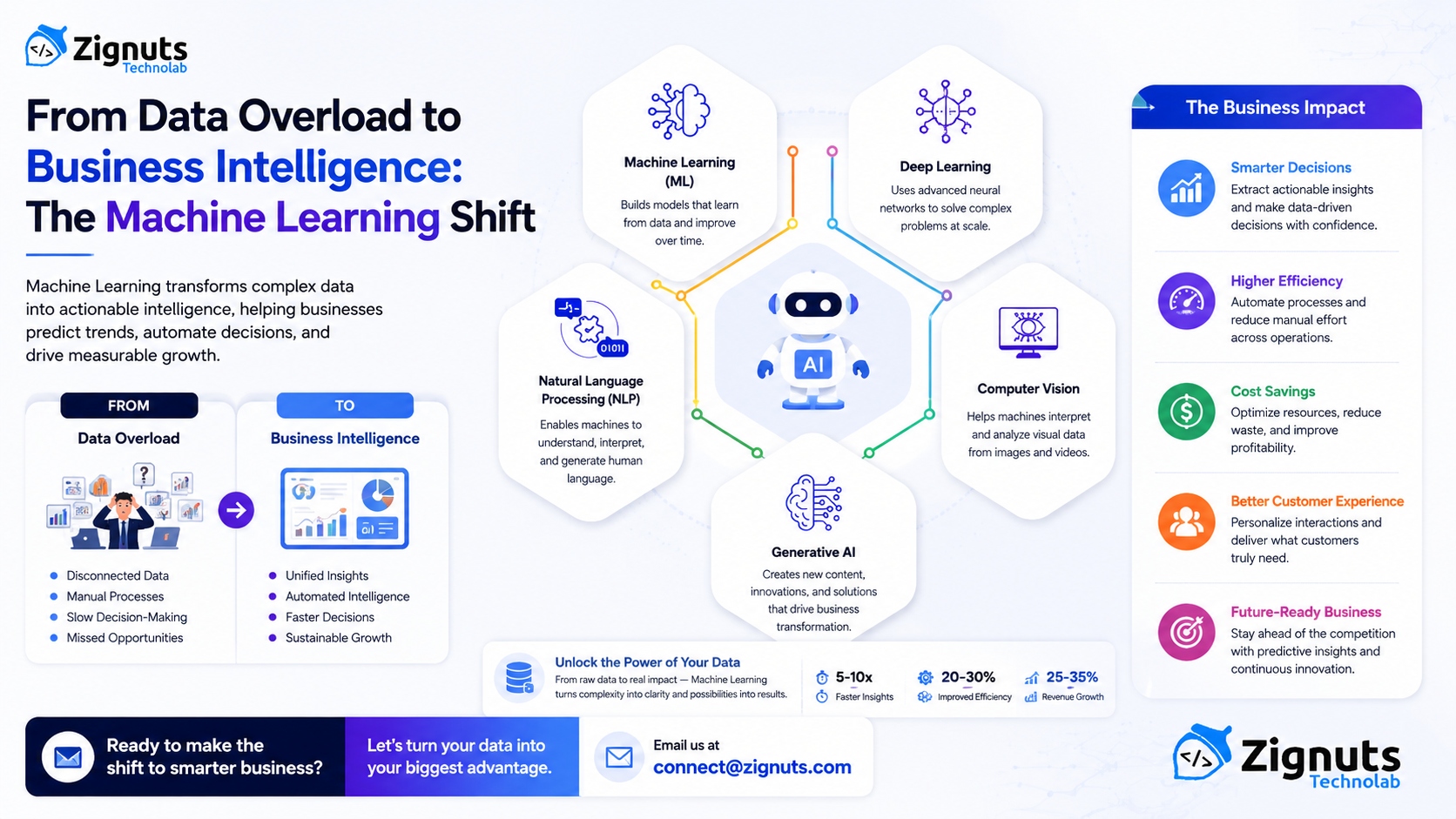
Your business may already have enough data to answer its most important questions. The problem is that valuable signals are often buried inside disconnected systems, endless reports, customer records, operational logs, and financial data. Leaders do not need more information simply for the sake of having it. They need to know what the information means, what is likely to happen next, and which decision deserves attention now. The shift from data overload to business intelligence is increasingly about using machine learning to turn complex information into practical business insight. This is where AI implementation becomes a strategic priority rather than a technical one. Successfully deploying AI is less about the sophistication of the model and more about how well it is built into existing systems, workflows, and decision points so that insight reaches the person who needs to act on it, at the moment it still matters. Done well, implementation turns scattered data into a working part of the business, not a separate initiative running alongside it.
2027 Insight | Business Impact | What Leaders Should Do |
|---|---|---|
Business intelligence becomes increasingly predictive | Leaders can move beyond historical reporting toward earlier decision support | Prioritize analytics that connect directly to business actions |
Data becomes more valuable when connected across departments | Cross-functional insights can reveal risks and opportunities hidden in individual systems | Reduce data silos and establish clear ownership |
Machine learning becomes more embedded in everyday workflows | Employees can receive relevant insights without manually analyzing large datasets | Integrate predictive capabilities into existing business tools |
Data governance becomes a strategic requirement | Better control over data improves reliability, security, and responsible use | Establish clear data quality, privacy, and governance processes |
These are forward-looking expectations rather than guaranteed outcomes. By 2027, the organizations best positioned to benefit will likely be those that treat business intelligence as a continuous decision-making capability instead of a reporting function alone.
The Problem With Having More Data
For years, businesses have invested in collecting information.
Customer relationship platforms store interactions. E-commerce systems record purchases. Finance platforms track transactions. Marketing systems capture engagement. Operational systems generate performance data.
Yet more data does not automatically produce better decisions.
A senior executive may receive dozens of dashboards every week and still struggle to answer a simple question: what deserves attention first?
This is where the difference between data and intelligence becomes important.
Data describes events. Business intelligence provides context around those events. Machine learning can take the process further by identifying patterns and relationships that may help explain what could happen next.
The objective is not to replace traditional reporting. It is to make the information layer more useful to the people responsible for making decisions.
From Reporting to Intelligent Business Insight
Traditional reporting typically answers questions such as:
What happened?
How much did we sell?
Which products performed best?
What were last month's expenses?
Which customers contacted support?
Machine learning can support additional questions:
What is likely to happen next?
Which customers may require attention?
Which transactions appear unusual?
Where could demand change?
Which operational conditions may indicate a problem?
That transition creates a more proactive model of decision-making.
Instead of waiting for a monthly report to reveal a problem, teams can use continuously updated signals to identify areas that deserve investigation.
The Data-to-Decision Journey
The transformation from raw information to business value works best when every stage has a clear purpose.
Raw Business Data → Data Integration → Machine Learning → Intelligent Insight → Business Decision → Measurable Outcome
The process should not end with a prediction or dashboard. The final objective is a business action that can be evaluated.
If an insight cannot influence a decision, its practical value may be limited.
Why Machine Learning Changes Business Intelligence
Traditional business intelligence is extremely useful for understanding performance. But modern organizations often operate in environments where historical information is not enough.
Customer preferences can shift. Product demand can change. Costs can fluctuate. New competitors can appear. Operational conditions can evolve quickly.
Machine learning can analyze patterns across large datasets and identify relationships that support forecasting, classification, anomaly detection, recommendations, and prioritization.
For example, a retailer may use customer behavior to improve product recommendations. A manufacturer may analyze equipment information to identify unusual performance. A subscription business may examine engagement patterns to identify customers who may need additional support.
The technology is valuable because it can help organizations process complexity at a scale that manual analysis cannot easily match.
Business Benefits Beyond Better Reports
Faster Decision-Making
Executives and managers spend significant time collecting information before they can make decisions.
When relevant insights are available within existing workflows, teams can reduce the time between detecting an issue and deciding how to respond.
Speed matters when the opportunity or risk has a limited window.
Better Resource Allocation
Machine learning can help businesses prioritize limited resources.
Sales teams can focus on high-potential opportunities. Customer success teams can prioritize accounts requiring attention. Operations teams can investigate unusual performance. Finance teams can focus on transactions or patterns that warrant review.
The objective is not necessarily automation. It is better allocation of human attention.
Improved Customer Experiences
Businesses can use behavioral information to understand customers more effectively.
Personalized recommendations, targeted offers, relevant service interventions, and more timely communication can improve the customer journey when implemented responsibly.
The key is relevance rather than volume. Customers do not benefit from receiving more messages. They benefit from receiving useful interactions at appropriate moments.
Operational Efficiency
Machine learning can identify inefficiencies across recurring processes.
For example, an organization may discover that certain workflow conditions consistently lead to delays. Instead of responding to every delay individually, management can investigate the underlying pattern and address the process itself.
This can create operational improvements that extend beyond a single incident.
Practical Business Use Cases
Retail and E-Commerce
Retail and e-commerce organizations generate substantial amounts of behavioral and transaction data.
Machine learning can support:
Demand forecasting
Product recommendations
Customer segmentation
Inventory planning
Purchase pattern analysis
Fraud and anomaly detection
The business objective is to understand customer and demand signals early enough to improve planning and engagement.
Financial Services
Financial organizations can use machine learning to analyze transactions, identify unusual patterns, support risk assessment, and improve customer segmentation.
Because financial decisions can have significant consequences, governance, explainability, privacy, security, and regulatory requirements must be considered from the beginning.
Manufacturing
Manufacturers can combine equipment data, production records, quality information, and maintenance history to identify patterns associated with operational problems.
Predictive maintenance is one example. Instead of relying exclusively on fixed maintenance schedules or waiting for equipment failure, organizations can use available signals to support more informed maintenance planning.
SaaS Businesses
SaaS organizations have access to valuable product usage information.
Machine learning can help identify patterns around customer engagement, feature adoption, support activity, renewals, and expansion opportunities.
This can help product, sales, and customer success teams coordinate their efforts around customer behavior rather than assumptions.
The Business Intelligence Maturity Shift
Current Challenge | Machine Learning Opportunity | Business Outcome |
|---|---|---|
Reports explain performance after the fact | Add predictive analysis to recurring reporting | Earlier awareness of potential changes |
Data is separated across departments | Connect relevant sources for broader analysis | More complete business context |
Employees manually review large datasets | Automate pattern identification and prioritization | Faster analysis and better use of employee time |
Managers react to operational problems | Detect unusual signals earlier | More proactive intervention |
This shift does not mean every business process needs machine learning. The best candidates are usually processes with repeated decisions, meaningful data, measurable outcomes, and enough business value to justify implementation.
Data Quality Determines the Value of Intelligence
Machine learning does not eliminate fundamental data problems.
If customer information is duplicated, financial records are inconsistent, or important operational data is missing, the resulting analysis may be unreliable.
Leaders should therefore evaluate data readiness before selecting a solution.
Important questions include:
Where does the required data live?
Who owns each source?
How frequently is it updated?
Are definitions consistent across departments?
How much historical information is available?
What privacy restrictions apply?
Can the information be securely integrated?
Data governance should not be treated as paperwork that happens after implementation. It is part of the foundation for trustworthy business intelligence.
Build, Buy, or Integrate?
There is no universal answer to whether a business should build its own machine learning capability or purchase one.
Buying an established solution may be sensible when the business problem is common and a proven platform can meet requirements quickly.
Building may make more sense when proprietary data, specialized processes, unique customer experiences, or competitive differentiation are involved.
A hybrid approach is also possible. Businesses can use established infrastructure while developing customized analytical capabilities around their most important business processes.
Executives should compare options based on total cost, implementation time, data ownership, integration requirements, security, scalability, internal expertise, and long-term strategic value.
Executive Decision-Making Checklist
Before investing in a machine learning-driven business intelligence initiative, leaders should ask:
What business decision are we trying to improve?
What is the financial or operational cost of making that decision poorly?
What data is required?
Is the data reliable enough?
Where will the resulting insight appear?
Who is responsible for acting on it?
How much automation is appropriate?
What security and privacy requirements apply?
How will success be measured?
What happens when the model is wrong?
Can the solution integrate with existing systems?
Can it scale if the initial pilot succeeds?
These questions help prevent a common failure pattern: building an impressive analytical capability that employees rarely use.
Implementation Roadmap
Step 1: Identify Information Bottlenecks
Find decisions that currently require too much manual analysis, too many reports, or too much time.
Step 2: Choose One High-Value Use Case
Start with a problem where improved intelligence can create a measurable business benefit.
Step 3: Map the Data
Identify relevant sources, ownership, quality issues, access requirements, and integration dependencies.
Step 4: Define Business Metrics
Decide how success will be measured before deployment. Technical performance should support business metrics, not replace them.
Step 5: Run a Controlled Pilot
Test the capability within a defined team, process, or business unit.
Step 6: Connect Insight to Action
Make the output available where employees already work. The closer the insight is to the decision, the more likely it is to be used.
Step 7: Scale Carefully
Expand only after the organization understands the business value, technical requirements, governance needs, and adoption challenges.
Risks Businesses Need to Manage
Overconfidence in Predictions
Machine learning identifies patterns based on available information. It does not guarantee what will happen.
Unexpected market changes, new regulations, shifts in customer behavior, or unusual events can reduce predictive reliability.
Privacy and Security
Businesses must understand what information is being processed and ensure appropriate safeguards are in place.
Sensitive customer, employee, financial, or proprietary information requires particular care.
Organizational Silos
A technically capable system cannot solve a structural problem where departments refuse to share information or use inconsistent definitions.
Successful business intelligence requires cooperation across functions.
Employee Resistance
Employees may worry that predictive systems are intended to replace their judgment or jobs.
Leaders should communicate the purpose clearly and explain where human expertise remains essential.
Integration Costs
Connecting new capabilities with existing ERP, CRM, finance, customer service, and operational systems can become a significant part of the project.
Integration should therefore be included in the original business case rather than treated as an afterthought.
The Future of Business Intelligence Is More Action-Oriented
The value of business intelligence is moving closer to the moment when decisions are made.
Executives increasingly need information that does more than describe yesterday's performance. They need context, priorities, early signals, and possible outcomes.
Machine learning can help create that layer of intelligence, but it works best when combined with strong data governance, domain expertise, effective workflows, and accountable leadership.
The organizations that benefit most will not necessarily be those that deploy the largest number of models. They will be those that identify the decisions where better intelligence can create meaningful business value and then integrate that intelligence into everyday operations.
Conclusion
The journey from data overload to business intelligence is not simply a technology upgrade. It is a change in how organizations use information to make decisions.
Machine learning can help businesses uncover patterns, anticipate potential changes, prioritize resources, and move from retrospective reporting toward more proactive action. But the technology should always serve a clearly defined business objective.
For executives, the most practical starting point is to identify one decision where the organization currently has too much information but not enough clarity. Examine the data behind that decision, test whether machine learning can improve the insight, and measure the resulting business impact.
More data is not the goal. Better decisions are.
FAQs
1. What is the difference between data and business intelligence?
Data consists of individual facts, records, and observations. Business intelligence organizes and analyzes that information so decision-makers can understand performance, identify patterns, and make informed choices.
2. How does machine learning improve business intelligence?
Machine learning can identify patterns across large datasets and support forecasting, recommendations, anomaly detection, classification, and prioritization. This can extend business intelligence beyond historical reporting.
3. Does every business need machine learning?
No. Machine learning is most useful when a business has a suitable problem, relevant data, measurable outcomes, and enough potential value to justify implementation.
4. What industries benefit from machine learning-driven business intelligence?
Retail, e-commerce, manufacturing, financial services, SaaS, logistics, healthcare, and professional services can all benefit when appropriate use cases and governance processes are in place.
5. What is the first step toward implementing machine learning?
Start with a business decision rather than a technology. Identify a specific problem, define the desired outcome, assess the required data, and determine whether machine learning is an appropriate solution.
6. How can executives measure the value of business intelligence?
Value can be measured through improvements such as faster decisions, reduced operational costs, better resource allocation, improved customer outcomes, increased revenue opportunities, or reduced business risk.
7. Is machine learning-based intelligence fully automated?
It can automate some analytical and decision-support tasks, but human oversight remains important for complex, high-impact, or uncertain decisions. The appropriate balance depends on the business context.
Comments
Log in or sign up to join the conversation.