

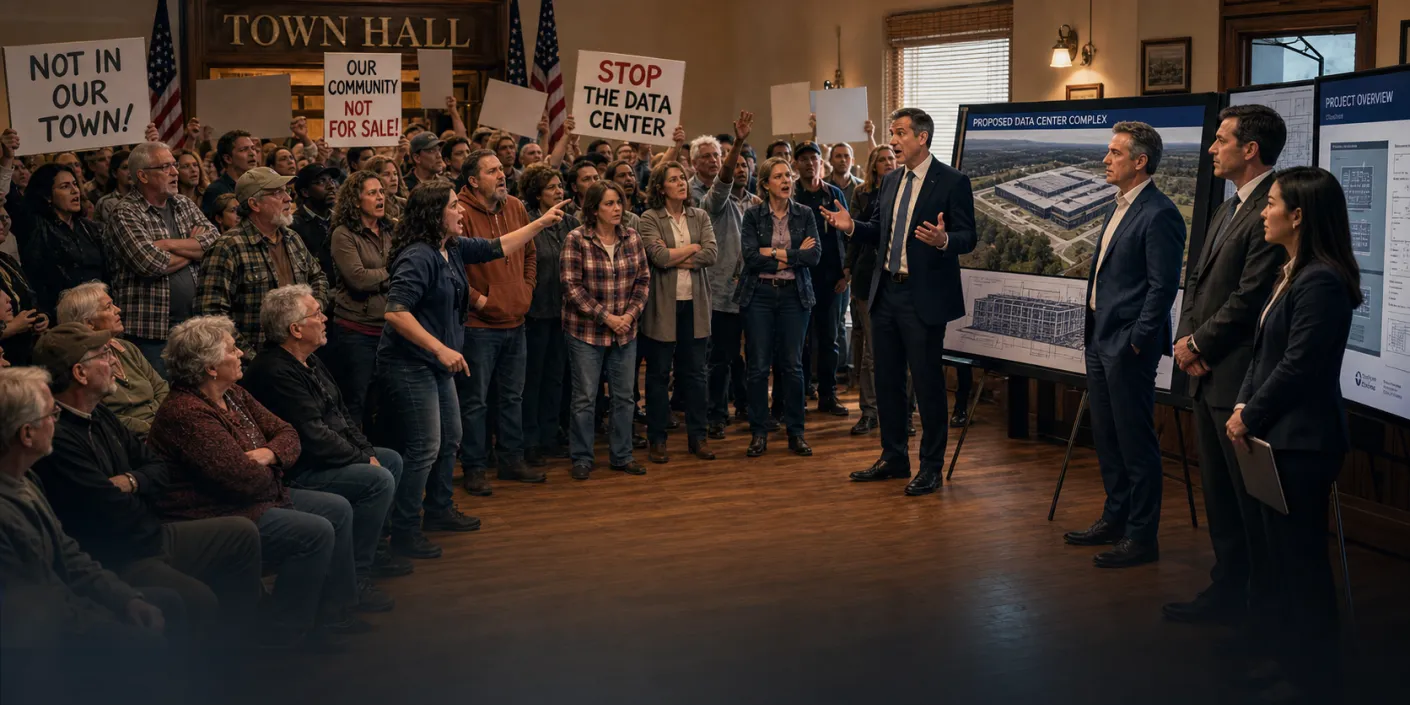
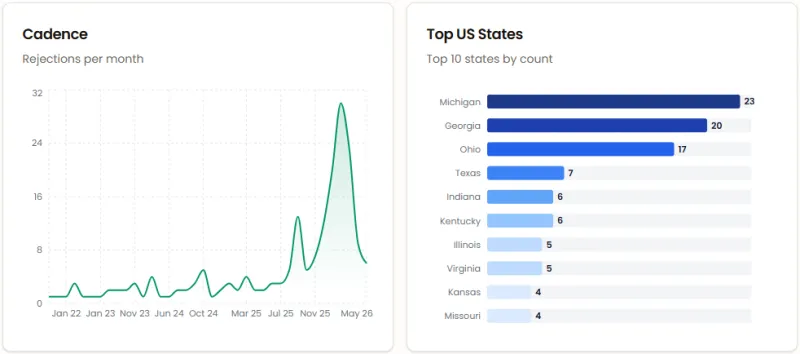
In the first four months of 2026, Americans rejected or restricted more data centers than they did in all of 2025. The numbers tell the story: 49 rejections last year, 79 already this year. Something has snapped. A backlash is building against the physical infrastructure of the AI boom, and it's bipartisan, emotional, and growing fast.
Robert Bryce, a veteran energy reporter who has spent the last 16 years cataloging local revolts against energy projects, says he has never seen anything like it. His Renewable Rejection Database documents nearly 1,200 cases of communities pushing back against wind, solar, and battery projects. But the new Data Center Rejection Database—launched at the suggestion of his son, who watched the same dynamic unfold across Europe—is filling up at a pace that dwarfs anything in the renewable space.
A Cultural Backlash, Not Just a Local One
What makes this fight different, Bryce argues, isn't the property-value worries or scenic concerns familiar from past land-use battles. It's something deeper: a populist revolt against Big Tech itself.
"Ordinary people are looking at Big Tech—Amazon (AMZN), Google (GOOGL), Oracle (ORCL), Microsoft (MSFT), Meta (META)—and they don't trust them," Bryce says. "Our privacy is being taken, and people are saying, 'I can't fight these monster, multitrillion-dollar companies in the virtual world. But I can fight them, or even stop them, in my neighborhood.'"
The polling backs him up. A March Quinnipiac survey found 78% of Democrats, 66% of independents, and 56% of Republicans opposed to data centers in their communities. Concerns clustered around electricity (72%), water (64%), and noise (41%). More striking still: 70% believed AI would shrink job opportunities, and 55% said it would do more harm than good.
The Box Elder Spectacle
The temperature of the opposition was on full display last week in Box Elder County, Utah, where Kevin O'Leary—the "Mr. Wonderful" of Shark Tank—is promoting a 9-gigawatt project called Stratos. That's roughly twice the entire current power demand of Utah, devoted to a single development.
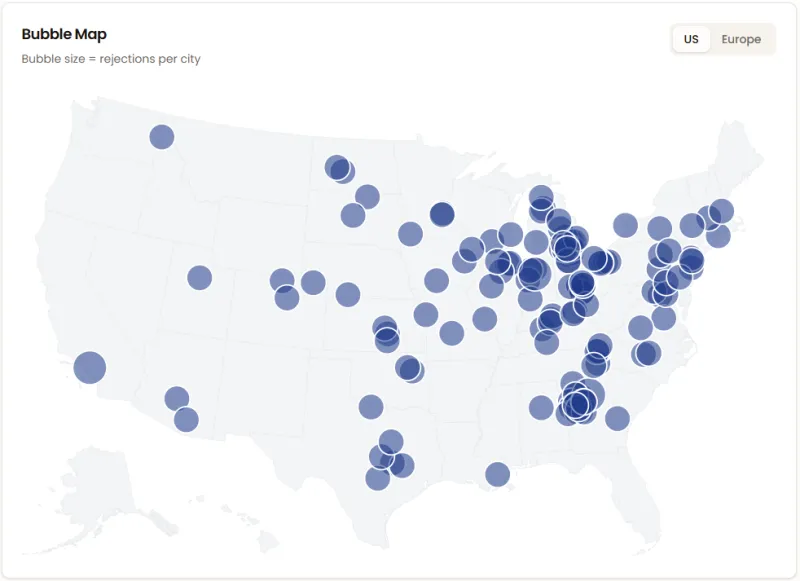
US Data Center Rejection Map
Nine hundred people turned out for the county commission hearing. Six hundred packed a gymnasium-sized exhibition hall; another 300 protested outside. "It's gob smacking to see how angry people are," Bryce says. O'Leary's celebrity status surely fanned the flames—but in Utah, where water and electricity are existential issues, the fuel was already there.
An AI Boom Powered by Natural Gas
For all the noise about a green transition, the data center build-out tells a different story. Wind is essentially dead in the United States, Bryce argues, with the Trump administration weaponizing FAA and Defense Department reviews to block new projects. Solar continues to expand. But the real engine behind AI is methane.
"There's no other option but natural gas," Bryce says flatly. "The entire data center story is a gas story." In Texas alone, more than 50 gigawatts of new gas-fired generation sit in the development queue. Williams Companies (WMB), the Tulsa-based pipeline operator, has already booked over $7 billion in gas-to-power projects serving data centers. This, Bryce contends, is America's strategic edge over China: not just Nvidia (NVDA) chips, but a continent of cheap, abundant gas.
Why the Opposition Won't Stop the Build-out
Despite the rejections, roughly 700 data centers are currently under construction in the U.S., and Big Tech is on track to spend something like $700 billion on capital expenditures this year. Federal legislation to slow the build-out—including a bill from Bernie Sanders and Alexandria Ocasio-Cortez—is going nowhere. A Maine moratorium passed by the state House sits unsigned by the governor.
The real action is local. City councils in Rochelle, Illinois; Ferguson, Missouri; and Wichita Falls, Texas have all said no in recent weeks. Even Google, with a market cap approaching $4.8 trillion, withdrew a proposed Indianapolis project last fall when it became clear the council would reject it.
Water remains the most flammable issue, and Bryce thinks the industry is losing the argument. "The old saying in politics is, 'If you're explaining, you're losing,'" he notes. When tech companies insist their facilities use no more water than an office building, they've already conceded the emotional ground.
The Five-Year View
Bryce is careful to position himself as neither anti-AI nor anti-data center—just a reporter clear-eyed about what he sees. His prediction: the U.S. will keep its lead over China, the grid will expand dramatically, and much of the new generation will be built "behind the meter" by the tech companies themselves. But the bubble is real. Many speculative projects—including, possibly, O'Leary's Stratos—will never find tenants and will quietly die.
The question isn't whether AI moves forward. It's whether the companies building its physical backbone learn to read the room before the next nine hundred angry citizens show up at a county commission hearing.


Comments
Log in or sign up to join the conversation.