
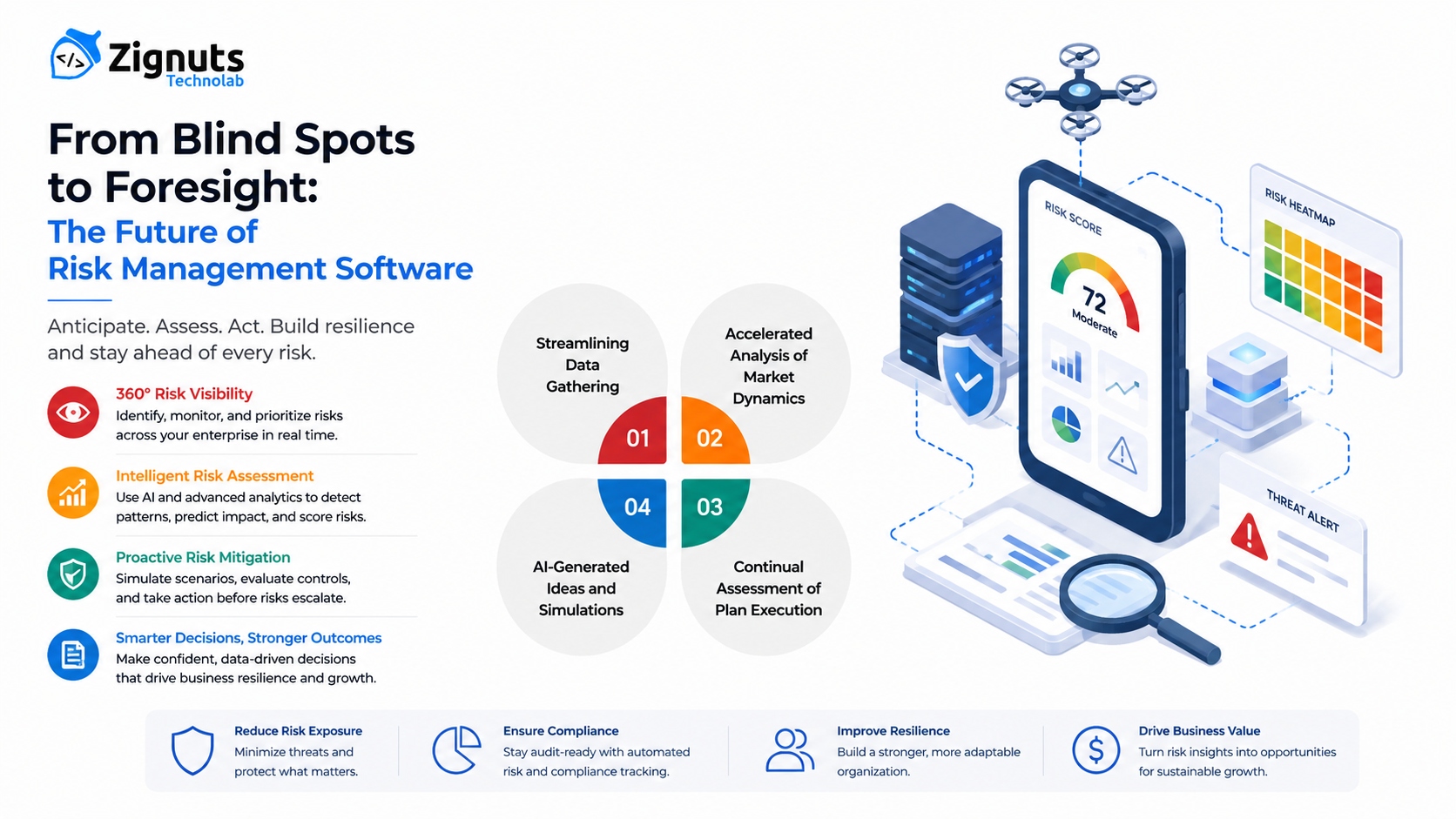
Most enterprise risk registers are historical artifacts rather than operational navigators. Organizations spend millions aggregating data about disruptions that have already occurred, presenting polished quarterly dashboards to board members who can do nothing more than nod grimly at money already lost.
Treating risk management as a periodic auditing exercise is one of the quietest destroyers of enterprise value.
Evaluating predictive risk management software requires admitting a frustrating operational reality: looking backward to prevent future operational failures assumes tomorrow's threats will follow yesterday's script. In a world of volatile supply chains, shifting regulatory mandates, and rapid technological shifts, that assumption is dangerous.
The enterprise leaders who protect their margins over the coming decade will not be those who document liabilities most meticulously. They will be the executives who build real-time foresight directly into their daily operating cadence.
Industry Context: Market Trends and Evolving Pressures
The operational environment across global industries has grown interconnected, fast-moving, and unforgiving. Several macroeconomic and structural trends make legacy risk models obsolete:
Hyper-Interconnected Value Chains: A disruption at a tertiary supplier three continents away can halt assembly lines within 48 hours, exposing unseen operational vulnerabilities.
Compressing Regulatory Windows: Compliance mandates across cybersecurity, carbon tracking, and data privacy now require continuous monitoring rather than annual point-in-time attestations.
Accelerating Velocity of Data: Information flows at unprecedented speeds, yet many risk management functions still rely on manual spreadsheet aggregation and weekly status calls.
Changing Board Accountability: Investors and executive boards no longer accept passive explanations for operational disruptions. They demand clear evidence of proactive resilience planning.
Why Traditional Thinking Falls Short
When risk programs fail to protect margins, leadership teams often assume they need more staff or longer compliance checklists. These interventions miss the root issue because they are built on flawed assumptions about how risk should be managed.
Assumption 1: "Risk management is primarily a compliance function."
When risk is treated purely as a regulatory requirement, teams focus on clearing audits rather than protecting operational continuity. True risk management is a strategic capability that enables organizations to take calculated bets with higher confidence.
Assumption 2: "Quarterly risk assessments provide adequate visibility."
A quarterly risk matrix is obsolete the moment it is finalized. Operational parameters, vendor stability, and market conditions shift daily. Static reporting tools create a false sense of security while operational blind spots expand beneath the surface.
Assumption 3: "Adding more approval gates mitigates exposure."
Layering manual sign-offs onto business processes slows decision-making without improving safety. Manual approvals often rely on subjective judgment and incomplete data, creating operational bottlenecks while missing systemic risks.
Modern Business Strategy: Engineering Continuous Foresight
Transitioning from reactive auditing to continuous foresight requires connecting risk evaluation directly into active business workflows. Modern risk architectures leverage real-time data streaming, automated risk scoring, and predictive modeling.
Instead of waiting for an operational failure to trigger a post-mortem review, modern risk platforms process live telemetry from ERP systems, supply chain sensors, financial markets, and regulatory feeds. When an anomaly breaches established parameters, the system triggers automated mitigation workflows before the issue impacts bottom-line performance.
Connecting predictive analytics to business execution shifts risk management from an administrative overhead function into a core driver of operational resilience.
Strategic Decision Matrices
Business Value Matrix
This matrix evaluates predictive risk capabilities based on technology readiness, expected business value, and implementation complexity.
Business Capability | AI Readiness | Expected Business Value | Implementation Difficulty | Priority |
Real-Time Supply Chain Telemetry | High | Prevents production downtime and protects gross operating margins. | Medium | Strategic Priority 1 |
Continuous Compliance Monitoring | High | Reduces manual audit preparation expenses by up to 60%. | Medium | Strategic Priority 1 |
Predictive Credit & Counterparty Risk | High | Lowers bad debt exposure and speeds up commercial approval cycles. | Low to Medium | Strategic Priority 2 |
Automated Incident Escalation | Medium | Accelerates operational response time during severe business disruptions. | Low | Strategic Priority 2 |
Scenario Simulation Engines | Medium | Improves strategic capital allocation during volatile market shifts. | High | Strategic Priority 3 |
Executive Decision Matrix
Use this framework to evaluate risk software investments against concrete operational outcomes.
Decision Area | Questions Leaders Should Ask | Risk if Ignored | Success Indicator |
Data Integration | Does the platform ingest live operational data or rely on manual form entry? | Blind spots remain unmonitored while administrative workloads multiply. | Ingestion of real-time data streams across all core business units. |
Workflow Automation | Can the software trigger mitigation protocols automatically upon detecting risk thresholds? | Delayed human intervention leads to compounded financial losses. | Measurable reduction in mean time to respond (MTTR) to operational threats. |
Architecture Scalability | Is the platform built on cloud-native, API-first architecture? | Vendor lock-in, high integration maintenance fees, and slow updates. | Ability to connect new operational data sources in days rather than months. |
User Adoption | Is the software intuitive enough for operational leaders outside compliance teams? | Low adoption rates leave risk data isolated inside specialized silos. | High active monthly engagement among line-of-business managers. |
AI Value Stack Framework
To build a mature predictive risk management software capability, enterprise technology leaders should structure their capabilities across four strategic levels:
Level 4: Autonomous Resilience Systems
Systems that automatically execute contingency workflows, re-route supply chains, or reallocate capital buffers based on live threat feeds.
Level 3: Predictive Scenario & Threat Modeling
Platforms that simulate potential market, regulatory, or operational disruptions to calculate financial impact before events occur.
Level 2: Automated Exception & Anomaly Detection
Tools that continuously scan operational data streams to highlight compliance gaps or operational drifts in real time.
Level 1: Aggregated Unified Risk Data Foundation
Single-source customer, vendor, and operational datasets connected via open APIs and cloud infrastructure.
Attempting to build Level 3 or Level 4 capabilities on top of fragmented Level 1 data assets results in unreliable predictions and wasted capital.
Industry Examples Across Business Functions
To understand how predictive risk management software delivers tangible business outcomes, consider these realistic operational scenarios across distinct industries.
1. Healthcare Operations & Patient Safety
Business Problem: A multi-hospital network experienced recurring surgical delays and regulatory fines due to untracked sterilizer maintenance issues and inventory stockouts.
Technology Approach: Deployed predictive equipment monitoring connected to automated maintenance scheduling and compliance tracking platforms.
Implementation Challenge: Integrating sensor feeds from older medical hardware across dozens of physical facility locations.
Measurable Business Outcome: Reduced equipment-related procedure delays by 48% and cut compliance audit preparation hours by half.
2. Advanced Manufacturing & Supply Chain
Business Problem: An automotive supplier suffered costly assembly line halts caused by tier-two vendor insolvencies and component delays.
Technology Approach: Implemented a predictive supply chain risk platform that monitors global financial feeds, weather data, and logistics bottlenecks.
Implementation Challenge: Mapping complex sub-tier vendor relationships without compromising confidential vendor supplier networks.
Measurable Business Outcome: Identified critical component shortages 14 days before impact, saving an estimated $8.5 million in downtime penalties.
3. Financial Services & Commercial Lending
Business Problem: A commercial lending division experienced unexpected portfolio defaults because counterparty risk assessments relied on annual financial reviews.
Technology Approach: Shifted to continuous credit monitoring using live corporate banking transactions, news analytics, and market sentiment data.
Implementation Challenge: Training risk models to distinguish between temporary cash flow fluctuations and structural insolvency threats.
Measurable Business Outcome: Reduced credit default losses by 22% while accelerating low-risk loan approvals from weeks to hours.
4. Retail & Omni-Channel Customer Operations
Business Problem: A global retail chain faced severe brand damage and inventory loss due to localized store shrinkage and supply chain diversion.
Technology Approach: Integrated point-of-sale transaction data with computer vision anomalies and real-time inventory tracking engines.
Implementation Challenge: Managing massive daily data volumes without degrading local store network performance.
Measurable Business Outcome: Decreased inventory shrinkage by 31% within nine months of deployment.
Key Business Benefits
Modernizing risk software capabilities delivers clear structural, operational, and financial advantages across the enterprise.
Improved Operational Efficiency: Automated risk monitoring eliminates manual data compilation and reduces administrative overhead.
Faster Decision-Making: Real-time risk scoring empowers operational leaders to approve transactions or adjust plans without waiting for weekly reviews.
Better Customer Experience: Proactive risk identification prevents service outages, stockouts, and delivery delays that damage customer trust.
Reduced Manual Work: Automated compliance mapping frees risk analysts to focus on strategic threat modeling rather than filling out questionnaires.
Greater Scalability: Cloud-native platforms monitor millions of operational parameters across global networks without requiring proportional headcounts.
Increased Productivity: Clear, actionable risk dashboards help business unit managers resolve issues independently within set boundaries.
Better Compliance: Continuous automated audit logging provides permanent, verifiable proof of governance for regulatory bodies.
Implementation Challenges and Practical Mitigation
Transitioning to predictive risk systems presents operational obstacles that require deliberate leadership intervention.
Challenge 1: Fragmented and Siloed Enterprise Data
Legacy operational systems store risk data in incompatible formats, making cross-departmental threat modeling difficult.
Mitigation: Deploy a centralized data layer to harmonize operational logs before running predictive algorithms.
Challenge 2: Cultural Resistance to Automated Alerts
Operational managers may ignore automated risk flags if they perceive them as untrustworthy or intrusive.
Mitigation: Involve line-of-business operators in setting risk thresholds, ensuring alerts deliver clear, actionable recommendations.
Challenge 3: Balancing False Positive Signals
Highly sensitive predictive models can generate excessive alerts, causing decision-makers to suffer from alert fatigue.
Mitigation: Fine-tune model sensitivity using historical operational data, prioritizing high-impact risk thresholds first.
Challenge 4: Overcoming Unclear Return on Investment
Executive boards often struggle to evaluate software investments designed to prevent events that may never happen.
Mitigation: Frame ROI around concrete efficiency gains, such as reduced audit costs, lower insurance premiums, and avoided downtime expenses.
Executive Best Practices
To maximize the return on predictive risk software investments, executive teams should adopt five core strategic principles:
Start with High-Impact Operational Bottlenecks: Focus initial deployment on areas where disruptions carry immediate financial penalties, such as primary supply chains or revenue-critical IT services.
Prioritize Real-Time Data Streams Over Periodic Surveys: Replace static questionnaires with continuous integration into operational ERP, CRM, and financial software platforms.
Establish Clear Accountability Metrics: Assign specific risk mitigation targets to line-of-business leaders rather than isolating risk inside a central compliance group.
Build Cross-Functional Risk Response Squads: Pair risk analysts directly with software engineers and operations staff to build pragmatic mitigation workflows.
Measure Value Through Prevented Downtime: Track operational resilience metrics, such as reduced incident recovery times and lowered audit prep hours, to demonstrate ongoing business impact.
Frequently Asked Questions
What is predictive risk management software?
Predictive risk management software is an enterprise technology solution that uses real-time data streaming, automated analytics, and machine learning models to identify, assess, and mitigate operational threats before they cause business disruptions. Unlike traditional compliance tools that track historical incidents, predictive platforms process live operational metrics to provide forward-looking visibility and automated response workflows.
Why does moving away from legacy risk platforms matter for executives?
Legacy risk tools rely on manual data entry and static quarterly assessments, leaving organizations vulnerable to sudden operational disruptions, compliance penalties, and supply chain failures. Moving to modern risk software allows executives to protect profit margins, lower insurance costs, speed up strategic decision-making, and ensure uninterrupted service delivery in volatile operating environments.
How much does implementing predictive risk software cost?
Implementation expenses depend on enterprise complexity, data source volume, and deployment scope. Initial modernizations focused on specific operational units typically range from mid-five-figure investments for targeted modules to multi-hundred-thousand-dollar deployments for global enterprises. Organizations offset these costs quickly by reducing manual auditing hours and preventing costly operational downtime.
How do organizations measure ROI on predictive risk systems?
ROI is measured through both operational cost savings and loss prevention. Direct savings include reduced compliance audit preparation hours, lower administrative overhead, and decreased insurance premiums. Value protection is measured by tracking reductions in system downtime, lower supply chain disruption costs, and the elimination of regulatory non-compliance fines.
How long does a predictive risk software implementation take?
While establishing a fully autonomous enterprise-wide risk platform can take eighteen to twenty-four months, targeted implementations deliver measurable results quickly. By connecting cloud APIs to existing core operational tools, organizations can deploy live anomaly detection and real-time risk dashboards within three to six months.
What common pitfalls should executive teams avoid?
The most frequent mistake is treating software adoption as a purely technical IT project rather than an operational strategy. Leadership must also avoid attempting to monitor every metric at once, which leads to alert fatigue. Finally, organizations should avoid buying advanced analytics platforms without first cleaning and unifying their core operational data sources.
Conclusion
The line dividing market leaders from struggling competitors often comes down to visibility. Continuing to manage modern enterprise risks using static spreadsheets and quarterly reviews exposes organizations to unnecessary operational disruption.
By shifting from reactive auditing to predictive risk management software, leadership teams can replace operational blind spots with real-time foresight. The technology is established, the business case is clear, and the competitive advantage is measurable.
How long can your organization afford to navigate modern operational risks using a rearview mirror?
Comments
Log in or sign up to join the conversation.