
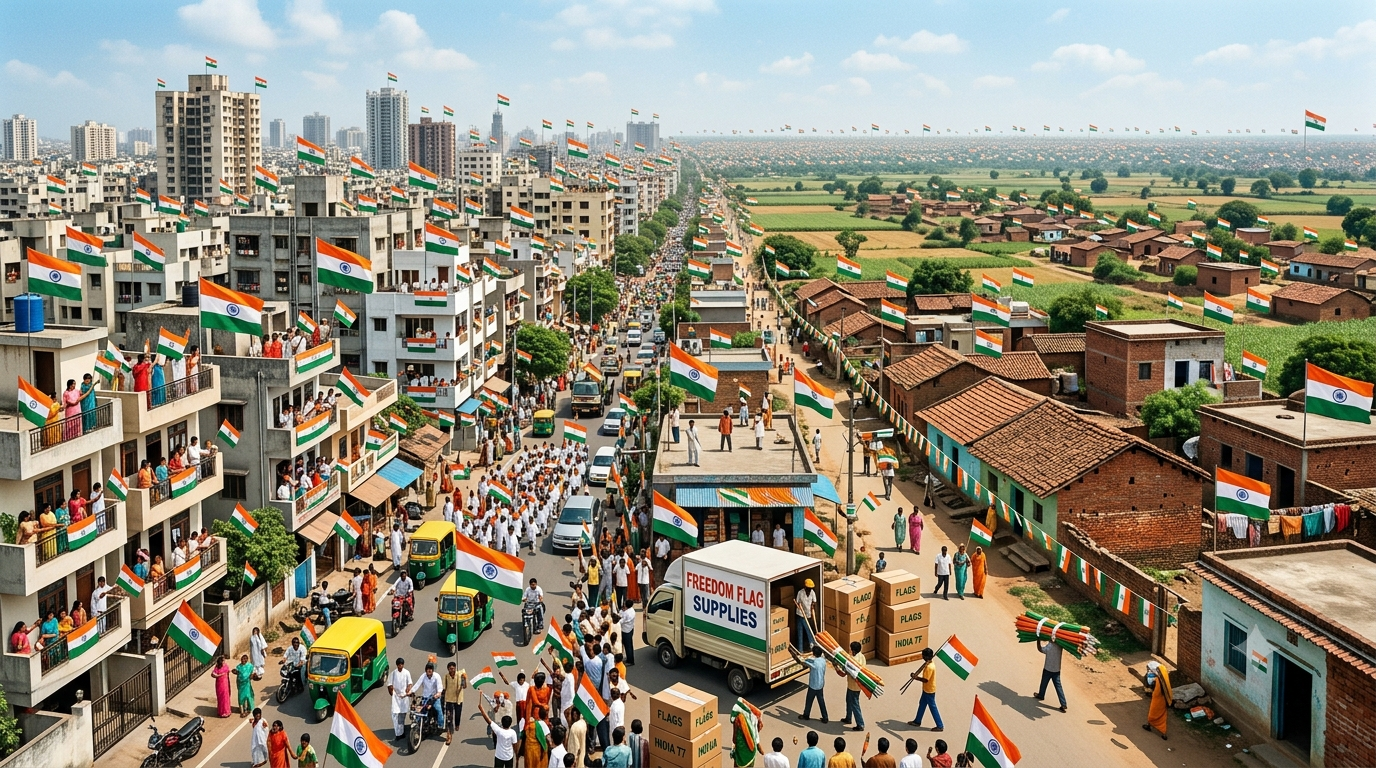
For most of independent India's history, every official national flag came from a single place. A khadi weaving unit in Bengeri, a small locality in Hubballi, Karnataka, held the only certification in the country to make the tricolour.
Then, in December 2021, one rule changed. Within eight months, more than 10 lakh people across India were making flags. Thirty crore of them were produced in about 20 days. This is the story of how India built one of its fastest consumer supply chains almost overnight, and what it cost the unit that made flags for 65 years before that.
The only flagmaker in the country
The Karnataka Khadi Gramodyoga Samyukta Sangha (KKGSS) was set up in 1957 by a group of Gandhian workers in Bengeri. It is the only unit in India certified by the Bureau of Indian Standards to manufacture the khadi national flag. The flags that fly on the Red Fort and at Indian embassies abroad come from this one facility.
The Sangha directly employs about 1,200 people, of whom around 1,000 are women. Every flag is hand spun, hand woven, cut, dyed, stitched and checked against strict size and colour standards. For decades, this was the entire official flag industry of a country of over a billion people.
One amendment opened the market
On 30 December 2021, the government amended the Flag Code of India to allow national flags made from machine-made cotton, polyester, wool and silk, alongside the traditional hand-spun khadi. Until then, only hand-made khadi or cotton flags were permitted.
The timing was deliberate. The amendment came just before the Har Ghar Tiranga campaign, launched in 2022 under Azadi Ka Amrit Mahotsav, which asked every household in the country to hoist a flag between 13 and 15 August. That single ask created demand on a scale the old rules could never have supplied.
What happened in 2022
The numbers from the first campaign are worth reading twice.
According to the Confederation of All India Traders (CAIT), more than 30 crore flags were sold in 2022, generating business worth about Rs 500 crore. Before this, annual flag sales around Independence Day sat at roughly Rs 150 to 200 crore. The market grew close to three times in a single season.
The same CAIT statement carries the number that gives this article its title. Because flags could now be machine made, more than 10 lakh people found work making them, many stitching flags at home or in small workshops. SME manufacturers and traders produced the 30 crore flags in a record window of about 20 days.
Distribution was just as remarkable. India Post sold more than 1 crore flags in just 10 days through its network of 1.5 lakh post offices, priced at Rs 25 apiece, with over 1.75 lakh flags ordered online through the ePostOffice portal with free doorstep delivery.
The demand side matched the supply side. The Communications Ministry reported that 23 crore households hoisted the tricolour in 2022, and 6 crore people uploaded selfies on the Har Ghar Tiranga website.
The supply chain, year by year
The campaign has run every year since, and the production system behind it has kept growing.
Year | Key supply and participation numbers |
2022 | 30 crore flags sold, Rs 500 crore in business, 10 lakh people employed in flag making (CAIT). 23 crore homes hoisted the flag, 6 crore selfies uploaded |
2023 | Around 35 crore flags expected, with business of about Rs 600 crore (CAIT). Over 10.16 crore selfies uploaded |
2025 | More than 7.5 crore selfies uploaded and over 9 lakh Tiranga Volunteers mobilised in the fourth edition |
One honest note on the data. No comparable trade estimate for the 2024 season appears to have been published, so the sales series jumps from 2023 to the participation figures of 2025. We have not filled that gap with a guess.
The most interesting shift in these years is who makes the flags. In 2025, the Uttar Pradesh State Rural Livelihood Mission mobilised around 30,000 self-help group members to produce 2 crore flags for the campaign. In Bihar, nearly 500 artisans across 10 to 15 districts worked through local producer companies. What began as an SME and trader story has steadily become a women-led self-help group story.
2026 production has already begun
The pattern is repeating this year, and the announcements are already public.
The Delhi government said in July that self-help groups will produce around 2 lakh flags for the 2026 campaign, as part of a plan to distribute more than 15 lakh flags across the city, with the rest sourced partly from online marketplaces. The flag has quietly become an e-commerce product too, sold alongside the big Independence Day sales that deal platforms like GrabOn track every August.
West Bengal has directed a week-long campaign from 9 to 17 August, with 1.5 lakh flags going to each district and to the Kolkata Municipal Corporation.
In other words, the flag supply chain now switches on a full month before Independence Day, state by state, with procurement targets announced in advance. Very few seasonal products in India work with this level of coordination.
What it cost the original flagmaker
There is a second half to this story, and it plays out back in Bengeri.
The same amendment that created 10 lakh jobs undercut the one unit that held the certification. Cheap machine-made polyester flags sell for a fraction of the price of hand-made khadi ones, and buyers moved quickly. KKGSS sales fell from Rs 4.28 crore in 2022-23 to Rs 1.80 crore the following year, and to just Rs 49 lakh by early August 2025, about a quarter of the previous year. The unit reported wage delays for its roughly 2,000 women workers across spinning, weaving and stitching.
Workers at the centre told Deccan Herald that monthly earnings have dropped from about Rs 10,000 to Rs 4,000, and that flag stock worth Rs 2 crore is lying unsold because large orders have stopped coming. Textile industry commentators have also pointed out that the windfall from the campaign largely bypassed traditional weaver communities and flowed to machine-made polyester manufacturers instead.
Both stories are true
Har Ghar Tiranga is a genuine supply chain success. A market worth Rs 150 to 200 crore tripled in one season. Ten lakh people earned from it. Post offices became flag shops. Self-help groups in UP, Bihar and Delhi now hold production contracts that arrive every summer.
And at the same time, the one facility that made India's official flags for 65 years is fighting to stay open.
That is usually how large market openings work. The gains spread wide and the losses land in one place. The tricolour just happens to make both sides of it visible at once, every August.
Comments
Log in or sign up to join the conversation.