One customer, 1,285 railcarsFreightCar America announced yesterday after the market closed that it removed a tank car retrofit order covering 1,285 railcars from its backlog. Management believes the customer is unlikely to meet its contractual obligations. The company also cut its 2026 outlook.
|
FreightCar America builds and modifies railcars and supplies parts. It sells equipment and services rather than earning money by hauling freight. A retrofit modifies an existing railcar. This order was scheduled for deliveries beginning in the second half of 2026 and continuing through 2027, so the removal affects expected work across both years.
|
According to the company's October 19 announcement, backlog at September 30, after removing the order, stood at 2,660 units valued at $284.5 million. Management says no other orders are affected by this adjustment and that the remaining backlog has firm customer commitments. The announcement does not identify the customer or explain the underlying reason it may be unable to perform.
|
An order still has to become profitable workBacklog is ordered work that has yet to be completed and delivered. It helps a manufacturer plan production. To become revenue, the work must proceed and the contractual requirements must be met. To become profit, that revenue must cover the costs of doing the work.
|
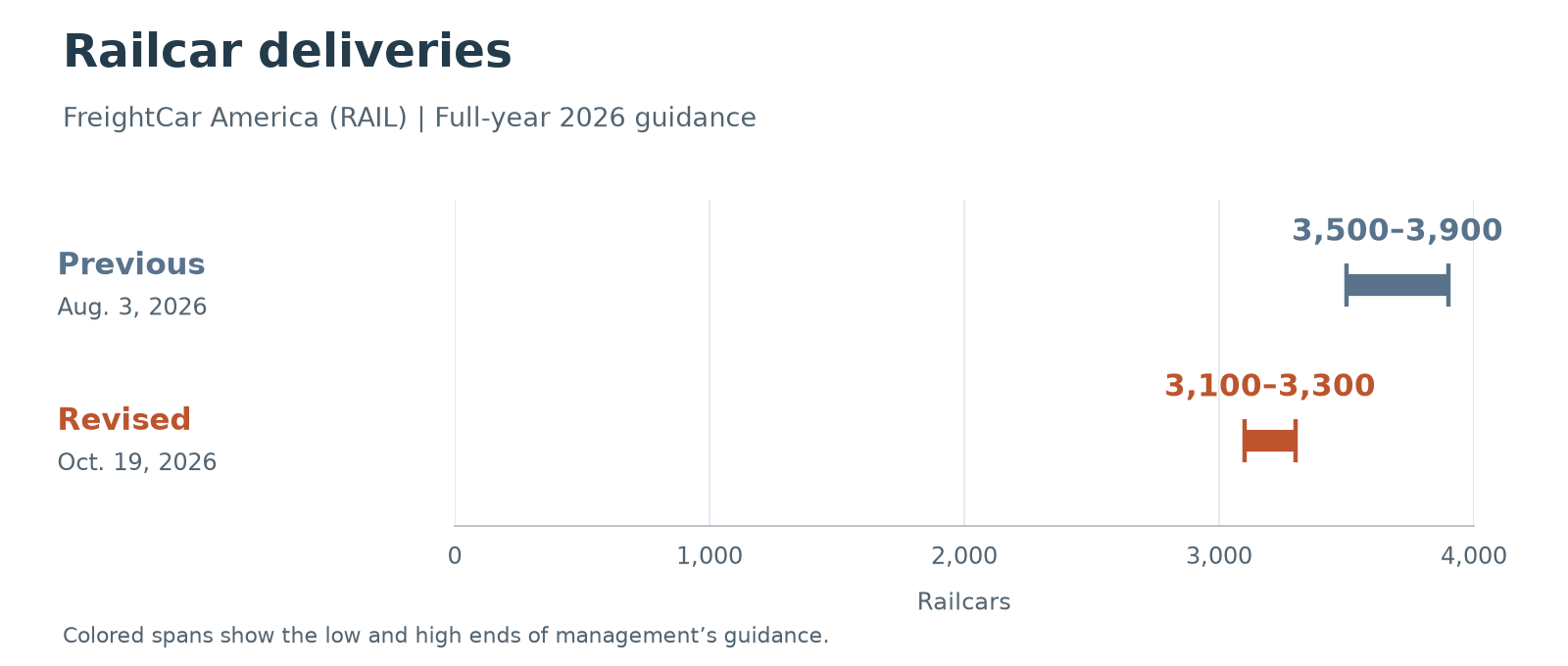
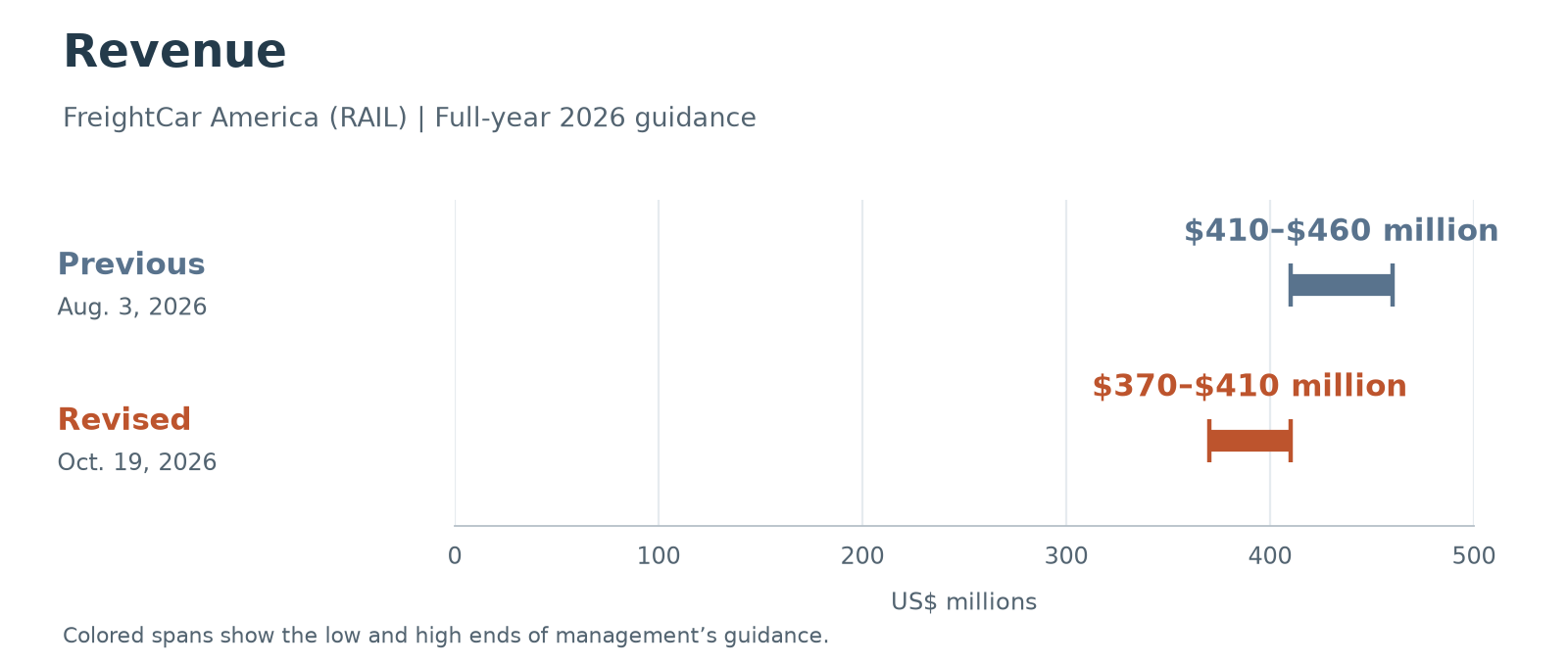
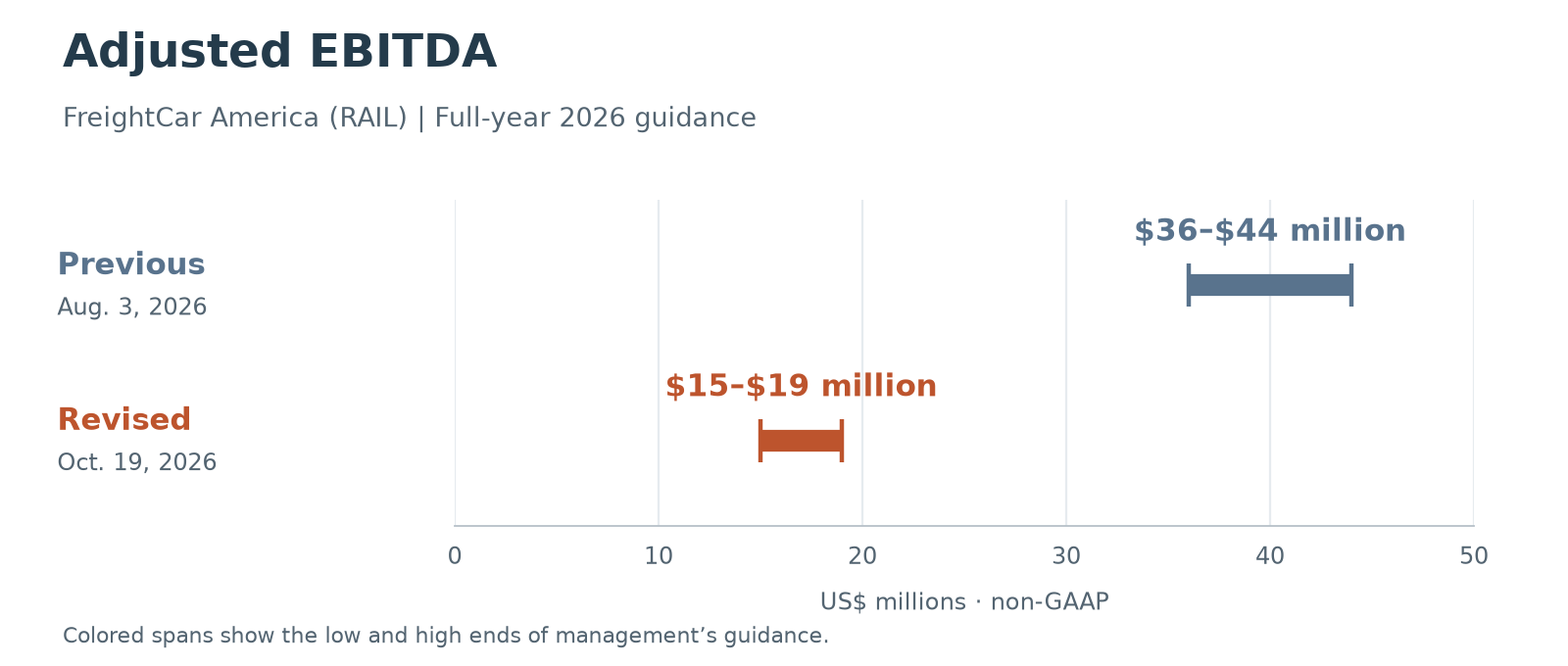
Here is how management's full-year 2026 outlook changed. Each colored span shows the low-to-high guidance range. Dollar amounts are in US dollars. |
|
Adjusted EBITDA is a company defined earnings measure that excludes interest, taxes, depreciation, amortization and certain other items. It is a non GAAP measure, distinct from standard accounting net income and cash flow. These forecasts come from management, rather than analyst consensus.
|
Why can earnings suffer more than sales? Many factory costs persist when production falls. With fewer railcars moving through production, each completed car may need to cover a larger share of those costs.
|
That pressure was already present. In its August results, management said customer delivery timing had delayed the production ramp, left fewer units to absorb fixed costs and pushed some expected deliveries into early 2027. The October update does not break down how much of the latest forecast reduction comes from the removed order versus other operating changes.
|
The preliminary figures for the third quarter ended September 30 show the strain. Revenue is expected to be $75 million to $77 million, compared with $160.5 million a year earlier. Adjusted EBITDA is expected to range from a $0.3 million loss to a positive $0.3 million. Those results remain unaudited and subject to closing procedures.
|
Moving freight is different from buying railcarsFreight activity can tell us something about demand for physical goods. Factories need raw materials, stores need inventory and finished products need to reach customers. Sustained weakness across those movements can be a warning about demand, although much of the services economy generates little direct rail freight.
|
Buying equipment is a separate decision. A fleet owner handling more shipments might put idle railcars back to work before ordering new ones. Replacement needs, financing and the suitability of existing equipment can also influence purchases. Railcar orders can weaken while freight keeps moving.
|
The recent volume evidence argues against treating this order removal as proof of a broad freight contraction. In its October 14 traffic release, the Association of American Railroads reported that combined US carloads and intermodal traffic rose 7.2% in the week ended October 10 compared with the corresponding week last year. Intermodal traffic consists of containers and trailers moved by rail as part of journeys that can use more than one form of transportation. Combined traffic was also up 3.6% over the first 40 weeks of 2026.
|
Rail can gain business from trucks as well as from growing demand. In its October overview, AAR cited trucking constraints, diesel costs and railroad service as reasons intermodal had become more attractive to shippers.
|
At the Port of Los Angeles, September loaded import container volume increased 19% from a year earlier, according to its October 9 release. Port management attributed its cargo strength partly to inventory replenishment and cargo shifting from other routes. Growth at one port can therefore reflect where goods travel and when inventories are rebuilt, as well as demand from the people who eventually buy them. Port and rail figures can also capture different stages of the same container journey.
|
These figures compare physical volumes with the prior year. They measure something different from freight prices, transportation stock returns or seasonally adjusted growth. Positive annual comparisons can coexist with a slowing pace of growth, and one port cannot represent the whole shipping industry.
|
Strong traffic also does not guarantee strong transport company profits. Our September article on J.B. Hunt's freight volume and margin squeeze explains how costs can rise before customer pricing catches up.
|
For FreightCar America, the clearest signal is an order reliability problem. Whether this customer's difficulty reflects something broader remains unresolved.
|
What cash exposure might remain?Removing expected work can leave more than a hole in future sales. If materials have already been purchased or work has begun, cash could remain tied up in a project that no longer proceeds as planned. Customer deposits, recoveries under the contract or materials that can be used elsewhere could soften the impact. The announcement does not establish those details for this order.
|
There is a reasonable recovery case, too. Management says this adjustment affects only one order. In August, it targeted approximately $12 million of annualized structural savings, with benefits beginning in the third quarter. Annualized means the expected yearly pace of savings, rather than an amount promised for 2026.
|
If the savings arrive and remaining orders become deliveries, the company could rebuild earnings despite this setback. Improving margins and cash generation at the revised production level would make that case more convincing than the size of the backlog alone.
|
The next results need to explain the gapThe company expects to release full third quarter results on November 9 after the close, followed by a November 10 conference call. Three questions would help explain where the business stands: |
How much of the outlook reduction comes from this order rather than other operating changes? What cash or inventory exposure remains? How much of the planned cost reduction has reached the results?
The broader economic question needs a different set of evidence. Sustained weakness across rail commodity groups, container traffic at several ports and other freight measures would make a broader slowdown interpretation more persuasive. Continued broad growth in freight movements would argue against a contraction, while changes in the pace of growth would still matter. Successful deliveries from the remaining backlog would separately help rebuild confidence in FreightCar America's orders.
|
Freight volumes help show how much goods movement is taking place. A manufacturer's backlog shows work it expects to do next. For shareholders, the value comes from completing that work profitably and collecting the cash. |
|






Comments
Log in or sign up to join the conversation.