
WhatsApp has become one of the most important communication channels for businesses. Small businesses, startups, ecommerce brands, service providers, and growing companies use WhatsApp to answer enquiries, generate leads, provide customer support, send notifications, and follow up with prospects.
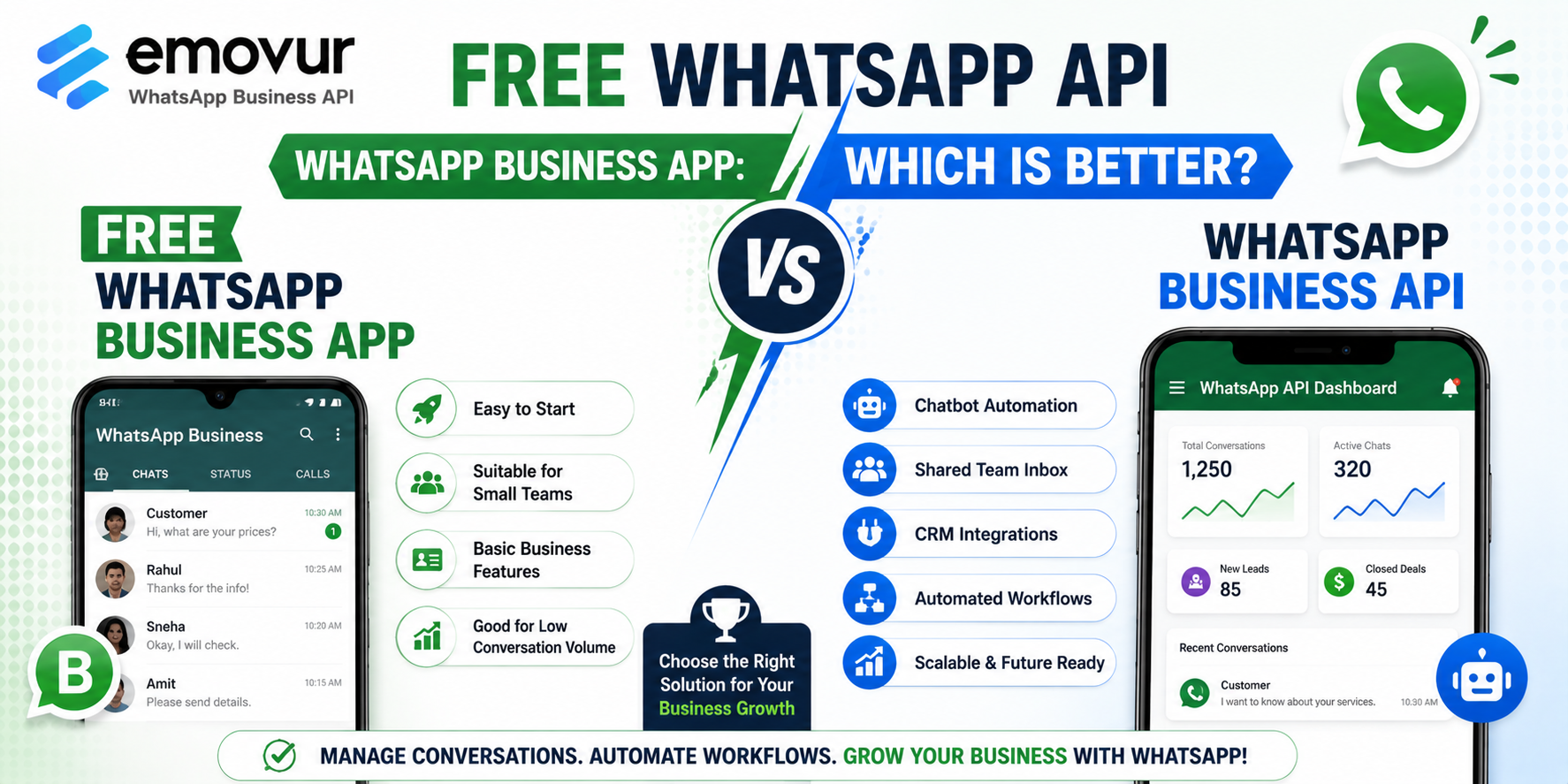
When businesses start using WhatsApp, they often have two options to consider: the WhatsApp Business App or the WhatsApp Business API.
For businesses looking to reduce software costs, a free WhatsApp API plan can make the comparison even more interesting.
But which option is better?
The answer depends on your business size, number of customer conversations, automation requirements, team size, and integration needs.
This guide compares the free WhatsApp API vs WhatsApp Business App and explains when each option makes sense.
What Is the WhatsApp Business App?
The WhatsApp Business App is designed primarily for businesses that manage customer communication manually.
It provides useful business features such as a business profile, quick replies, labels, catalog functionality, and basic customer communication tools.
For a small business receiving a limited number of enquiries each day, the app can be enough.
For example:
Customer: What are your prices?
Business: Our packages start from ₹10,000. Would you like me to send you the details?
The employee manually handles the conversation.
This approach works well when customer communication is relatively simple and does not require complex automation.
What Is the WhatsApp Business API?
The WhatsApp Business API, also known as the WhatsApp Business Platform, is designed for businesses that need automation, integrations, multiple agents, and scalable communication.
The API can connect WhatsApp with:
CRM systems
Websites
Chatbots
Ecommerce platforms
Lead management systems
Customer support tools
Automation workflows
Businesses can use it to automate customer replies, qualify leads, manage shared inboxes, send notifications, and build structured customer journeys.
Businesses interested in getting started can explore the WhatsApp Business API by Emovur.
Is a Free WhatsApp API Available?
Yes, some providers offer free or ₹0 monthly platform plans.
For example, Emovur currently lists a Free Forever plan at ₹0/month. The plan includes WhatsApp inbox access, one team inbox agent, three chatbots, unlimited chatbot sessions, onboarding and training assistance, and free conversation credits. Applicable WhatsApp message charges are separate.
This means a business can potentially access API-based automation without paying a recurring monthly platform subscription.
However, free API access does not necessarily mean free WhatsApp messaging.
Businesses should separately consider applicable WhatsApp messaging charges when comparing the total cost.
Free WhatsApp API vs WhatsApp Business App
The biggest difference is manual communication versus automation.
WhatsApp Business App
Customer sends a message → Employee reads it → Employee replies manually
WhatsApp API
Customer sends a message → Automated system responds → Information is collected → Lead is qualified → Human agent takes over when needed
This makes the API more suitable for businesses that receive a large number of enquiries or want to automate repetitive customer interactions.
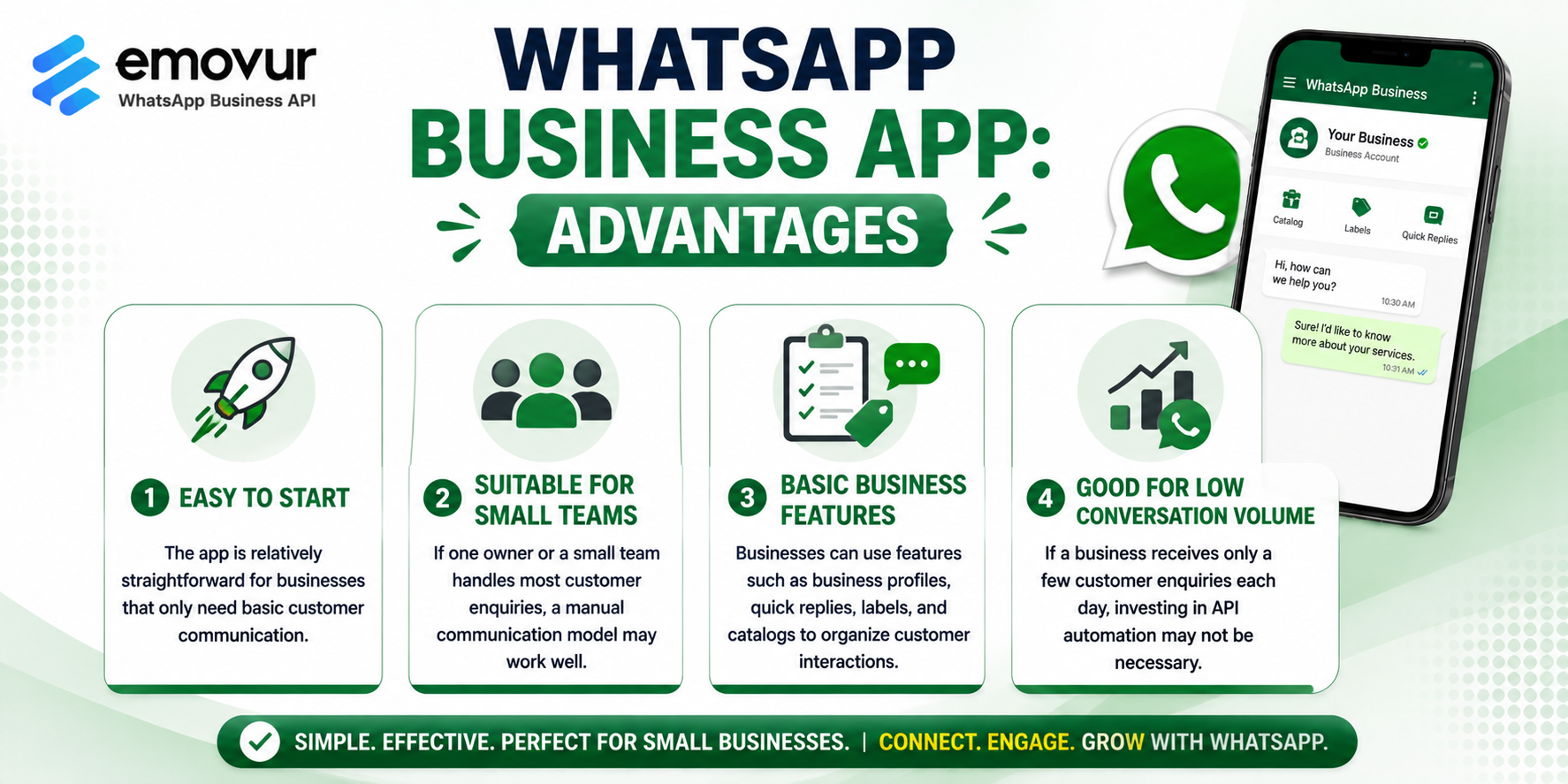
WhatsApp Business App: Advantages
The WhatsApp Business App has several advantages for smaller businesses.
1. Easy to Start
The app is relatively straightforward for businesses that only need basic customer communication.
2. Suitable for Small Teams
If one owner or a small team handles most customer enquiries, a manual communication model may work well.
3. Basic Business Features
Businesses can use features such as business profiles, quick replies, labels, and catalogs to organize customer interactions.
4. Good for Low Conversation Volume
If a business receives only a few customer enquiries each day, investing in API automation may not be necessary.
WhatsApp Business API: Advantages
The API becomes more valuable when the business needs automation and scalability.
1. Chatbot Automation
Businesses can create automated workflows for FAQs, lead qualification, product information, appointment booking, and customer support.
The WhatsApp Business App itself does not provide the same bot logic, webhooks, or CRM integration capabilities available through the Business Platform.
Businesses interested in chatbot automation can read the WhatsApp Chatbot for Business guide.
2. Shared Team Inbox
A WhatsApp API platform can provide a centralized inbox where multiple team members can manage customer conversations.
This can be particularly useful for sales and customer support teams.
3. CRM Integrations
Businesses can connect WhatsApp with CRM and other business systems to manage leads and customer information more efficiently.
4. Automated Customer Journeys
The API can be used to create workflows such as:
Lead enquiry → WhatsApp message → Chatbot qualification → Sales assignment → Follow-up
This reduces the amount of repetitive manual work required from employees.
5. Scalable Communication
Businesses handling hundreds or thousands of customer interactions can benefit from automation and structured communication workflows.
Free WhatsApp API vs WhatsApp Business App: Comparison
Feature | WhatsApp Business App | Free WhatsApp API |
Basic customer messaging | Yes | Yes |
Business profile | Yes | Yes |
Manual replies | Yes | Yes |
Chatbot automation | Limited/basic automation | Available depending on provider |
Shared team inbox | Limited | Available depending on plan |
Multiple agents | Limited/plan-dependent | Usually plan-dependent |
CRM integration | Limited | Available |
Automated workflows | Limited | Yes |
Lead qualification | Mostly manual | Can be automated |
Scalability | Suitable for smaller operations | Better for growing businesses |
Developer integrations | No/limited | Available depending on provider |
Monthly platform fee | App-based model | ₹0 on some provider plans |
The exact API features depend on the provider and selected plan.
Which Is Better for Small Businesses?
There is no universal winner.
The WhatsApp Business App may be better if:
You receive a small number of enquiries
One or two people manage conversations
You don't need complex automation
You mainly communicate manually
You don't need CRM integration
A free WhatsApp API may be better if:
You want to test chatbots
You need automated replies
You want to qualify leads automatically
Multiple people need to manage conversations
You want a shared inbox
You need CRM integrations
You want to build automated workflows
For example, a local salon receiving 20 enquiries per day may be comfortable with the WhatsApp Business App.
A real estate company receiving hundreds of enquiries from advertising campaigns may benefit more from an API-based chatbot that qualifies leads before sending them to sales representatives.
What About WhatsApp Messaging Costs?
Businesses should not assume that a free WhatsApp API means all messages are free.
The platform subscription and WhatsApp messaging charges are separate considerations.
For example, Emovur currently lists ₹0/month for its Free Forever platform plan while separately displaying applicable marketing, utility, and authentication messaging rates.
Therefore, businesses should calculate:
Platform cost + WhatsApp messaging charges + additional feature costs
before making a final decision.
You can learn more about WhatsApp costs in the WhatsApp API Pricing in India guide.
When Should You Switch From the App to API?
A business may want to consider moving from the WhatsApp Business App to an API when manual communication starts becoming difficult to manage.
Common signs include:
Too many customer enquiries
Slow response times
Repetitive questions
More employees need access
Leads are being missed
Follow-ups are inconsistent
CRM integration is required
Chatbot automation is needed
Marketing workflows need automation
The goal is not to move to an API simply because it has more features. The switch should happen when automation and scalability solve an actual business problem.
What Should You Check Before Choosing a Free WhatsApp API?
Before selecting a provider, compare:
Monthly platform fee
WhatsApp messaging charges
Provider markup
Number of team members
Chatbot limits
Automation features
Broadcast capabilities
WhatsApp Flows
CRM integrations
Developer API access
Customer support
Upgrade options
The WhatsApp API Provider Checklist can help businesses evaluate these factors before signing up.
See the WhatsApp API Product Demo
If you're still unsure whether a free WhatsApp API is right for your business, seeing the platform in action can help.
The WhatsApp API Product Demo showcases features such as shared team inboxes, WhatsApp broadcasts, WhatsApp Flows, ecommerce, payments, drip campaigns, and WhatsApp AI.
A product demo can help you understand whether your business actually needs API automation or whether the WhatsApp Business App is sufficient.
Final Thoughts
So, which is better: a free WhatsApp API or the WhatsApp Business App?
For businesses that mainly need manual customer communication, the WhatsApp Business App can be a simple and practical choice.
For businesses that need chatbots, automation, multiple agents, CRM integrations, lead qualification, and scalable communication, a WhatsApp API is generally more suitable.
A free WhatsApp API plan can make the transition easier because businesses can start with a ₹0 monthly platform subscription on eligible plans and upgrade when their requirements grow.
Before making a decision, compare your customer communication volume, automation needs, team size, integrations, messaging costs, and future growth plans.
If you're ready to explore WhatsApp automation, review the WhatsApp Business API plans and pricing and check the WhatsApp API Product Demo to see which approach is a better fit for your business.
Comments
Log in or sign up to join the conversation.