

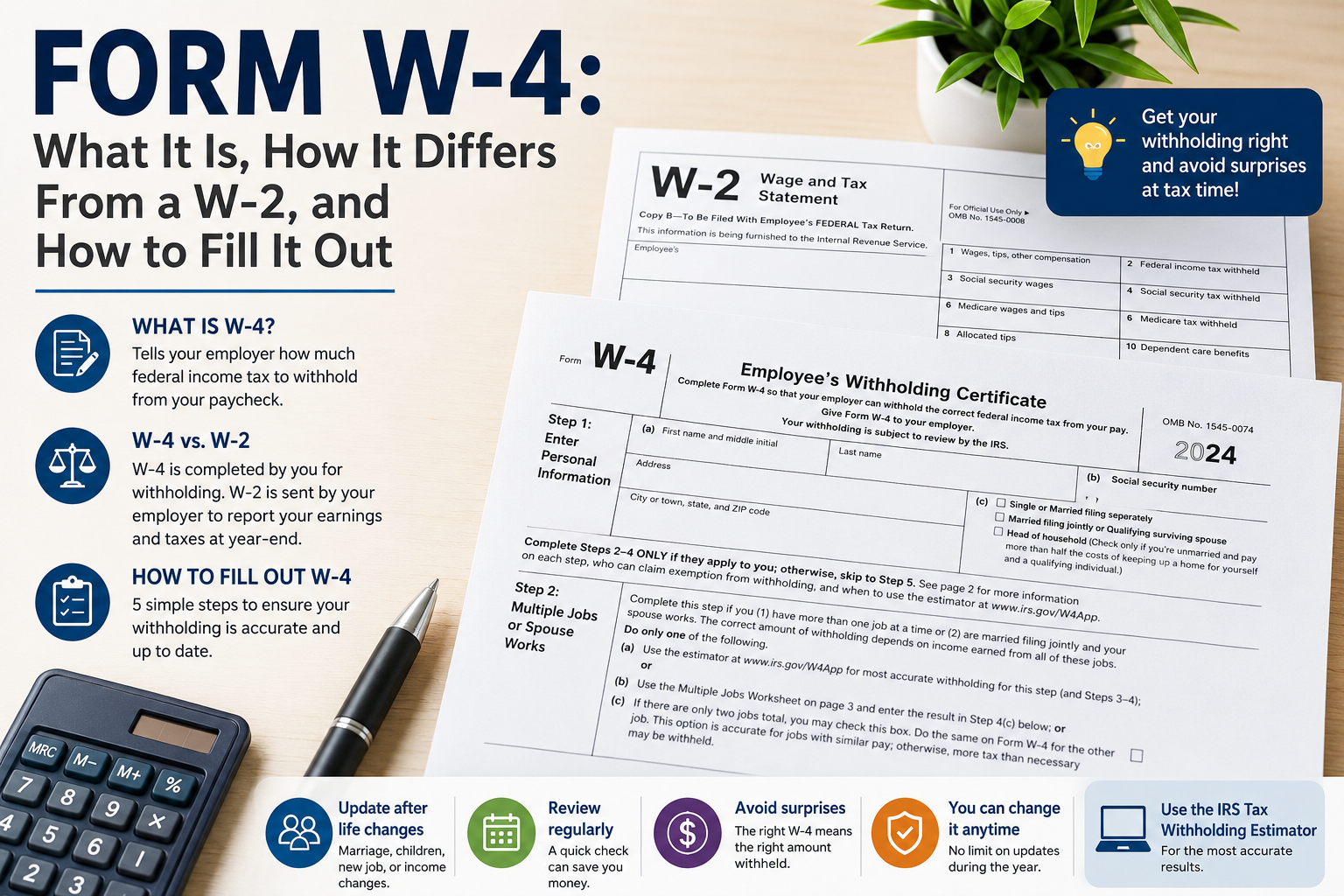
If you've ever started a new job in the United States, chances are someone in HR handed you a stack of paperwork — and buried in that stack was a form called the W-4. It's easy to overlook, but filling it out correctly can save you from a surprise tax bill (or a disappointing refund) come April. Here's a plain-English breakdown of what the W-4 is, how it compares to the W-2, and how to complete one.
What Is the W-4 Form?
The W-4, officially titled the "Employee's Withholding Certificate," is a form you give to your employer — not to the IRS directly — that tells them how much federal income tax to withhold from each paycheck. Based on the information you provide, your employer calculates a withholding amount and sends it to the IRS on your behalf throughout the year.
The goal of the W-4 is to get your withholding as close as possible to your actual tax liability. If too little is withheld, you'll owe money (and possibly a penalty) when you file your return. If too much is withheld, you'll get a refund — but that essentially means you gave the government an interest-free loan during the year.
You typically fill out a W-4 when you start a new job, but you can and should update it whenever your financial situation changes significantly — getting married, having a child, picking up a second job, or experiencing a major shift in income.
The IRS redesigned the W-4 in 2020, removing the old "allowances" system (where you claimed a number like 0, 1, or 2) in favor of a more straightforward format based on dollar amounts and actual financial details. If you haven't looked at a W-4 in a few years, the current version will look quite different from what you may remember.
W-4 vs. W-2: What's the Difference?
This is one of the most common points of confusion, largely because the names are so similar. Here's the key distinction:
W-4 is a form you fill out and submit to your employer at the start of employment (or whenever you want to adjust withholding). It's forward-looking — it tells your employer how to handle your future paychecks.
W-2 is a form your employer fills out and sends to you (and the IRS) at the end of the year. It's a summary — it reports how much you actually earned and how much was actually withheld in taxes, Social Security, and Medicare during that calendar year.
In short: the W-4 sets your withholding in motion, and the W-2 reports the results. You use the W-2 when preparing your annual tax return, while the W-4 is something you generally only think about when your job or personal situation changes.
How Do I Fill Out a W-4 Form?
The current W-4 is broken into five steps, though not everyone needs to complete all of them.
Step 1: Personal Information Enter your name, address, Social Security number, and filing status (single, married filing jointly, married filing separately, or head of household). Every employee must complete this step.
Step 2: Multiple Jobs or Spouse Works If you hold more than one job at a time, or you're married and your spouse also works, this step helps account for the combined income so you don't under-withhold. The IRS provides a Tax Withholding Estimator tool online, and the form itself includes a worksheet, to help calculate the right adjustment. Many people find the estimator easier than the worksheet.
Step 3: Claim Dependents If your total income will be $200,000 or less ($400,000 or less if married filing jointly), you can claim credits for qualifying children and other dependents here. This directly reduces the amount withheld, since it accounts for tax credits you'll claim later.
Step 4: Other Adjustments (Optional) This section covers extra income not from a job (like interest or dividends), itemized deductions beyond the standard deduction, and any additional amount you'd like withheld from each paycheck — useful if you want a bigger cushion or have side income without its own withholding.
Step 5: Sign and Date Your employer won't apply the form until it's signed.
A few practical tips: if your situation is simple — one job, no dependents, standard deduction — you may only need Steps 1 and 5. If your finances are more complex, the IRS's online Tax Withholding Estimator is generally more accurate than doing the worksheets by hand. And remember, you can submit a new W-4 to your employer at any time during the year; there's no limit on how often you can adjust it.
Getting the W-4 right doesn't require perfection, just periodic attention — a quick review after any major life or income change will keep your withholding on track and your tax season stress-free.
Frequently Asked Questions
Q1.Do I have to fill out a new W-4 every year?
No. Unlike some tax documents, the W-4 doesn't expire annually. Once you submit one, it stays in effect until you file a new one. Most people only update it when their job or personal situation changes.
Q2.What happens if I don't submit a W-4 at all?
If you don't submit one, the IRS requires your employer to withhold tax as if you were single with no other adjustments — generally the highest withholding rate. It's in your interest to submit one so your withholding matches your actual situation.
Q3.Can I claim "exempt" on my W-4?
Yes, but only if you meet specific criteria: you had no federal tax liability last year and expect none this year. If you qualify and claim exempt, no federal income tax will be withheld from your paycheck. This status must be renewed every year by February 15th, or your employer will revert to standard withholding.
Q4.How often can I change my W-4?
As often as you like. There's no IRS limit — you can submit a new W-4 to your employer any time your circumstances change, whether that's a raise, a new dependent, or a second job.
Q5.Will changing my W-4 affect my paycheck right away?
Not instantly, but soon. Employers are required to apply a new W-4 by the start of the first payroll period beginning 30 days or more after you submit it, though many apply it much sooner.
Q6.Why did my refund change even though my income stayed the same?
This usually comes down to withholding, not income. If you adjusted your W-4, changed jobs, or your employer recalculated your withholding, the amount taken from each paycheck can shift — which changes your refund or balance due, even if your actual income and tax liability didn't move much.
Comments
Log in or sign up to join the conversation.