

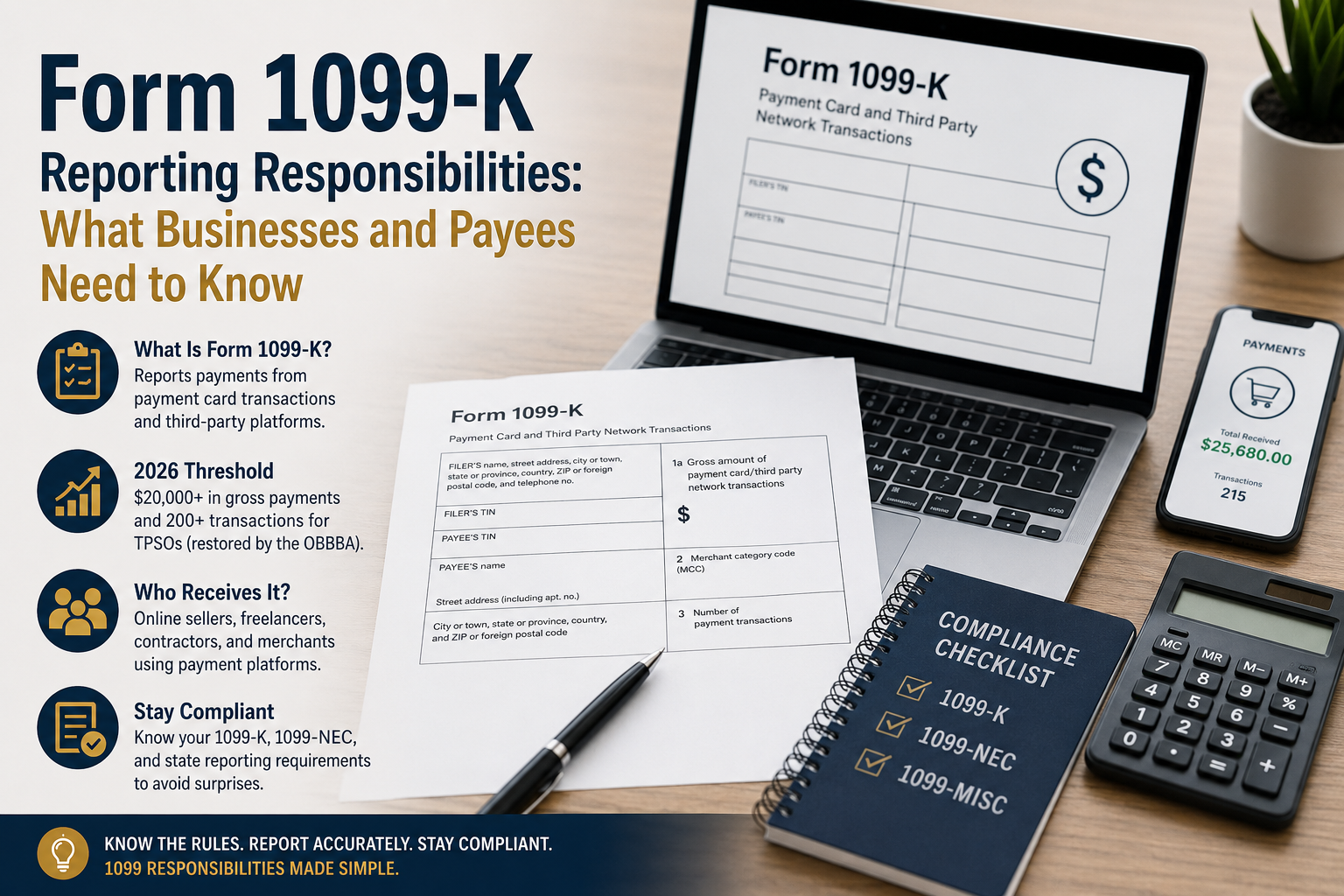
Form 1099 reporting has always been a moving target for payroll professionals, accountants, and business owners, but few forms in the series have caused as much confusion in recent years as the 1099 K. Between shifting IRS thresholds, the passage of the One Big Beautiful Bill Act (OBBBA), and the rise of payment apps and online marketplaces, understanding who must issue this form — and who must report the income it captures — has become essential for anyone managing payroll or business tax compliance.
What Is Form 1099-K?
Form 1099-K, Payment Card and Third-Party Network Transactions, reports gross payments processed through two channels: payment card transactions (credit, debit, and stored value cards) and third-party settlement organizations, or TPSOs. TPSOs include payment apps and online marketplaces such as PayPal, Venmo, and Etsy, as well as gig-economy and crowdfunding platforms. A key distinction that trips up many filers: the payment processor or platform issues the 1099-K, not the business or individual making the payment. That's different from Form 1099-NEC, which a business sends directly to the contractors it pays for services.
The Current 1099-K Threshold
For years, the reporting threshold for TPSOs sat at more than $20,000 in gross payments and more than 200 transactions in a calendar year. The American Rescue Plan Act attempted to lower that bar dramatically, phasing it down toward a $600 threshold with no transaction minimum. That phase-down never fully took hold. With the OBBBA signed into law on July 4, 2025, Congress repealed the ARPA threshold and retroactively restored the original $20,000-and-200-transaction rule for TPSOs, effective for the 2025 tax year and continuing into 2026.
Payment card transactions work differently and remain reportable at any dollar amount, with no minimum threshold. There's also a backup withholding exception: if a TPSO withheld tax during the year because a payee's taxpayer identification number was missing or didn't match IRS records, the platform must issue a 1099-K regardless of the total amount paid.
Business owners and tax professionals should also remember that federal thresholds don't override state rules. Several states have set their own, lower reporting thresholds for TPSOs that remain in effect independent of the federal change, so it's worth checking the requirements in any state where a business operates or where payees are located.
Who Receives a 1099-K, and Why It Matters
Typical recipients include online sellers accepting payments through marketplaces or payment apps, freelancers and contractors paid via third-party platforms, and merchants who process card payments. The IRS uses the gross payment totals on Form 1099-K to cross-check reported income and strengthen voluntary compliance, which means the figures on the form may not match a taxpayer's actual taxable income. Because Form 1099-K reports gross payments, it can include refunds, fees, or transfers between friends and family for non-business reasons — amounts that generally aren't taxable and shouldn't be reported as income. Recipients need to reconcile the gross figure against their own books and adjust for these non-income items when preparing a return.
Coordinating 1099-K With Other Information Returns
For payroll and accounting teams, the practical challenge isn't just understanding the 1099-K threshold in isolation — it's coordinating it with the rest of a business's 1099 reporting obligations. A contractor paid through a payment app for services may generate both a 1099-K from the platform and a 1099-NEC from the business itself, since Form 1099-NEC covers direct payments to independent contractors for services (with its own federal threshold of $2,000 for payments made in 2026). Businesses need clear internal processes to avoid double-counting income when both forms apply to the same payee, and to correctly classify which payments belong on which form.
Staying Compliant Amid Ongoing Changes
Form 1099-K has been in near-constant flux over the past several tax seasons, and payroll and tax professionals should expect continued regulatory attention even though the practical threshold has settled back at $20,000 and 200 transactions for now. Staying current means monitoring IRS guidance, tracking state-level threshold differences, and building payee education into year-end processes so business owners and contractors aren't caught off guard by a form that may look unfamiliar even when the underlying income was already reported elsewhere.
For payroll departments, accountants, and HR teams managing multiple information return types, the safest approach is a documented, repeatable 1099 reporting checklist — one that accounts for 1099-K, 1099-NEC, and 1099-MISC obligations together, rather than treating each form as a standalone compliance task.
Frequently Asked Questions
Q1.What is the 1099-K threshold for 2026?
For 2026, third-party settlement organizations must issue a 1099-K when a payee's gross payments exceed $20,000 and the number of transactions exceeds 200. This restores the original federal threshold after the OBBBA repealed the lower $600 rule that had been scheduled to take effect.
Q2.Do I have to pay taxes on 1099-K income?
Only the portion of the reported gross payments that reflects actual taxable income. Refunds, reimbursements, and personal payments between friends or family aren't taxable, so recipients should reconcile the form against their own records rather than reporting the full gross amount as income.
Q3.What's the difference between a 1099-K and a 1099-NEC?
A 1099-K is issued by a payment processor or platform and reports gross payment volume, regardless of what the payments were for. A 1099-NEC is issued directly by a business to report payments of $2,000 or more made to a specific contractor for services in 2026.
Q4.Will I still get a 1099-K if I don't meet the federal threshold?
Possibly. Some platforms choose to issue a 1099-K below the federal threshold, and several states set their own lower reporting requirements that apply regardless of the federal $20,000 rule. Check the payment platform's policy and the rules in any state where you or your payees are located.
Comments
Log in or sign up to join the conversation.