

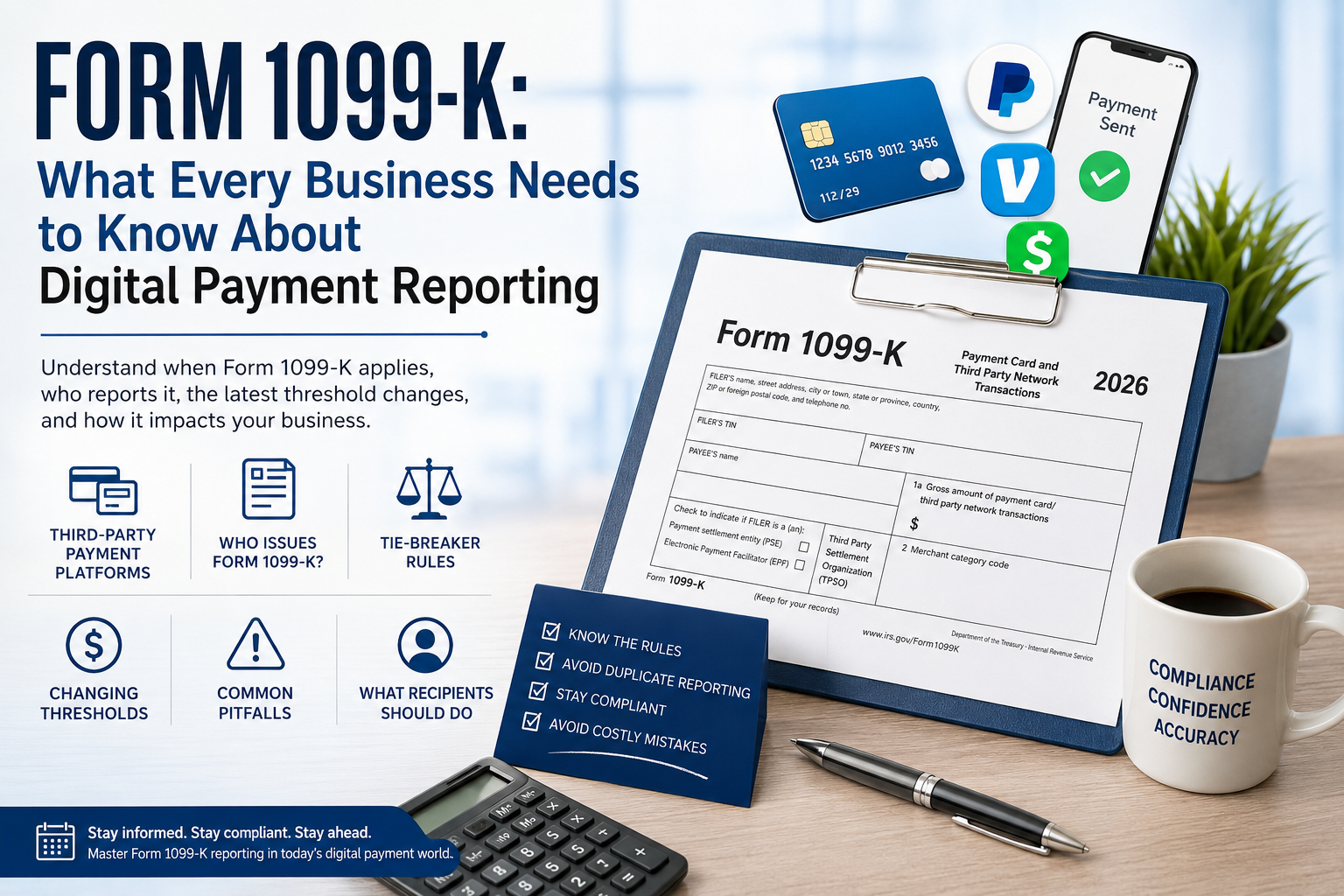
Paying vendors used to be simple: cut a check, track the total, and issue a Form 1099 at year-end if the threshold was met. But the explosion of digital payment tools — credit cards, Venmo, PayPal, Cash App, and platforms like BILL — has quietly rewritten the rules. Many accounts payable teams still assume that paying a contractor automatically means they owe that person a Form 1099-NEC or 1099-MISC. In reality, the payment method itself can shift the reporting obligation entirely, and that's where Form 1099-K enters the picture.
Why Form 1099-K Exists
Form 1099-K is issued by payment settlement entities — banks, card networks, and third-party platforms — to report payments processed on behalf of a business or individual. Its purpose is to capture transactions that move through electronic payment systems rather than traditional cash or check payments made directly by a business.
The confusion arises because many organizations don't realize that Form 1099-K can override the need to issue a Form 1099-NEC or 1099-MISC. If a vendor was paid through a credit card or a qualifying third-party platform, the payer may not be responsible for issuing any form at all, because the reporting duty has already shifted to the payment processor.
The Role of Third-Party Settlement Organizations
A central concept in understanding Form 1099-K is the Third-Party Settlement Organization, or TPSO. These are platforms that settle payments between buyers and sellers, such as Venmo, PayPal, or Cash App. When a payment for goods or services runs through a TPSO, that platform — not the business making the payment — typically becomes responsible for issuing the Form 1099-K.
This distinction matters because not every digital platform functions the same way. Some hybrid systems, like BILL, can behave differently depending on how the payment is routed, which makes it easy for accounts payable staff to misclassify transactions. Knowing whether a platform qualifies as a TPSO — and whether a specific transaction counts as "goods and services" rather than a personal payment — is essential to getting reporting right.
Applying the "Tie-Breaker" Rules
When a payment could theoretically trigger both a Form 1099-K and a Form 1099-NEC or 1099-MISC, tie-breaker rules determine which form actually applies. Generally, if the payment was processed through a payment card or a TPSO, the 1099-K reporting path takes precedence, and the business making the payment does not also issue a Form 1099-NEC. Issuing both can create duplicate reporting, confuse the IRS matching process, and create unnecessary headaches for the vendor.
Thresholds Keep Changing
Reporting thresholds for Form 1099-K have shifted repeatedly in recent years. The threshold structure established under the Affordable Care Act was later lowered under the American Rescue Plan Act, sparking significant compliance uncertainty for small businesses and gig-economy workers alike. More recently, legislative changes — including provisions tied to the One Big Beautiful Bill — have moved the threshold landscape again. Staying current on these changes is critical, since a threshold that applied last tax year may no longer apply this year.
Common Pitfalls
Some of the most frequent mistakes organizations make include:
Issuing a Form 1099-NEC "just to be safe" even when a Form 1099-K already covers the payment
Misclassifying peer-to-peer payments as business transactions, or vice versa
Failing to recognize when a hybrid payment platform has shifted reporting responsibility away from the business
Overlooking backup withholding obligations when a vendor hasn't provided proper taxpayer information
Mishandling foreign vendor payments, which carry their own separate reporting rules
What Recipients Should Do
Businesses that receive a Form 1099-K also need to understand how to reconcile it. Because the form often reports gross payment volume rather than net income, recipients may need to back out fees, refunds, or personal transactions mixed in with business activity before using the figures for tax filing.
The Bottom Line
As digital payments become the default rather than the exception, understanding how Form 1099-K interacts with traditional Form 1099 reporting is no longer optional for accountants, bookkeepers, and business owners. Getting it wrong can mean duplicate filings, IRS mismatches, or missed compliance obligations.
For a deeper, scenario-based walkthrough of these rules — including the latest threshold changes and real-world examples of common errors — Course Ministry's upcoming webinar, "1099K: What You Need to Know," presented by Jason Dinesen, LPA, EA, on August 4, 2026, offers a practical guide for navigating this increasingly complex area of information reporting.
Frequently Asked Questions
1. Does receiving a Form 1099-K mean I also need a Form 1099-NEC?
No. In most cases, once a payment qualifies for Form 1099-K reporting through a card network or third-party settlement organization, the payer is not required to issue a separate Form 1099-NEC or 1099-MISC for that same payment.
2. Who is responsible for issuing a Form 1099-K?
The payment settlement entity — such as a card processor or a third-party platform like PayPal or Venmo — issues the Form 1099-K, not the business that made the payment.
3. Does every Venmo or PayPal payment trigger a Form 1099-K?
Not necessarily. Only payments classified as "goods and services" through a qualifying platform typically count. Personal payments between friends or family generally fall outside Form 1099-K reporting.
4. Why might the amount on my Form 1099-K look higher than my actual income?
Form 1099-K often reports gross transaction volume, which can include fees, refunds, or non-business transfers. Recipients usually need to reconcile this figure before using it for tax reporting.
Comments
Log in or sign up to join the conversation.