

Image Source: Unsplash
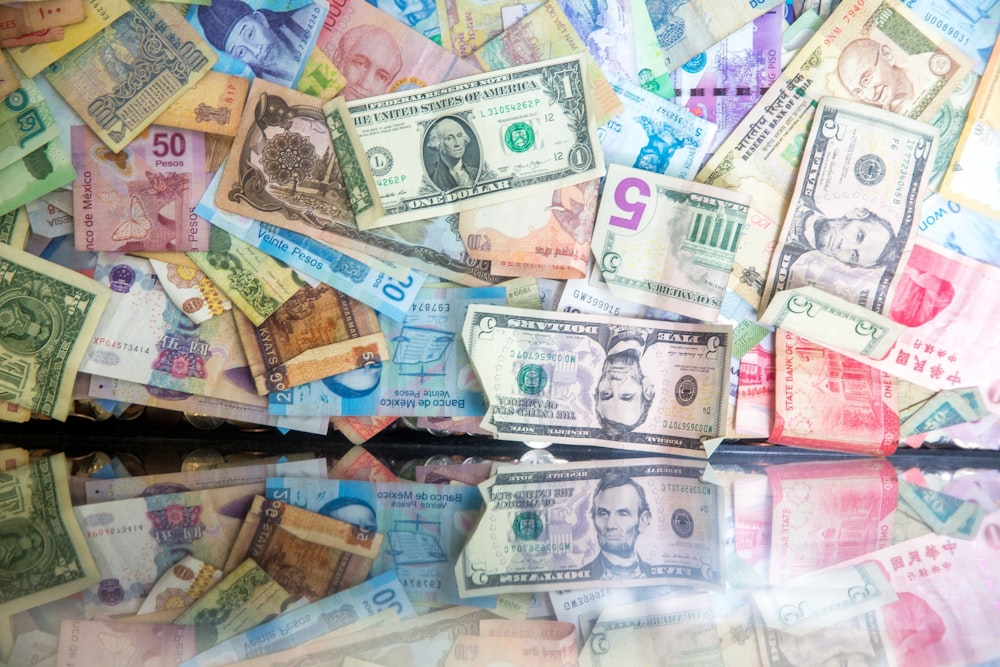
Forex is short for foreign exchange, and forex traders are active in the foreign currency market where currencies are exchanged for each other, e.g. USD for EUR and vice verse.
Today, you do not have to amass a big bankroll before getting into forex trading since many forex brokers and platforms are available online for non-professional small-scale hobby traders.
The foreign exchange market is decentralized: there is no single market where all the trading takes place. Instead, it is made up of a multitude of exchanges and transactions. On average, currencies worth over 6.6 trillion USD will be traded on this decentralized market. In terms of monetary value, this makes the global forex market much bigger than the global stock market.
Currency pairs
Before you can become active in the forex market, you need to understand the concept of currency pairs. On the forex market, the trading takes place in pairs. You don´t simply offer up 100,000 USD and accept payment in any currency for it.
Examples of frequently traded currency pairs:
- The Euro and the United States dollar: EUR/USD.
- The United States dollar and the Japanese yen: USD/JPY.
- The British pound sterling and the United States dollar: GBP/USD.
- The United States dollar and the Swiss franc: USD/CHF.
- The Australian dollar and the United States dollar: AUD/USD.
- The United States dollar and the Canadian dollar: USD/CAD.
- The New Zealand dollar and the United States dollar: NZD/USD.
A currency pair is the quotation of two different currencies, with the value of one being quoted against the other. The first currency is the base currency, and the second is the quote currency.
Example: For the currency pair USD/EUR, the United States dollar is the base currency, and the Euro is the quote currency.
USD/EUR 0.9749 means you need 0.9749 EUR to purchase 1 USD.
Since the currency market is based on established currency pairs, you may sometimes find yourself in situations where you can not do a direct exchange of one currency to another.
Example: You wish to exchange Swedish krona (SEK) for Albanian lek (ALL). You can not find a SEK/ALL currency pair at the trading platform, so you need to do two transactions: First, you exchange the SEK for a major currency, typically USD or EUR, and then exchange that currency for ALL.
Getting exposure to the forex market
A trader does not have to buy and sell currency to get exposure to exchange rate fluctuations. Today, a wide range of instruments are available based on forex.
Examples:
- Forex CFDs (Contracts for Difference based on currency pairs)
- Forex options
- Currency futures
- Currency swaps
- Foreign exchange forward
- Power reverse dual-currency notes (PRDC)
Small-scale hobby trading
Forex trading (and forex derivatives trading) has become very popular among small-scale hobby traders. Below, we will take a look at some points that are good to keep in mind before you start forex trading.
Fit it to your schedule
Finding time to daytrade when a certain stock exchange market is open can be tricky for hobby traders. Fortunately, there is almost always some part of the forex market that is open and active during weekdays, so you can easily tailor your trading schedule to your other obligations. Take advantage of this.
The standard week for currency trading runs around the clock from 5 pm EST on Sunday to 4 pm EST on Friday.
Specialization
A common beginner mistake is to spread oneself too thin. You might see a bunch of opportunities out there, but it is difficult to be long-term profitable if you act on every hunch. If you don´t reign yourself in and employ a strict trading strategy, you will soon be trading a multitude of different currency pairs and juggling a swarm of complex derivatives.
Choose one currency pair, one instrument type and one strategy and perfect this first. When you see long-term profitability, you might be ready to branch out more.
Liquidity
The forex market is famous for its high liquidity, but some currency pairs have much higher liquidity than others.
The general recommendation for novice forex day traders is to choose a currency pair with very high liquidity, such as USD/EUR, USD/JPY or GBP/USD.
When the liquidity is high, there is less risk of slippage. When liquidity is not high enough, you may not be able to execute a trade at exactly the point you selected.
Selecting a forex broker
It is not possible to say that one specific forex broker is the best one since a broker that is ideal for one trader and a certain trading strategy can be completely wrong for another trader using another strategy. It is important that you seek out a broker that is a good fit for you concerning your preferences and the type of trading you are planning to do.
It is also good to remember that you can use more than one broker, and you do not have to settle for one so-so-compromise broker. Maybe you need one broker for your USD/EUR scalping and another one for another currency pair where you hold on to open positions a bit longer. Do not hesitate to shop around and cherry-pick the best forex broker or forex brokers that suits your needs the best.
What can I trade, and how?
What do you want to trade with (e.g. USD/JPY Contracts for Difference), and does the broker offer this? Are the terms and conditions optimal for this particular instrument and the trading strategy of your choice? It does not matter how highly a broker scores in general reviews if they offer sub-par terms and conditions for the trading you want to do.
All the costs
It is easy to get lured in by promises of “no commission” or “zero spreads”. But always take a look at the whole situation. What will it cost you to use this broker for your particular trading strategy? Sometimes, “no commission” comes with broad spreads, and sometimes the “zero spread” broker turns out to nickel-and-dime their clients through a myriad of deposit fees, withdrawal fees, platform fees, and so on.
Take all relevant costs into account when you compare brokers. By relevant, we mean relevant to your particular preferences (e.g. preferred deposit method) and trading strategy.
Customer support
This is one point that seems unimportant until it becomes super important.
- Will you be able to reach customer support through your preferred method? (Phone, e-mail or live chat are the most common methods.)
- If the phone is your preferred method, will you need to make an expensive phone call to another country to get hold of the support?
- Is the customer support staffed when you are most likely to trade? If you typically trade at night, you will not be able to get help quickly from a support that is only staffed from 9 am to 5 pm.
- Is support available in a language you are okay with?
Regulation
Choosing a properly licensed broker in your country or region will clarify the legal situation.
Example: If you are a trader in one of the European Union member states, it is recommended to pick a broker who is licensed in one of the member countries. That way, you do not risk ending up in the kind of complex legal situation that can arise when you are trading in the European Union through a broker based in the Seychelles and licensed in Belize.
Note: Many large international brokers based outside the European Union now have subsidiaries within the European Union to be fully licensed and regulated there. This means that even though the broker may be headquartered in a place like Australia or South Africa, a European Union subsidiary fully under the auspices of The European Securities and Markets Authority (ESMA) will be your counterpart.
Examples of license givers that have a good reputation for being stringent:
- CySec (Cyprus, an EU member state)
- BaFin (Germany, an EU member state)
- FINMA (Switzerland)
- UK FCA (United Kingdom)
- ASIC (Australia)
Market maker?
A market maker broker will take the opposite position of the client. Your orders are therefore not matched against orders from other traders. Therefore, you and the broker are essentially “against” each other, and there is a built-in conflict of interest.
A broker who is not a market maker will not take the opposite position of the client. Therefore, the broker is not your counterpart in the transactions. This type of broker will make money on your trades regardless of whether they are profitable for you or not. There is no built-in conflict, but they do have incentives to encourage you to trade a lot.
Reputation
Does this broker have a good reputation among the traders online? All brokers (and other businesses) have some disgruntled clients, but how does this broker fare compared to other brokers? And are there certain complaints that seem to come up over and over again with this specific broker?

Comments
Log in or sign up to join the conversation.