

As regular readers of my work across various websites are likely well aware, I have been expressing concerns that foreign interest in buying and owning U.S. Treasury securities appears to be fading. This could potentially problematic due to the simple fact that the willingness of foreign investors to lend money to the United States Federal government is critical for the ability of the Federal government to finance its deficits and maintain its spending at the current levels. In addition to this, U.S. Treasury securities form the bedrock of the financial system as they are considered to be the only U.S. dollar-denominated assets that do not have any default risk. As a result, reduced interest from investors for these securities exerts upward pressure on interest rates paid by governments, businesses, and consumers in the United States, and there is little that the Federal Reserve can do to reduce interest rates without triggering even higher levels of inflation than the country is already experiencing. A rise in U.S. Treasury yields can also cause stock valuations to decline due to the simple fact that the yield of U.S. Treasuries is used as the discount rate in asset-pricing models. As such, this is something that investors should pay attention to.
Recent Signs Of Trouble In The U.S. Treasury Market
As nearly all bond investors know, the United States Treasury conducts periodic auctions in order to issue new U.S. Treasuries into the market. The money raised by the issuance of new securities is used to both finance the current deficits as well as repay the investors who own maturing U.S. Treasury securities. There is nothing new about this process as the U.S. Treasury has kept it largely unchanged for decades.
American brokerage firm Charles Schwab offers a fairly good description of how U.S. Treasury auctions work. From this article:
At the auction, the Treasury first accepts all non-competitive bids, or those in which the bidder-which can be individuals, partnerships, corporations, foreign monetary authorities, and others-agrees to accept the rate, yield, or discount margin determined at the auction. Then it accepts competitive bids until the entire amount of the offering is awarded. A competitive bid means investors specify the rate, yield, or discount margin they’re willing to accept. All successful bidders get the same rate, yield, or discount margin as the highest accepted bid.
Obviously, the U.S. government’s goal is to sell all of the bonds that are at auction at the lowest possible yield. After all, the lower the yield, the less money that the government has to pay in interest. As these are traditional bonds, the coupon payment is locked in as a percentage of the face value at the completion of the auction. While it possible for U.S. Treasury yields to change after the auction, the actual amount of money that the U.S. Federal government has to pay in interest is locked in at the time that the auction is concluded.
Another thing to keep in mind is that it is technically not possible for the Federal government to fail to sell all of the U.S. Treasury securities that are being auctioned off. This is because the primary dealers (generally large banks) are required to buy any U.S. Treasuries that are not sold to the competitive and non-competitive bidders at the completion of the auction. However, while the Federal government will never fail to raise the money that it wants to in any auction, it is problematic if the primary dealers have to purchase a sizable proportion of the securities that are available for purchase. This is because that is a sign of low demand for U.S. Treasuries, which is not a good thing since low demand means that the U.S. government has to offer higher yields to entice possible buyers to choose U.S. Treasuries over alternative investments. That is obviously not desirable for an institution that is $40 trillion in debt, needs to borrow around $2 trillion annually, and needs to roll-over many more trillions of debt every year. After all, if we were to assume that the U.S. Federal government needs to pay an average of 5% on its debt, that puts the annual interest expense at $2 trillion (more than the government spends on Social Security).
Unfortunately, this past week, we saw some signs that investors’ willingness to purchase U.S. Treasury securities may be waning.
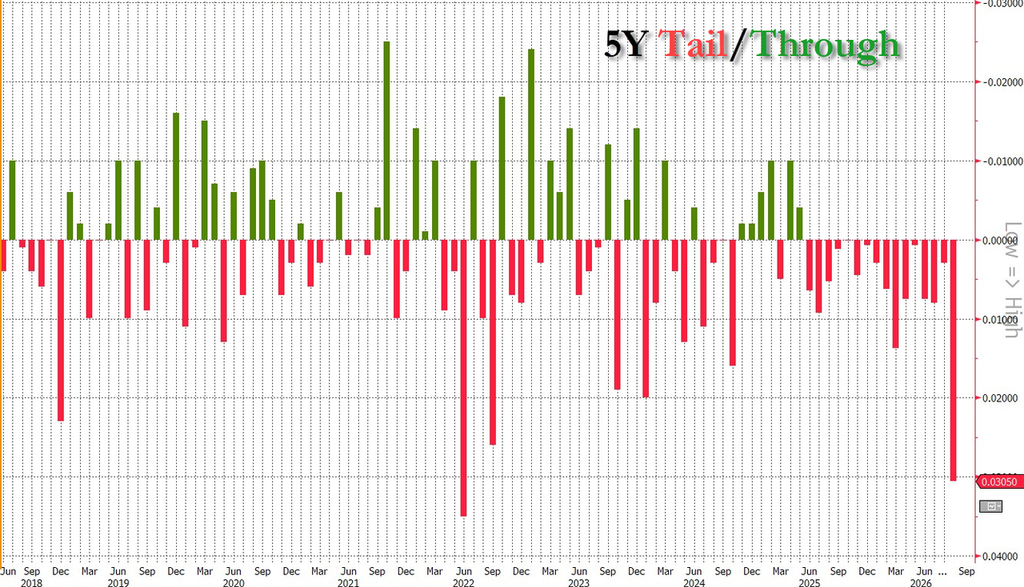
On Wednesday, September 23, 2026, the U.S. Treasury held an auction of $70 billion worth of five-year U.S. Treasuries. This auction was, to put it simply, catastrophic. The securities ultimately sold at a yield of 5.033%, which was the first five-year auction to be priced at more than 5% since 2007. In addition to this, the auction had a massive 3.1 basis-point tail, which makes it the second-largest tail for this particular Treasury tenor on record:
Source: Zero Hedge
In U.S. Treasury parlance, a tail means that the securities priced at a higher yield than was expected just before the auction. Convex Trade states:
“The auction tail measures the spread between the highest accepted yield and the pre-auction when-issued yield in a government bond auction, signaling the degree of market indigestion. A wide tail indicates weak demand and can trigger sharp selloffs in the broader rates market.”
As Wednesday’s five-year U.S. Treasury auction had the second-largest tail for any five-year auction in history, we can clearly conclude that there was very low demand among investors to lend money to the United States government for five years, even at a rate just north of 5%. Further evidence that demand for these securities was very low can be found in the bid-to-cover ratio, which came in at 2.212. That means that the total amount of U.S. dollar value of bids submitted was just 2.212 times the total amount of money that the U.S. government was trying to raise. This is considered a very low ratio, and it was the worst bid-to-cover ratio on record since December 2018.
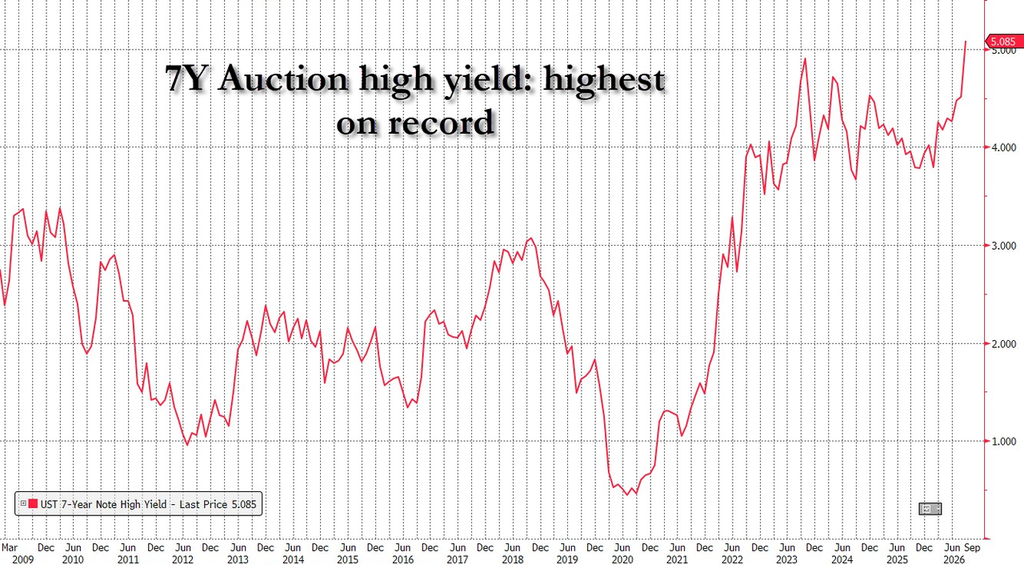
The next day, on September 24, 2026, the U.S. Treasury auctioned off $44 billion worth of seven-year U.S. Treasury securities. This auction was similarly terrible. The securities sold at a yield of 5.085%, which was the highest yield on record for seven-year U.S. Treasury notes:
Source: Zero Hedge
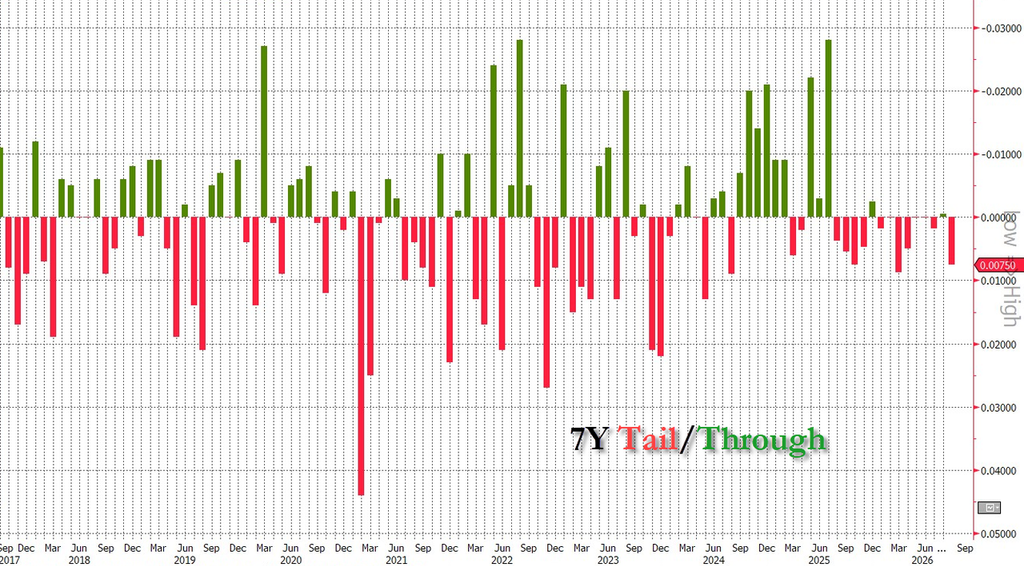
This auction also tailed, but the tail was not nearly as large as one that the five-year U.S. Treasury auction suffered the day before. In this case, the tail was only 0.7 basis points. While this was the largest tail since March 2026, it is far from the biggest tail on record:
Source: Zero Hedge
The demand from foreign investors was also especially bad during the seven-year auction. Foreign investors only purchased 57.2% of the U.S. Treasury securities on auction. That was the worst showing of 2026, and the last time that foreign interest was so low was in November 2025.
Rising Yields In The Bond Market
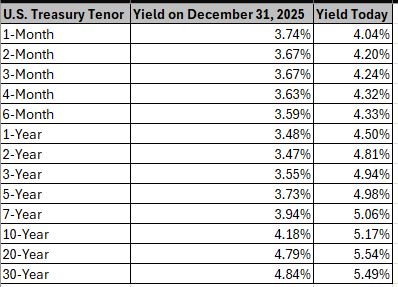
It is unlikely to be a surprise to anyone reading this that bond yields have been rising significantly since the start of the year. This table shows the yields of each of the different U.S. Treasury securities at the start of this year and today:
Source: Power Hedge
As we can clearly see, the yields of all U.S. Treasury yields have increased significantly since the start of 2026. However, the largest increases have occurred at the long-end of the yield curve. This is not particularly surprising since those securities carry the greatest risks. Admittedly, most investors would likely argue that U.S. Treasury securities are generally considered to be risk-free assets. However, there are still some risks that these securities possess, including the following:
Inflation Risk: Bonds have no inherent protection against inflation. As such, there is always a risk that inflation will reduce the purchasing power that the investor receives at maturity. If inflation is high enough, then there is a possibility of the bond actually delivering a negative return in real terms.
Interest Rate Risk: If interest rates rise, bond prices decline. The decline is greater for bonds with a long time until they mature than it is for bonds that mature relatively close to the present day. Due to this, there is a risk that the investor will lose money if they need to sell the bond before it matures.
Opportunity Cost: Due to the possibility of a bond’s price declining, an investor who owns the bond may not be able to make alternative investments without losing money. Thus, there is always the possibility that a better investment may come along that the investor will not be able to take advantage of.
Thus, the longer the bond’s term, the greater the investor’s risk. In order to compensate for this, investors usually demand a higher yield in exchange for tying their money up for a longer period of time. Thus, it makes a certain amount of sense that the longer-term notes and bonds would see their yields rise more than bonds that return the principal back fairly quickly.
At their core, bond prices and yields are a function of supply and demand. The more investors that want to buy a specific bond, the higher its price will rise and the more than its yield would drop. In addition, the U.S. Treasury auctions award securities to the investors who demanded the lowest yields first, and ultimately it prices at the lowest rate that actually gets the entire bond issuance sold. As we just saw, recent bond auctions are showing signs of weakening demand for U.S. Treasury securities. With that in mind, we can conclude that the demand weakness could be a major contributing factor to the rise in bond yields that we have seen all year.
The Need For Foreign Investors
As was just shown, foreign interest for U.S. Treasuries came in rather low in recent auctions. This was particularly noticeable in the seven-year U.S. Treasury auction, which saw foreign interest come in at the lowest level since November 2025. This is problematic due to the fact that the United States cannot finance the deficits solely through reliance on American investors.
Ultimately, all bonds are purchased with savings. An individual investor might put money into a bank savings account, only to have the bank turn around and purchase bonds. Alternatively, that individual investor may decide to purchase a bond with that portion of their money that they choose not to use for immediate consumption. The same thing applies to a business, which may purchase bonds using its profits if it does not have any better opportunities to invest in.
For the United States, the net national savings is approximately $2.2 trillion annually. This is the sum of all of the corporate profits generated by all American companies (minus the amount that gets paid out in dividends) and the total of the after-tax income of all American households minus consumption. This is the total amount of money that is theoretically available to purchase bonds, assuming that nobody invests in anything other bonds.
The U.S. fiscal deficit for the 2026 fiscal year is projected to come in at approximately $2.1 trillion, according to the Congressional Budget Office. Thus, if America were to try to finance its fiscal deficit without any foreign bond buying, it would take nearly all domestic savings to do so. There would only be $100 billion available for mortgages and other new lending. There would not be anywhere enough money available to finance the technology industry’s aggressive push to construct data centers all across the United States to power their artificial intelligence ambitions. It is essentially certain that interest rates would rise substantially as residential homebuyers and the technology industry compete against the U.S. government for access to a relatively small pool of available capital.
In other words, the United States needs foreign investors to purchase its U.S. Treasury securities. The apparent declining interest among these investors to purchase U.S. Treasuries is a problem that should not be ignored.
Conclusion
In conclusion, there are signs that foreign interest in investing in U.S. Treasuries has begun to decline. In 2011, foreigners owned approximately half of all marketable U.S. Treasury securities, but that figure is down to 30% today. Furthermore, recent Treasury auctions have been weak with muted foreign demand. This is problematic because the United States does not have the ability to finance its fiscal deficits internally without starving private businesses and consumers of capital. This could very easily be a contributing factor to the surge in bond yields that we have seen this year, and it could portend further weakness for bonds going forward.


Comments
Log in or sign up to join the conversation.