
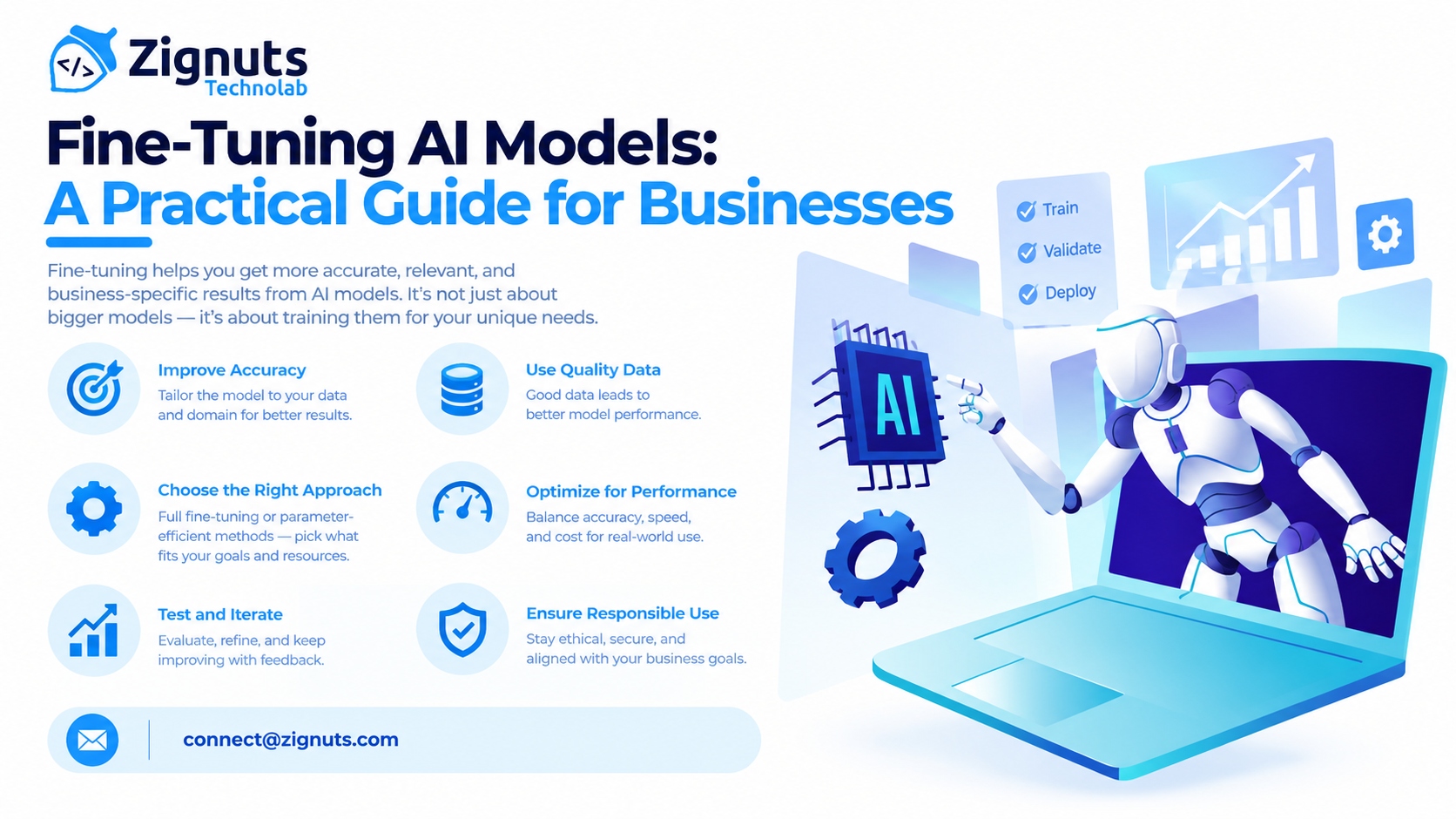
Artificial intelligence is moving from experimental projects into everyday business operations. Organizations now use AI for customer service, document processing, forecasting, workflow automation, content generation, and decision support. However, general-purpose models do not always understand an organization's terminology, processes, standards, or operational expectations. Fine Tuning AI Models can help businesses adapt existing models to specific tasks and improve how consistently they perform within defined environments.
Fine-tuning is not simply a technical upgrade. It is a business decision that requires clear objectives, reliable data, appropriate evaluation, and a realistic understanding of operational risks. A model may produce impressive results during a demonstration but fail when it encounters unusual inputs, incomplete information, changing requirements, or domain-specific language.
For business leaders, the goal should not be to fine-tune a model because the technology is available. The goal should be to determine whether model customization can solve a meaningful business problem more effectively than alternative approaches such as prompt engineering, retrieval-augmented generation, workflow automation, or conventional software development.
What Is Fine-Tuning AI Models?
Fine-tuning is a machine learning process in which a pretrained AI model receives additional training on a specialized dataset. The additional training is intended to adapt the model's behavior to a particular task, domain, format, or set of requirements.
Instead of building an AI model from the beginning, organizations use an existing foundation and customize it for a defined purpose. Depending on the model and training method, fine-tuning may be used for:
Text classification
Specialized language generation
Document categorization
Structured response generation
Industry-specific terminology
Image recognition
Speech or audio processing
Intent detection
Task-specific content transformation
The outcome depends on the quality of the original model, the training dataset, the fine-tuning method, and the evaluation process.
Fine-tuning does not automatically provide current knowledge, eliminate hallucinations, or guarantee that a model will make reliable decisions. It should be treated as one component of a broader AI system.
The Business Outlook for Fine-Tuning in 2027
Businesses are likely to continue exploring more specialized AI applications as they move beyond basic experimentation. Fine-tuning may become part of a broader model customization strategy that includes retrieval, tool integration, evaluation systems, and workflow controls.
The following table presents potential directions rather than guaranteed market outcomes or verified predictions.
Expected Direction in 2027 | Potential Business Development | Strategic Consideration |
|---|---|---|
More specialized AI workflows | Organizations may customize models for focused business tasks | Define a clear use case before investing in training |
Efficient customization methods | Teams may explore parameter-efficient approaches and smaller adapted models | Evaluate infrastructure requirements and ongoing operating costs |
Stronger evaluation practices | Businesses may create task-specific datasets and repeatable test procedures | Connect model performance to measurable business outcomes |
Hybrid AI architectures | Fine-tuned models may operate alongside retrieval systems, tools, and software rules | Design clear boundaries between model behavior and deterministic controls |
Greater governance requirements | Organizations may document model versions, datasets, and performance changes | Establish ownership, monitoring, and review procedures |
The practical value of these developments will depend on the use case, technical maturity, data quality, regulatory environment, and organizational ability to manage AI systems.
Why Businesses Consider Fine-Tuning
Organizations generally consider fine-tuning when an existing model does not meet the requirements of a specialized workflow. The problem may involve inconsistent outputs, incorrect classifications, unsuitable formatting, or difficulty following recurring task patterns.
1. Improving Task-Specific Performance
A general-purpose model may understand a broad subject but still struggle with a narrow business task. Fine-tuning can provide examples of the expected inputs, outputs, labels, and response structures.
For example, a company may need to categorize customer inquiries into predefined operational groups. A specialized training dataset can demonstrate how different types of requests should be classified.
2. Increasing Output Consistency
Businesses often require predictable output formats. A model may provide useful information but use different structures, labels, or levels of detail across responses.
Fine-tuning may help improve consistency when the training examples clearly demonstrate the required output behavior. However, structured schemas, validation rules, and application-level controls may still be necessary.
3. Supporting Domain-Specific Language
Industries use specialized terminology, abbreviations, and documentation standards. A model may need additional examples to handle these patterns effectively.
Fine-tuning can support domain-specific tasks, but it should not be used as the only method for maintaining changing facts or confidential business knowledge. Retrieval systems may be more appropriate when the application needs current or frequently updated information.
4. Reducing Repetitive Instructions
If a model repeatedly receives the same detailed instructions for a stable task, fine-tuning may help incorporate recurring patterns into its behavior.
This does not mean that every repeated prompt should lead to fine-tuning. Organizations should first determine whether the task is stable enough and whether the expected improvement justifies the cost and complexity.
Identifying the Right Fine-Tuning Use Case
A successful fine-tuning project begins with a well-defined business problem. Broad objectives such as “make the AI smarter” are difficult to measure and rarely provide sufficient direction for implementation.
A stronger objective might be:
Improve the classification of customer support requests.
Extract specific fields from industry documents.
Generate responses using a consistent internal format.
Identify predefined categories in product feedback.
Adapt a model to a specialized transcription or recognition task.
Reduce manual corrections in a repeatable workflow.
The task should have clear inputs, expected outputs, and evaluation criteria.
Before development begins, business and technical teams should document:
The current workflow
The existing solution
The source of performance problems
The expected improvement
The cost of incorrect outputs
The data available for training
The conditions required for deployment
This process helps determine whether fine-tuning is necessary and prevents teams from selecting a technical solution before understanding the business requirement.
Fine-Tuning Compared With Other Approaches
Fine-tuning is not always the most efficient way to improve an AI application. Different challenges require different solutions.
Prompt Engineering
Prompt engineering focuses on improving the instructions, context, examples, and output requirements provided to the model.
It may be suitable when:
The model already understands the task.
The problem is caused by unclear instructions.
Requirements change frequently.
The organization needs rapid experimentation.
The task does not justify additional training.
Prompt engineering is often a useful first step because it can be tested quickly and requires less infrastructure than model training.
Retrieval-Augmented Generation
Retrieval-augmented generation connects an AI model to external information sources. The system retrieves relevant content and provides it to the model during response generation.
RAG may be more suitable when the primary problem involves:
Access to internal documents
Frequently changing information
Product or policy knowledge
Current organizational procedures
Source-based responses
Fine-tuning changes model behavior, while retrieval provides additional information at runtime. Some business applications may benefit from combining both approaches.
Workflow Automation and Business Rules
Certain tasks require predictable decisions based on fixed conditions. In these situations, traditional software rules may be more reliable and easier to audit.
For example, a process involving strict approval thresholds, calculations, or access permissions should not depend solely on a generative model.
Fine-Tuning
Fine-tuning may be appropriate when the model needs to learn recurring task patterns, specialized response formats, or domain-specific behavior that cannot be adequately achieved through prompts or external context alone.
The decision should be based on measured requirements rather than assumptions about the technology.
The Fine-Tuning Implementation Process
A structured implementation process reduces technical uncertainty and helps teams connect model development with business outcomes.
Business Assessment → Baseline Testing → Data Preparation → Model Selection → Fine-Tuning Experiment → Evaluation → Controlled Deployment
Step 1: Establish the Business Objective
Define what the organization wants to improve. The objective should be specific enough to measure and relevant enough to justify the investment.
For example, a document processing team may want to improve the accuracy of extracting specific fields from a defined document type. A customer support team may want to improve the classification of incoming requests.
The objective should identify the expected result, not simply the technology being considered.
Step 2: Establish a Baseline
Evaluate the existing model or workflow before fine-tuning. The baseline may include a general-purpose AI model, a prompt-based system, a manual process, or a rules-based solution.
Useful baseline measurements may include:
Task accuracy
Error frequency
Processing time
Manual correction rate
Cost per task
Escalation frequency
Response consistency
Without a baseline, it becomes difficult to determine whether fine-tuning creates a meaningful improvement.
Step 3: Collect and Prepare Data
Training data should reflect the actual task and expected production inputs. Depending on the application, examples may include labeled text, input-output pairs, annotated images, categorized documents, or other structured records.
Data preparation may involve:
Removing duplicate examples
Correcting inaccurate labels
Standardizing formats
Reviewing inconsistent annotations
Removing irrelevant records
Protecting confidential information
Including difficult and uncommon cases
Separating training, validation, and testing datasets
The dataset should be reviewed by people who understand both the business process and the expected output.
Step 4: Select the Model and Training Method
The selected model should support the task, data type, deployment environment, and required performance level.
Decision factors may include:
Model capability
Fine-tuning support
Language and domain coverage
Training resource requirements
Inference costs
Response latency
Deployment options
Security requirements
Licensing and usage conditions
Integration with existing systems
Organizations should avoid selecting a model solely because it is popular or technically advanced. Suitability for the actual business task is more important.
Step 5: Run a Controlled Experiment
Fine-tuning should begin with a controlled experiment rather than immediate large-scale deployment. Teams can test different training configurations and compare their results against the baseline.
The experiment should document:
Dataset version
Model version
Training configuration
Evaluation method
Observed errors
Resource consumption
Performance changes
Controlled experiments make it easier to identify which changes contribute to improvement.
Step 6: Evaluate Generalization
A fine-tuned model should be tested on examples that were not used during training. This helps determine whether the model has learned general patterns or simply memorized the training data.
Testing should include:
Typical production inputs
Ambiguous requests
Unusual examples
Incomplete information
Edge cases
Incorrect or unexpected formats
Inputs from different business segments
A model that performs well on training examples but poorly on new inputs may not be suitable for deployment.
Building a Reliable Fine-Tuning Dataset
Data quality is one of the most important factors in a fine-tuning project. A model can learn patterns from the examples it receives, including patterns that the business does not intend to reinforce.
Use Relevant Examples
Examples should reflect the task and the environment in which the model will operate. Irrelevant data may introduce patterns that do not support the intended business outcome.
Maintain Consistent Labels
When examples are labeled differently for similar inputs, the model may learn conflicting behaviors. Labeling guidelines should be documented and reviewed.
Include Difficult Cases
A dataset containing only simple examples may not prepare the model for real-world variation. Difficult, ambiguous, and incomplete inputs should be included where relevant.
Review Data Coverage
The dataset should represent important categories, user groups, document types, languages, or operational conditions. Missing categories can lead to uneven performance.
Protect Sensitive Data
Organizations should identify confidential information and personal data before using records for training. Appropriate controls may include anonymization, restricted access, retention limits, and data minimization.
Track Dataset Versions
Dataset versions should be documented so teams can identify which examples were used for a particular model. This is especially important when performance changes or errors need to be investigated.
Business Applications of Fine-Tuning AI Models
Fine-tuning can support a range of business applications when the task is sufficiently defined and the expected outputs can be evaluated.
Business Function | Possible Application | Operational Consideration |
|---|---|---|
Customer support | Classify incoming requests or identify predefined intent categories | Validate classifications before automated routing |
Legal and compliance operations | Categorize documents or identify specific text patterns | Require appropriate review and avoid treating model output as legal advice |
Financial operations | Organize records or classify recurring transaction descriptions | Use validation and controls for sensitive financial workflows |
Healthcare technology | Process specialized terminology in approved workflows | Protect sensitive information and maintain professional oversight |
Human resources | Categorize internal requests or organize policy-related inquiries | Review for bias, privacy concerns, and inappropriate automated decisions |
Manufacturing | Support selected visual inspection or document classification tasks | Test performance across equipment, conditions, and product variations |
The level of automation should reflect the consequences of errors. High-impact applications may require human approval, audit logs, fallback processes, and strict access controls.
Evaluating Fine-Tuned Model Performance
Model evaluation should be aligned with the business task. A single metric is rarely sufficient for every application.
Classification Performance
For classification systems, teams may evaluate:
Accuracy
Precision
Recall
F1 score
Confusion matrices
Error rates by category
The appropriate metric depends on the business impact of different errors. In some workflows, missing an important category may be more serious than incorrectly assigning a low-risk category.
Generation Quality
For generative applications, evaluation may consider:
Relevance
Completeness
Factual support
Instruction adherence
Output structure
Consistency
Tone
Human reviewer feedback
Automated evaluation can support the process, but human review may be needed for complex or high-impact tasks.
Extraction Quality
Document extraction systems can be evaluated by comparing generated fields with verified reference values. Teams should separately track missing fields, incorrect values, formatting errors, and unnecessary content.
Operational Performance
Technical quality should be evaluated alongside business performance. Relevant measures may include processing time, cost per task, manual review requirements, and system availability.
An improvement in model accuracy may not justify deployment if it creates excessive latency or operating costs.
Common Challenges in Fine-Tuning AI Models
Overfitting
Overfitting occurs when a model performs well on training data but struggles with unfamiliar examples. This can reduce the usefulness of the model in real-world settings.
Separate validation and testing datasets, representative examples, and careful evaluation can help identify this problem.
Inconsistent Training Data
If the dataset contains conflicting labels or unclear examples, the model may learn unreliable patterns. Data review should be treated as a core project activity rather than a one-time technical task.
Limited Data Availability
Some organizations may not have enough high-quality examples for a specific task. In these situations, teams may need to improve data collection, use synthetic examples cautiously, apply transfer learning methods, or consider alternatives to fine-tuning.
Model Drift
Business processes, customer language, and operating conditions can change over time. A model that performs well during initial deployment may require ongoing monitoring and updates.
Hallucinations
Fine-tuning does not guarantee that a model will only generate factual or supported information. Retrieval, validation, source attribution, and human review may be required depending on the application.
Cost and Infrastructure
Fine-tuning can involve expenses related to data preparation, experimentation, compute resources, model hosting, monitoring, and maintenance. The total cost should be assessed before implementation.
Security and Privacy Risks
Training datasets and model interfaces may expose sensitive information if they are not managed properly. Security controls should cover data access, training infrastructure, deployment environments, and application integrations.
Executive Decision-Making Questions
Business leaders should ask practical questions before approving a fine-tuning project.
What problem will fine-tuning solve?
The team should clearly explain the current limitation and why fine-tuning is being considered. A technical objective without a business purpose may not justify the investment.
What alternatives have been tested?
Prompt engineering, retrieval, workflow changes, and traditional software rules should be considered where appropriate. Comparing alternatives helps prevent unnecessary model customization.
Do we have enough reliable data?
The organization should assess the quality, volume, relevance, and ownership of available training examples.
How will success be measured?
Success criteria should include technical and operational metrics. The organization should define the minimum improvement required before deployment.
What are the consequences of errors?
The level of oversight should reflect the risk of incorrect outputs. Sensitive applications may require human approval and additional controls.
Who owns the model after deployment?
Ownership should cover monitoring, updates, dataset management, incident response, access permissions, and performance reviews.
How will the system scale?
Leaders should understand how training, inference, storage, monitoring, and integration costs may change as usage increases.
A Practical Roadmap for Businesses
Phase 1: Business and Technical Discovery
Identify the workflow, business problem, users, data sources, existing technology, and expected outcomes.
Phase 2: Baseline Measurement
Test the current system and document its strengths, weaknesses, operating costs, and error patterns.
Phase 3: Data Preparation
Create a reliable dataset with defined labeling standards, quality checks, privacy controls, and version tracking.
Phase 4: Model and Method Selection
Compare suitable models and fine-tuning approaches based on performance, cost, security, integration, and deployment requirements.
Phase 5: Prototype Development
Run a controlled experiment and compare the results with the baseline. Record both improvements and unexpected behavior.
Phase 6: Pilot Deployment
Test the model with a limited user group or controlled workflow. Monitor performance and collect feedback from operational teams.
Phase 7: Production Governance
Establish model monitoring, version management, security controls, review procedures, rollback plans, and periodic evaluation.
This phased approach allows organizations to learn before committing to a large-scale deployment.
Measuring Long-Term Business Value
A fine-tuned model should be assessed based on the value it creates for the organization. Technical performance is important, but it should support a measurable operational objective.
Businesses may track:
Reduction in manual processing
Improved classification consistency
Lower correction rates
Faster task completion
Reduced escalation volume
Cost per completed workflow
User satisfaction
Compliance with output standards
Quality of customer interactions
The evaluation period should be long enough to capture different input types and operating conditions. Initial results may not reflect long-term performance.
Organizations should also consider whether the solution remains practical as data, usage volume, and business requirements change.
Fine-Tuning and Enterprise AI Strategy
Fine-tuning should be considered within the broader architecture of an enterprise AI system. It is rarely sufficient to address every requirement on its own.
A complete AI solution may include:
A foundation model
A fine-tuned model or specialized adapter
Retrieval systems
Business APIs
Data processing pipelines
Validation rules
Identity and access controls
Monitoring systems
Human review processes
Audit and reporting mechanisms
Clear responsibilities should be assigned to each component. For example, the model may generate a classification, while software rules determine whether the classification can trigger an automated action.
This separation can improve transparency and reduce the risk of allowing uncertain model outputs to control sensitive business processes without review.
Future Considerations for Businesses
As AI systems become more specialized, businesses may adopt a combination of general-purpose models, smaller task-specific models, retrieval systems, and deterministic software components.
This approach may provide flexibility, but it can also increase architectural complexity. Organizations will need to manage multiple model versions, evaluation procedures, security requirements, and operational dependencies.
Future AI strategies should focus on measurable performance rather than model customization alone. A fine-tuned model is valuable when it solves a defined problem, operates reliably, and creates an acceptable business outcome.
Leaders should also plan for continuous improvement. Data distributions change, user expectations evolve, and business processes are updated. Monitoring and periodic reassessment are therefore important parts of the AI lifecycle.
Conclusion
Fine-tuning AI models can help businesses adapt pretrained systems to specialized tasks, domain-specific language, structured outputs, and recurring workflows. However, successful implementation depends on much more than additional training. Reliable data, clear objectives, appropriate model selection, rigorous testing, and effective governance are equally important.
Organizations should first understand the source of their AI performance problems and compare fine-tuning with alternatives such as prompt engineering, retrieval-augmented generation, and traditional software rules. This prevents unnecessary complexity and helps teams select an approach that matches the business requirement.
For business leaders, the practical path to AI customization begins with a measurable use case, a strong baseline, carefully prepared data, controlled experimentation, and continuous monitoring. When these elements are combined, fine-tuning can become part of a broader strategy for building more consistent, specialized, and operationally useful AI systems.
Frequently Asked Questions
1. What does fine-tuning AI models mean?
Fine-tuning AI models means adapting a pretrained model with additional task-specific or domain-specific training data. The objective is to improve performance for a defined application or workflow.
2. Is fine-tuning suitable for every AI application?
No. Fine-tuning may not be necessary when the problem can be solved through better prompts, retrieval, software rules, or improved data integration. The best approach depends on the task and business requirements.
3. How much data is required for fine-tuning?
The required amount of data depends on the model, task complexity, data quality, and training method. High-quality and representative examples are generally more useful than a large collection of inconsistent data.
4. Can fine-tuning eliminate AI hallucinations?
Fine-tuning does not guarantee the elimination of hallucinations. Retrieval, validation, source-based generation, structured outputs, and human review may be required to reduce the risk of unsupported responses.
5. How do businesses measure the success of fine-tuning?
Success can be measured through task-specific metrics such as accuracy, precision, recall, consistency, processing time, correction rates, operating cost, and user feedback.
6. What are the main risks of fine-tuning AI models?
Common risks include overfitting, poor-quality training data, biased outputs, model drift, privacy concerns, infrastructure costs, and insufficient generalization to unfamiliar inputs.
7. How can organizations maintain a fine-tuned model?
Maintenance may include performance monitoring, dataset updates, model version control, periodic evaluation, security reviews, retraining, and defined processes for handling errors or rolling back changes.
Comments
Log in or sign up to join the conversation.