
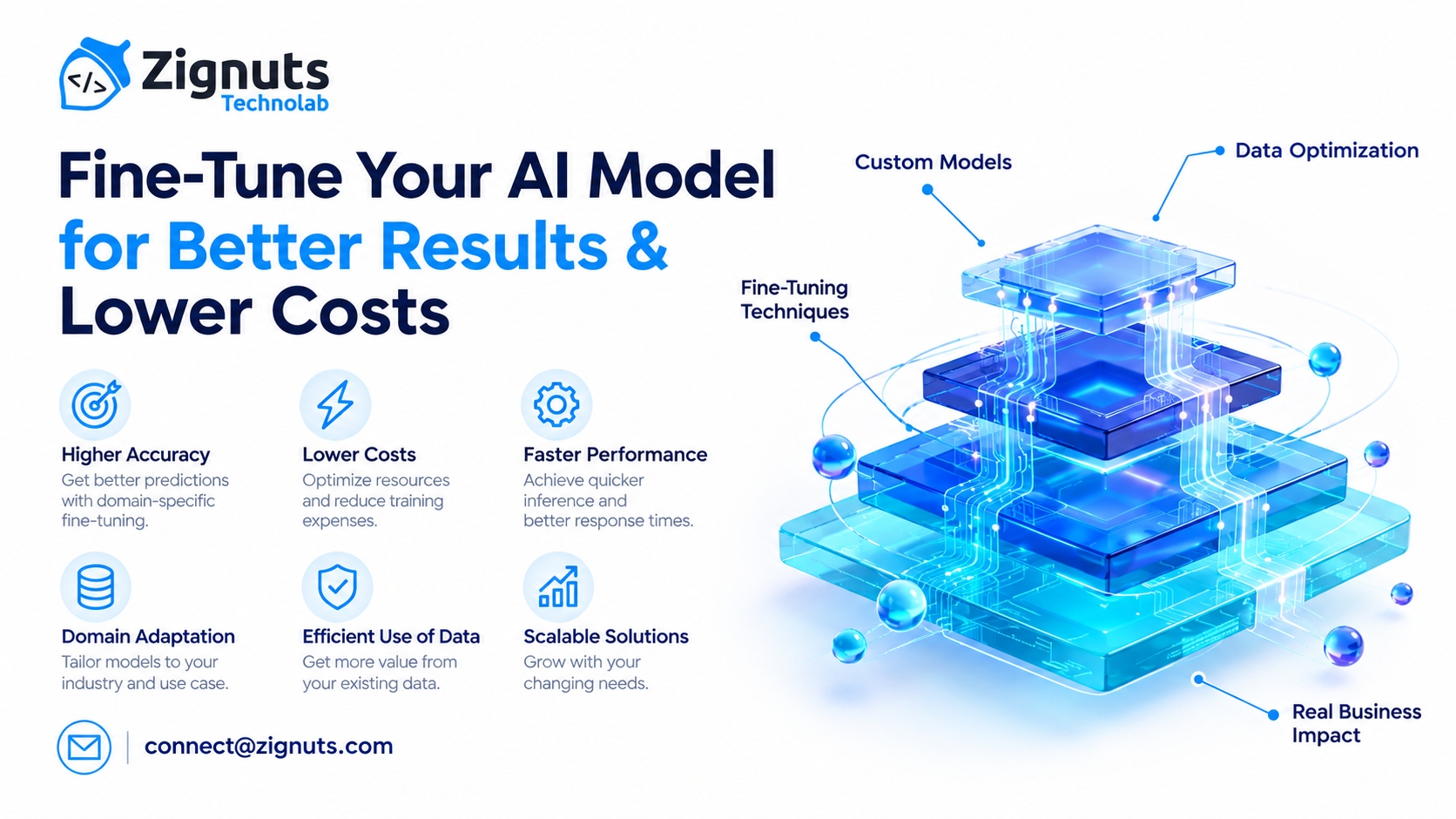
Many businesses discover that simply using a more powerful AI model does not always produce better results. Larger models can increase operating costs while still generating inconsistent outputs for specialized tasks. The smarter question is whether organizations can Fine-Tune Your AI Model to improve task-specific performance without continuously relying on expensive, broad-purpose capabilities. For companies moving AI from experimentation into production, specialization can become an important lever for both performance and cost control.
2027 Insight | Business Impact | What Leaders Should Do |
|---|---|---|
Task-specific models will gain wider adoption | Businesses may reduce dependence on oversized models | Match model capability to actual workload requirements |
AI cost optimization will become an executive priority | Inference and infrastructure costs can affect scalability | Track total AI lifecycle costs, not just development costs |
Model specialization will improve production reliability | Consistent outputs can reduce manual correction effort | Evaluate models against real operational scenarios |
Hybrid AI architectures will become more common | One AI technique may not solve every business need | Combine fine-tuning, retrieval, and automation strategically |
The financial conversation around AI is changing. Early experimentation often focused on what large language models could do. Production environments require a different perspective: what should the model do, how reliably can it do it, and what will it cost to operate at scale? Businesses exploring Fine-Tuning Services are increasingly looking for answers to these questions as they seek a better balance between model capability and economic efficiency.
Why Bigger AI Models Are Not Always Better for Business
A larger model can offer impressive general capabilities. However, general capability comes with trade-offs.
Businesses may encounter challenges such as:
Higher inference costs
Longer processing times
Complex prompting requirements
Inconsistent responses
Unnecessary computational capacity
Difficult scaling economics
Consider a company using AI to classify customer requests. It may not need a model capable of writing a detailed essay, analyzing poetry, or answering broad historical questions. It needs a system that accurately classifies a defined set of requests.
Using the most powerful available model for every task may be inefficient.
This is where model specialization becomes strategically important.
The goal is not always to maximize intelligence. The goal is to optimize performance for the business problem being solved.
What Happens When You Fine-Tune Your AI Model?
Fine-tuning adapts a pre-trained model using examples relevant to a particular task, domain, or expected behavior.
Instead of repeatedly instructing a general-purpose model how to perform the same task, organizations can customize the model around recurring requirements.
Fine-tuning can potentially help improve:
Task Accuracy
A model can be adapted to better recognize patterns relevant to a specialized workflow.
Output Consistency
Businesses often require predictable formats and responses.
Customization can help reduce variation for recurring tasks.
Domain Relevance
Models can be adapted around industry terminology and specialized language patterns.
Operational Efficiency
A more focused model may reduce the complexity of prompts and workflows required to achieve acceptable results.
However, fine-tuning should not be viewed as a guaranteed solution. The value depends on the quality of data, suitability of the use case, evaluation process, and architecture surrounding the model.
Performance and Cost Must Be Evaluated Together
One of the most common mistakes in AI strategy is evaluating performance without considering economics.
A model that produces excellent results may still be unsuitable if operating costs prevent the business from scaling the solution.
Similarly, a low-cost model may create hidden expenses if employees spend substantial time correcting its outputs.
The real objective is to find the right balance.
A useful business equation is:
Business Requirement → Right-Sized Model → Specialized Performance → Efficient Operations → Measurable ROI
This left-to-right process highlights why model selection should begin with the business requirement.
If leaders start by choosing the largest available model, they may end up designing the use case around the technology rather than selecting technology based on the use case.
Where Fine-Tuning Can Improve AI Economics
High-Volume Repetitive Tasks
AI costs become more significant when a task is performed thousands or millions of times.
Examples include:
Ticket classification
Document categorization
Content tagging
Data extraction
Customer query routing
Sentiment analysis
If a specialized model can perform these tasks effectively, businesses may have opportunities to optimize the cost of serving high-volume workloads.
Reduced Prompt Complexity
General-purpose models sometimes require long and detailed instructions to maintain consistent behavior.
A customized model may require less repetitive instruction for the specific task it was designed to perform.
This can simplify implementation and potentially improve workflow efficiency.
Better Resource Allocation
Organizations do not need to use the same model for every workload.
A mature AI architecture may route different tasks to different models based on complexity and business importance.
For example:
Smaller models for simple classification
Specialized models for domain-specific tasks
Larger models for complex reasoning
Retrieval systems for current information
This approach can improve resource allocation across the AI ecosystem.
Product-Level Scalability
For SaaS companies, AI operating costs can directly affect product margins.
A feature that works well for one hundred users may become expensive when used by one million.
Model optimization and specialization therefore become product and financial decisions, not only engineering decisions.
Fine-Tuning Versus Other Cost Optimization Approaches
Fine-tuning is one option, but businesses should evaluate multiple approaches before committing resources.
Optimization Challenge | Potential Solution | Business Consideration |
|---|---|---|
Repeated use of expensive models | Right-size the model | Match capability to task complexity |
Long repetitive prompts | Fine-tuning | Evaluate consistency and training effort |
Frequently changing information | Retrieval systems | Avoid repeatedly training changing knowledge |
Multi-step manual processes | Workflow automation | Focus on end-to-end efficiency |
Unpredictable AI spending | Usage monitoring | Track workload and infrastructure costs |
The strongest solution may involve several techniques working together.
For example, an organization may fine-tune a model for classification, use retrieval for internal knowledge access, and reserve a larger model for complex analytical tasks.
This prevents the common mistake of applying one expensive AI architecture to every problem.
Business Use Cases Where Specialization Matters
Customer Service
Customer support teams handle many recurring requests.
A specialized model can potentially assist with:
Ticket categorization
Initial response drafting
Conversation summarization
Intent detection
Escalation identification
The business benefit depends on whether the system reduces handling time while maintaining appropriate quality standards.
Financial and Administrative Operations
Organizations process repetitive documents and structured information.
AI may support extraction, classification, validation, and summarization tasks.
A model adapted to a narrow workflow may perform more consistently than a broad model repeatedly prompted to follow complex instructions.
Manufacturing and Technical Operations
Technical businesses often work with specialized terminology and documentation.
Customized AI can support knowledge-intensive tasks where general models lack familiarity with company-specific language and processes.
SaaS Product Features
Software companies can use specialized models to create AI-powered features aligned with specific user needs.
The economic advantage comes from evaluating which model provides sufficient performance at a sustainable cost.
A product does not always need maximum AI capability. It needs capability appropriate to the user experience.
How Leaders Should Decide Whether to Fine-Tune
Fine-tuning should be treated as an investment decision.
Before proceeding, executives and founders should evaluate several questions.
Is the Task Repetitive?
Fine-tuning can be more valuable when the organization repeatedly performs a similar task.
A one-time or highly variable request may not justify customization.
Is There a Measurable Performance Gap?
Identify what the current AI approach is failing to achieve.
Examples include:
Inconsistent classification
Excessive employee corrections
High processing costs
Poor domain understanding
Unreliable formatting
A clearly defined gap makes it easier to measure improvement.
Is Suitable Data Available?
The organization needs relevant examples representing the task it wants the model to perform.
Data quality matters more than simply collecting large volumes of information.
Can a Simpler Approach Solve the Problem?
Prompt engineering, retrieval, or workflow design may sometimes provide sufficient improvement without fine-tuning.
Businesses should test alternatives.
What Is the Total Cost of Ownership?
Training is only one expense.
Leaders should consider:
Data preparation
Training
Evaluation
Integration
Infrastructure
Monitoring
Maintenance
Security
The correct decision should be based on total business economics.
A Practical Plan to Improve AI Performance and Control Costs
Step 1: Audit Current AI Usage
Understand where AI is being used and which workloads generate the highest costs.
Look for repeated tasks that consume significant resources.
Step 2: Categorize Workloads by Complexity
Not every task needs the same model.
Group workloads into simple, specialized, and highly complex categories.
Step 3: Establish Performance Baselines
Measure current accuracy, processing time, employee intervention, and operating costs.
Without a baseline, it is difficult to demonstrate improvement.
Step 4: Test the Simplest Viable Solution
Evaluate prompting, retrieval, automation, and fine-tuning based on the actual requirement.
Avoid selecting a complex architecture before understanding the problem.
Step 5: Run a Focused Fine-Tuning Pilot
If customization appears justified, begin with one high-value use case.
Use representative data and realistic evaluation scenarios.
Step 6: Measure Cost Against Performance
Compare the specialized solution with the existing approach.
Consider both direct AI costs and indirect operational costs.
Step 7: Scale Selectively
Expand successful implementations while continuously monitoring usage and performance.
The goal should be efficient growth rather than applying the same model architecture everywhere.
Risks and Challenges to Consider
Fine-tuning can improve business performance, but it introduces additional responsibilities.
Poor Data Quality
Low-quality or inconsistent training examples can negatively influence model behavior.
Organizations should establish processes for data review and validation.
Training Without Clear ROI
Customization can become expensive when there is no measurable business objective.
Every project should have defined success criteria.
Over-Specialization
A model optimized too narrowly may struggle when workflows change.
Testing should include realistic variation and edge cases.
Hidden Operational Costs
Integration, monitoring, maintenance, and security can represent significant ongoing expenses.
Businesses should avoid focusing only on initial training costs.
Security and Privacy
Sensitive information requires appropriate data governance throughout the model lifecycle.
Access controls and vendor responsibilities should be clearly defined.
Employee Adoption
AI cost savings may not materialize if employees do not trust the system or continue performing the same tasks manually.
Workflow redesign and change management are important.
Preparing for a More Efficient AI Future
By 2027, AI investment decisions may increasingly focus on efficiency rather than raw capability.
As access to powerful foundation models expands, businesses will have more choices.
This means the ability to select and optimize the right model for each task may become a competitive advantage.
The future AI stack may include:
Large models for complex reasoning
Fine-tuned models for specialized tasks
Smaller models for high-volume processes
Retrieval systems for dynamic knowledge
Automated workflows connecting AI with business applications
This architecture allows organizations to think of AI as a portfolio of capabilities rather than a single technology purchase.
For executives, this creates a more disciplined approach to AI spending.
The objective is not to deploy the largest possible model. It is to build an AI environment where capability, reliability, and cost are aligned with business priorities.
Conclusion
The decision to Fine-Tune Your AI Model should be driven by a practical question: can specialization produce better business results at a sustainable cost?
For repetitive and domain-specific workloads, fine-tuning may improve consistency, relevance, and operational efficiency. It can also help organizations avoid using broad and expensive models for tasks that require focused capabilities.
However, fine-tuning is not automatically the lowest-cost or most effective option. Businesses should compare it with retrieval, prompt optimization, automation, and other architectural approaches.
The strongest AI strategies begin with the business problem, establish clear performance and cost baselines, and select technology based on measurable requirements.
As AI adoption matures, efficiency will become as important as intelligence. Organizations that understand how to match the right model to the right task will be better positioned to improve performance while maintaining control over the economics of AI at scale.
FAQs
1. Why should businesses fine-tune an AI model?
Businesses may fine-tune AI models to improve performance for specialized tasks, domain-specific workflows, or recurring requirements where general models produce inconsistent results.
2. Can fine-tuning reduce AI costs?
In some cases, a specialized model can improve efficiency for focused workloads. Actual savings depend on model selection, usage volume, infrastructure, and lifecycle costs.
3. Is a larger AI model always better?
No. Larger models may provide broader capabilities, but smaller or specialized models can be more appropriate for narrowly defined business tasks.
4. What is the difference between fine-tuning and prompt engineering?
Prompt engineering guides a model through instructions at inference time, while fine-tuning adapts model behavior using additional training examples.
5. When is fine-tuning worth the investment?
Fine-tuning may be worthwhile when a high-value, repetitive task requires specialized performance and simpler approaches cannot achieve the required level of consistency.
6. How should businesses measure AI cost efficiency?
Businesses should measure direct model costs alongside employee time, correction effort, processing speed, infrastructure expenses, and the overall business outcome.
7. What should executives evaluate before fine-tuning?
Executives should evaluate the business problem, data quality, expected ROI, alternative approaches, total cost of ownership, integration requirements, security, and scalability.
Comments
Log in or sign up to join the conversation.