

Summary: The near-term tape is still bullish, and we’re still long. Breadth is holding, financials just flashed a rare thrust, and the S&P is coiling in a way that more often breaks higher. We don’t argue with price.
Look further out and the picture darkens. Positioning, sentiment, and liquidity are all stretched to levels that have rarely rewarded the crowd. Cash is near record lows, leverage near record highs, and everyone’s crowded into the same comfortable story.
So we play both horizons: long the trend until breadth breaks, while sizing for the reversion the intermediate evidence keeps pointing toward. Two surprises this week — financials gave a rare bullish signal, and our Market-Implied Regime indicator flipped to something we didn’t expect. More on both below.
MO Portfolio & Trades
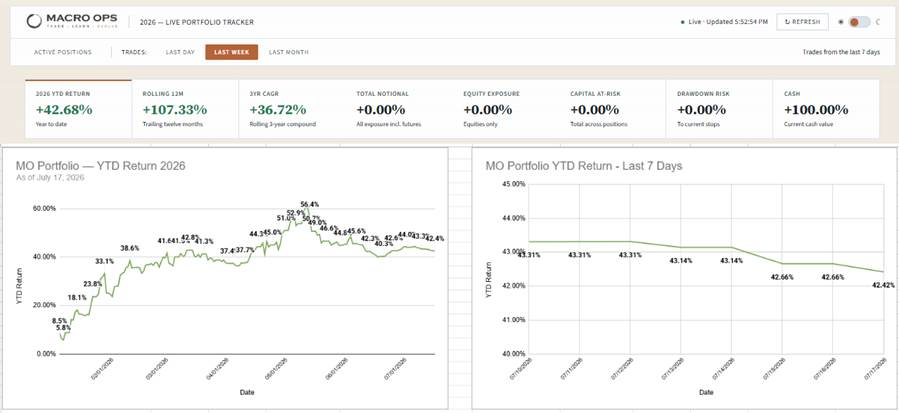
1. The portfolio gave back 70 basis points last week, leaving us +42.5% on the year and below our high-water mark of +61%. We recently reset to mostly cash. From here we expect to rebuild exposure in biotech (XBI, ARKG, and select names), cybersecurity, energy and crude, and a narrow set of the Mag7 (META, NVDA).
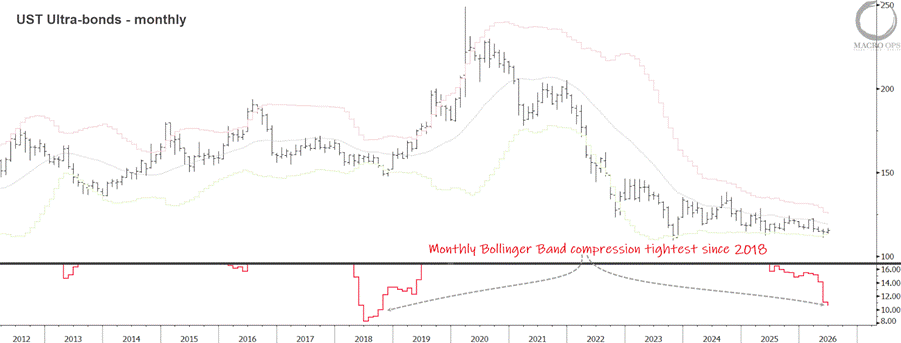
2. Bonds are compressing. Bollinger width on the monthly is its narrowest since 2018. Compression regimes are reliable in exactly one respect: they precede large moves. They say nothing about direction. Our bias is that this one resolves lower.
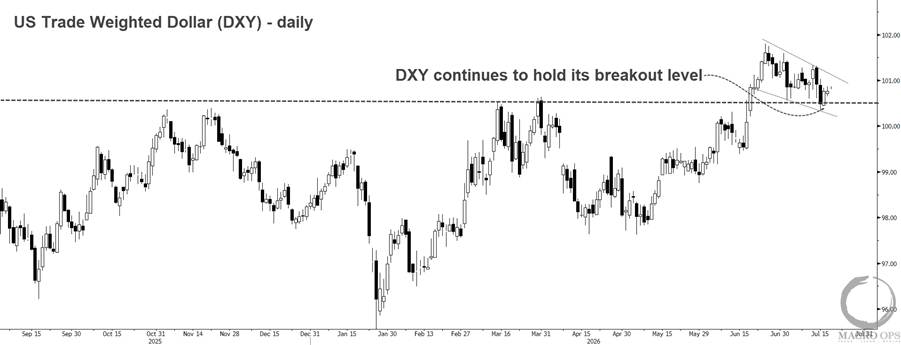
3. The dollar is testing its own line. DXY is dancing on the level it recently broke, now acting as support. Whether it holds there or fails will set the tone for macro over the coming months. We’re watching for follow-through, or a bull trap.
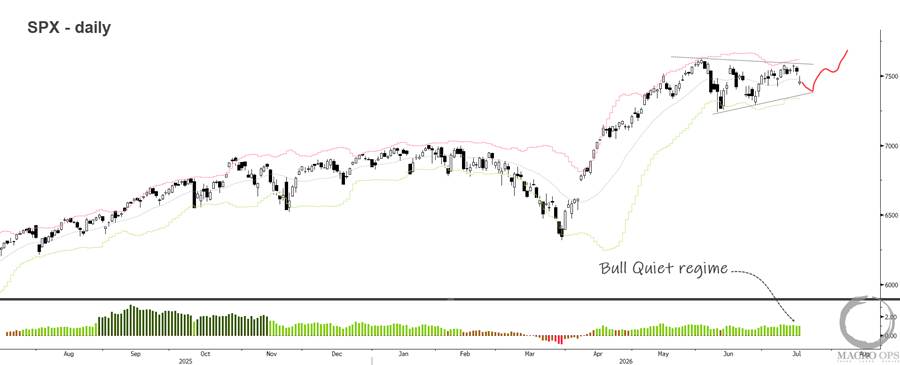
4.The S&P continues to coil. Our base case remains an eventual break higher. Near term, renewed US–Iran tension and firmer oil argue for some potential downside first.
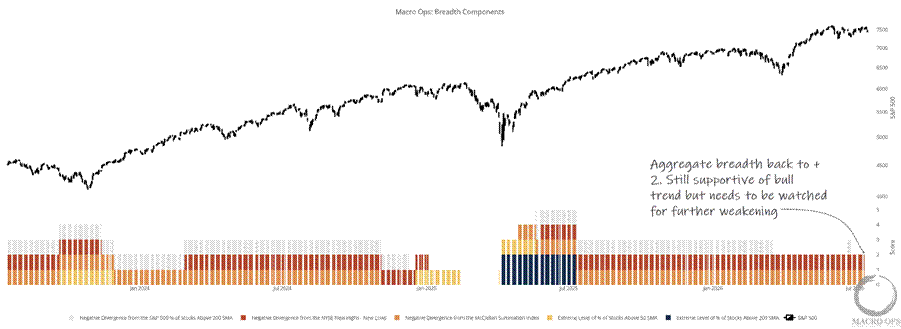
5. Breadth eased but held. Our Aggregate Breadth Indicator slipped to +2, still consistent with the prevailing uptrend. A move to +1 or below would, on our history, raise the odds of a 7%-plus correction materially.
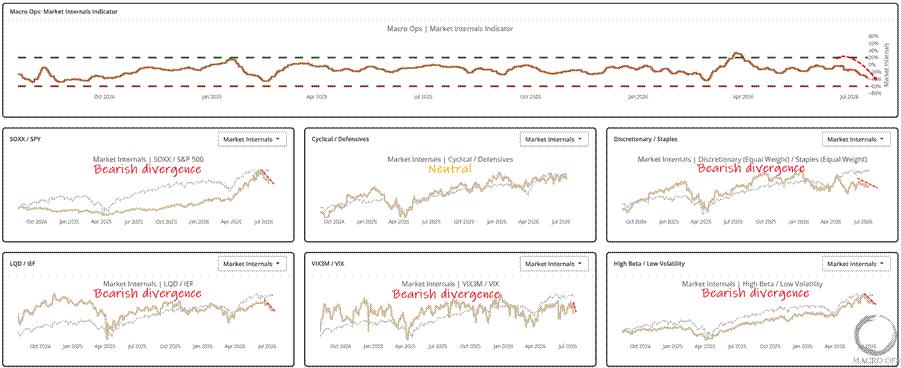
6. Internals are deteriorating. The key market internals are moving the wrong way. If the picture doesn’t stabilize soon, our one-to-three-month outlook turns decidedly more cautious.
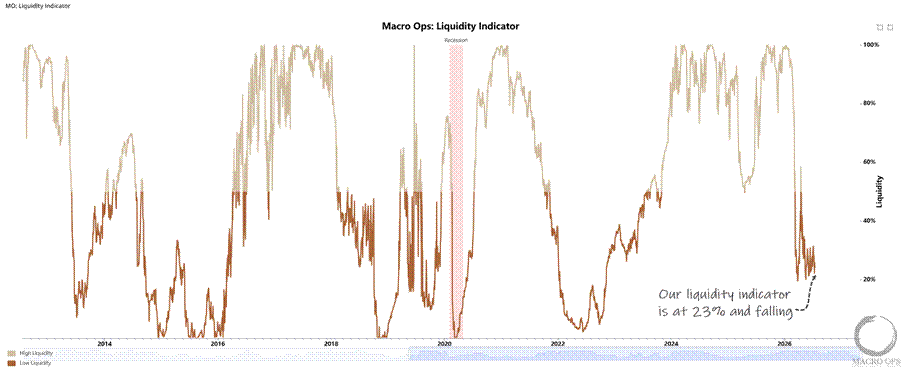
7. Liquidity keeps grinding lower. Our Liquidity Gauge continues to trend down, which adds weight to the intermediate-to-longer-term caution.
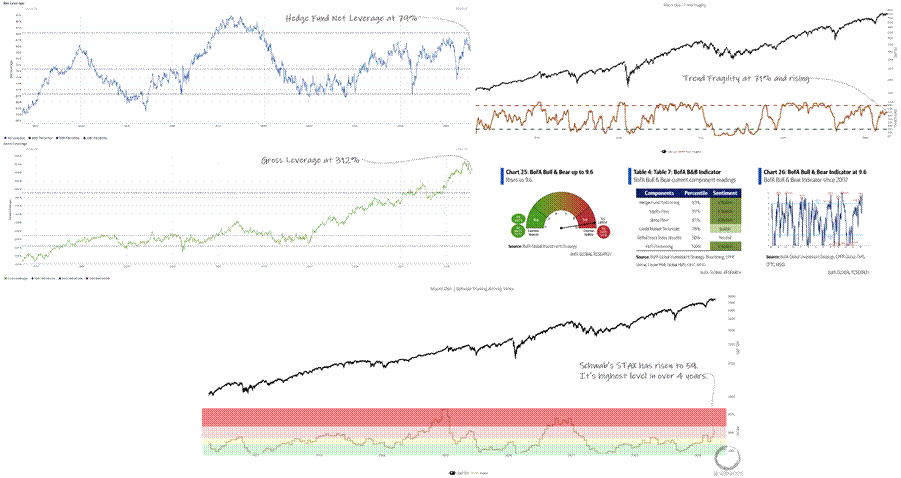
8. Positioning and sentiment are stretched, especially on longer horizons. Hedge-fund net leverage sits at 79%, just off four-year highs; gross leverage near 312%, close to a record. BofA’s Bull/Bear gauge is at 9.6, its highest in more than five years. Schwab’s STAX, which tracks actual retail flows and positioning, has jumped to 59, a four-year high. Our own Trend Fragility measure is at 71% and rising. None of these are a timing signal. But together they describe a market with little cushion.
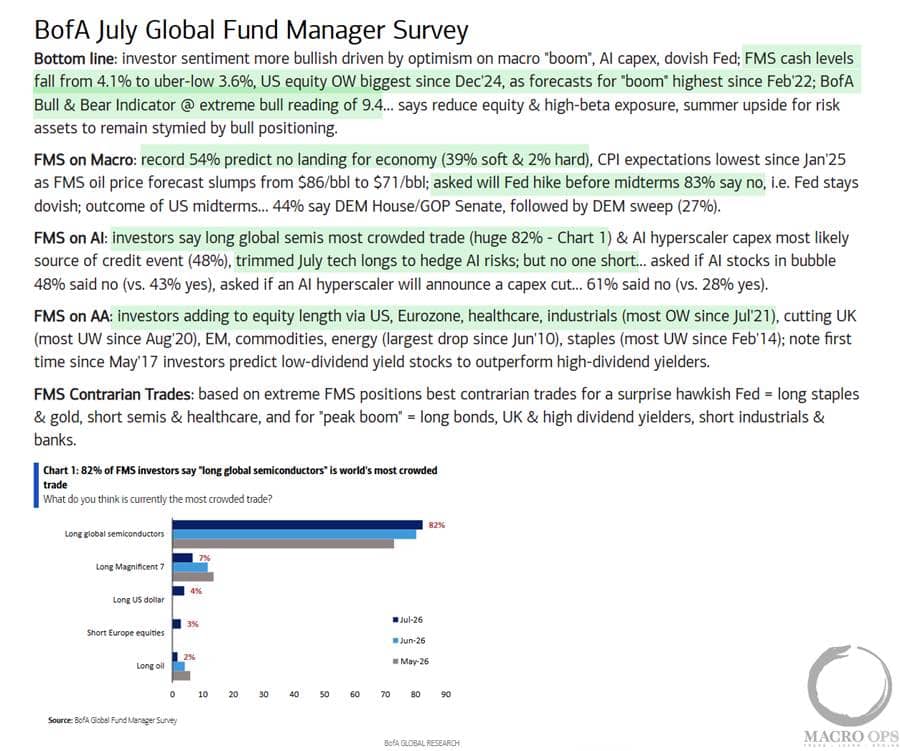
9. The latest FMS tells the same story. BofA’s July Global Fund Manager Survey shows cash down to an “uber-low” 3.6%, managers their most overweight US equities since December 2024, the highest “boom” expectations since February 2022, and a record 54% now forecasting no landing. Consensus has rarely been this comfortable.
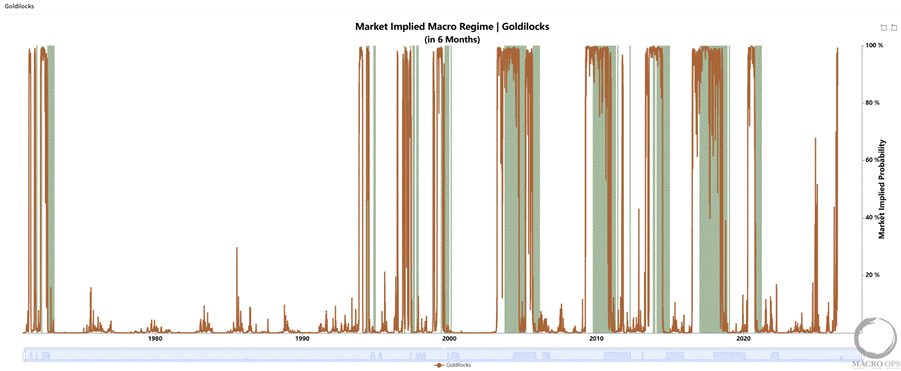
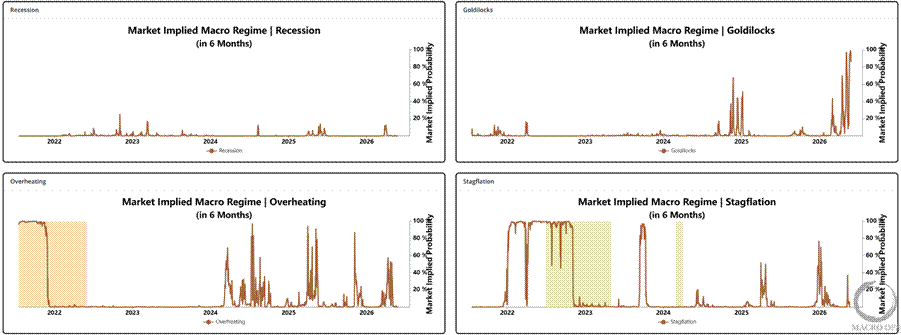
10. One model disagrees with us, and we’re listening. Nearly all of our work points to higher rates once the current one-to-two-month lull in inflation passes. One reading though cuts the other way. Last month our Market-Implied Macro Regime indicator flipped to a 100% Goldilocks signal, meaning low, positive growth alongside low and falling inflation. The indicator has a strong record predicting the regime six months out. It isn’t our base case. But a model with a good hit rate contradicting your priors is exactly the kind of evidence to sit with rather than wave off.
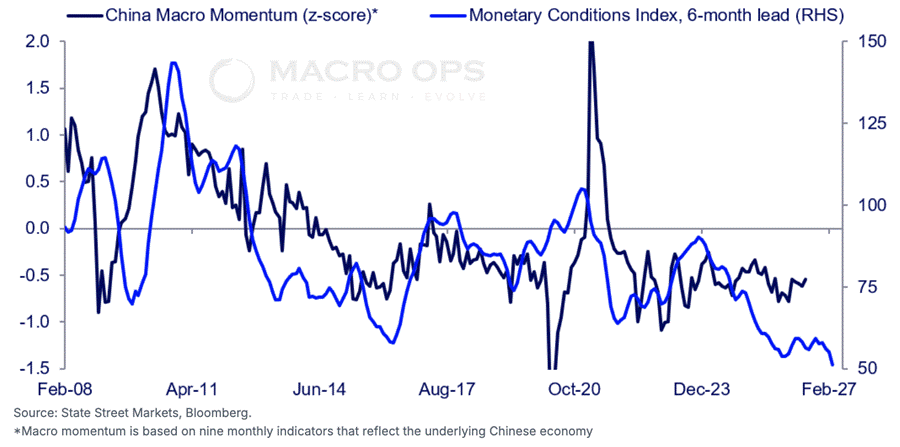
11. China is still deleveraging, and commodities don’t seem to care. State Street’s China Monetary Conditions Index keeps making new all-time lows, and it tends to lead macro momentum. What’s telling is how well commodities have held up regardless. Copper is near record highs through a long, deep Chinese deleveraging. The global growth and inflation picture changes materially the day China restarts its growth engine.
12. We still like precious metals, and we think we’re early. For now we’re waiting out the correction, which is a rates story. Until bonds find a durable floor, we stay on the sidelines here.
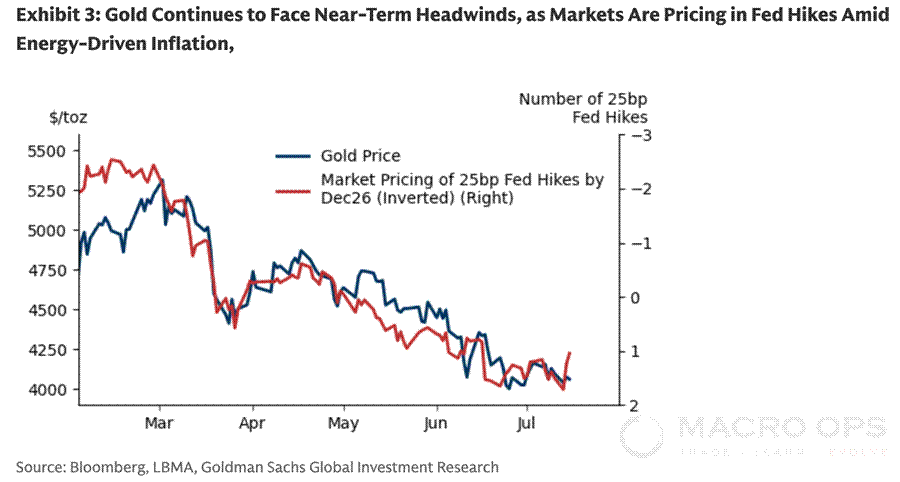
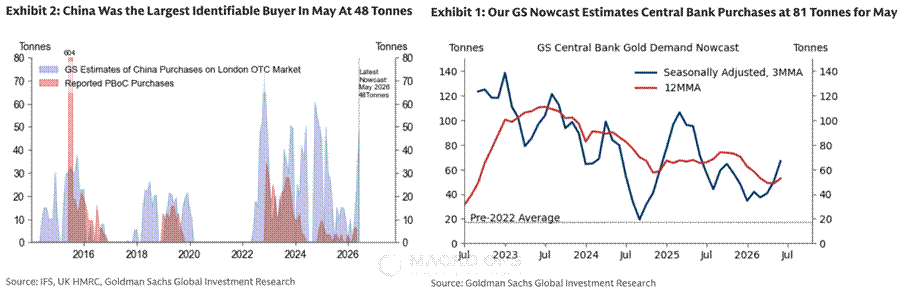
13. Central banks keep buying gold. The pace is accelerating, which puts a floor under how far the metals can fall.
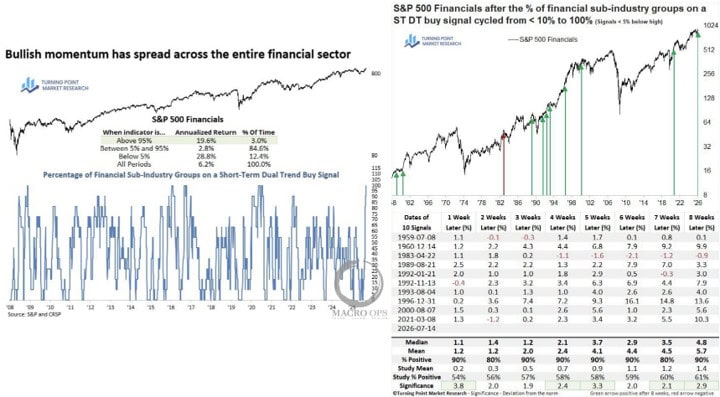
14. The clearest positive is in the financials. Our new colleague Dean Christians (TPMR) flagged a rare breadth thrust in the sector. This week every financial sub-industry group registered a bullish short-term Dual Trend buy signal, something last seen in 2021.
The base rate is encouraging: when more than 95% of financial sub-industries are on buy signals, the sector has compounded at 19.6% annually, well above its average back to 1959. As Dean put it, “the ongoing rotation out of technology has fueled improving participation across several other sectors, with financials standing out as one of the primary beneficiaries.”

Comments
Log in or sign up to join the conversation.