

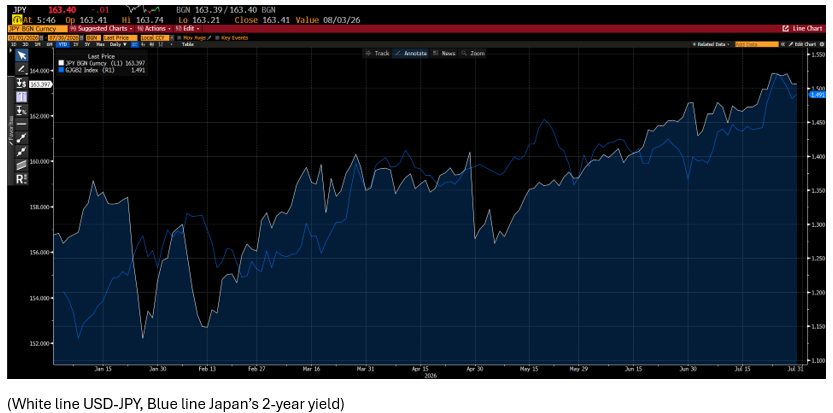
The decision to standpat on a 9-3 vote at the FOMC yesterday looked like a hawkish hold but it seemed like the more Chair Warsh affirmed the central bank’s commitment to achieving the inflation target, the more short-term interest rates and the dollar fell. The expected year-end effective Fed funds rate fell 15 bp from the session high yesterday. The 2-10-year yield curve steepened by 12 bp, completely unwinding the flattening of the last six consecutive sessions, and is now near 44 bp is the steepest since the end of May. The Bank of England, as widely expected, stood pat today, and the swaps market is discounting about 50% chance of a hike at the next meeting in September. There were three dissents. The Bank of Japan meets tomorrow, but it is also widely understood to be on hold.
The US two-year yield remains soft today and the dollar is consolidating with a softer profile against most currencies. The US Nasdaq has been unable to sustain upticks and has fallen for the past six sessions coming into today. Better tech earnings (Microsoft (MSFT) and Samsung (SSNLF)) appear to be encouraging investors to try again today. Meanwhile, despite the new hostilities in the Middle East, oil prices are narrowly mixed, with WTI slightly lower and Brent slightly higher.
Prices
G10
• The euro jumped from a little below $1.1400 before the Fed’s standpat announcement and reached almost $1.1470 as short-term US interest rates fell. It settled at its best level in two weeks and above the 20-day moving average (~$1.1420 today). The euro is consolidating between about $1.1435 and $1.1485. The three-month downtrend was violated on a closing basis yesterday. The trendline is slightly below $1.1420 today.
• The yen approached its 40-year low yesterday. The dollar peaked around JPY163.90 shortly after midday in NY and was sold to about JPY163.25 after the Fed’s announcement. However, the dollar did not settle below Monday’s low, the neckline of a potential double top (~JPY164.00) that projects to around JPY162.60. It is still under pressure today, though with the dollar slipping to around JPY163.20 in the European morning. Perhaps, another way to look at the price action: the greenback is pinned between two large option strikes. There are options for $2 bln at JPY163 and $1.5 bln at JPY163.50 the expire today.
• Sterling held above Tuesday’s low (~$1.3275) and reached above $1.3370 after the FOMC announcement. It frayed resistance in the $1.3380 area, which houses the 20-day moving average and the (38.2%) retracement objective of sterling’s losses from the July 15 high (~$1.3560). It settled at $1.3370. The 200-day moving average is near $1.3400 and the (50%) retracement objective is around $1.3415. Sterling was sold in Asia to around $1.3335 before it rebounded in Europe to session highs near $1.3410.
• The Canadian dollar strengthened for the second consecutive session yesterday, and the US two-year premium over Canada narrowed for the second day, too. The greenback fell to a seven-day low yesterday, slightly below CAD1.4025. Last week, the dollar bounced smartly after approaching CAD1.4000. It is consolidating between about CAD1.4030 and CAD1.4070 today. Options for $1.12 bln at CAD1.4015 expire today.
• The Australian dollar recovered from (~$0.6920), its lowest level since July 14. It reached a new session high, slightly shy of $0.6990 and left an ostensibly bullish hammer candlestick. It is consolidating between about $0.6945 and $0.6975 so far today. Regaining a foothold above $0.7000 lifts the technical tone.
EM
• The dollar approached the upper end of its recent range against the Mexican peso yesterday, near MXN17.54. The momentum was not sustained after the FOMC meeting and the greenback was sold to new session lows near MXN17.40 low, a four-day low. Despite trading on both sides of Tuesday’s range the settlement was near the middle of the day’s range, neutralizing the technical signal. The greenback was pressed back to MXN17.40 today and it is holding. The lower end of the recent range extends toward MXN17.35.
• The dollar posted an outside down day against the offshore yuan. It traded on both sides of Tuesday’s range and settled below its low. The US dollar was sold slightly below CNH6.7525 to record a new three-year low. The PBOC set the dollar’s fix at a new low since Q1 23 (CNY6.7892 vs. CNY6.7899 yesterday).
• The dollar recorded an inside day against the Indian rupee. Equity inflows appeared to have blunted the negative impact of firmer oil prices. The dollar rose for the first time in three sessions today and reached nearly INR95.7540. The three-day bounce in the rupee was the longest this month.
Other Markets
• Equities were uninspired by the decline in US short-term interest rates after the FOMC announcement. The Nasdaq briefly turned positive, but the upticks were sold into, and it finished lower for the sixth consecutive session ahead of Microsoft and Meta (META) earnings. The former did better than the latter and Samsung’s reported upbeat sales today. Still equities were mixed most mostly lower in the Asia Paciifc region today. Europe’s Stoxx 600 is up a little more than a third of a percent to recoup yesterday’s loss. US index futures are trading higher, led by a nearly 2/3 of 1% gain by the Nasdaq.
• The jump in oil prices and renewed hostilities that dashed the creeping optimism earlier in the week saw benchmark 10-year yields rise mostly 6-8 bp in Europe. The 10-year US Treasury yield rose seven basis points yesterday to 4.66%. Asia Pacific yields played catch-up today, rising mostly 5-8 bp. European yields are a little firmer today, and the 10-year Treasury yield is up nearly two basis points to 4.70%. On the other hand, the US two-year yield slumped yesterday. It initially rose four basis points and fell sharply after the FOMC meeting. It is a little softer today, a little below 4.27%.
• Gold was already recovering from the dip below $4000 in the North American morning but surged after the FOMC decision. It reached a little above $4116, a new three-day high by a few cents, but could not sustain the momentum and finished slightly below the 20-day moving average (~$4072 today). It was greeted with sellers today as it tried pushing above $4100. Silver settled firmly, up almost $1, but failed to impress. It is consolidating inside yesterday’s range.
• September WTI dipped below $77.80 on Tuesday and reached almost $85.60 yesterday as hopes that the Middle East war was winding down again were dashed. After being marked up following new US threats to hit Iran hard in retaliation for its strike on Jordan, September WTI held above $84 though most of the North American session. The new hostilities in the region saw the contract extend its gains to almost $86 but stabilized and is below $85 ahead of the North American opening.
Data
• With the FOMC meeting concluding yesterday, today’s data poses possible headline risk but in terms of policy or investment decision, the impact will be marginal. The June CPI and PPI remove most of the guess work around today’s US PCE deflators. The headline pace is expected to moderate to 3.7% from 4.1%, while the core rate may slip to 3.3% from 3.4%. Personal income itself is seen rising by 0.3% and consumption by 0.4%. Weekly jobless claims will get extra attention today after last week’s report showed the lowest claims since 1969 (187k). Many observers are skeptical, but another low print may be taken more seriously. Tomorrow’s headlines, though, will be about the first estimate of Q2 GDP. The Atlanta’s Fed’s GDP tracker is for a 1.6% annualized pace, while the economists in Bloomberg’s survey are more optimistic, looking for 2.0% growth (weekly survey) and 2.2% (monthly survey).
• Canada reports its May establishment employment survey today. The household survey showed an 87.8k increase in jobs, after a loss of nearly 18k in April. The market tends to react more strongly to the household survey than the establishment survey.
• Mexico reports Q2 GDP today. After a 0.6% contraction in Q1, the economy is expected to have grown by 1.3% quarter-over-quarter. If accurate, it would be the fastest growth since Q1 22. Private consumption is projected to have slow and government spending may have fallen as investment likely did, too. The big improvement came from the external sector, with stronger exports and weaker imports.
• Growth in the eurozone surpassed expectations, rising 0.4% after a flat Q1. Although the first estimate lacks many details, Germany grew by 0.2% (and Q1 was marked up to 0.4% form 0.3%). France and Italy also grew by 0.2%. Spain reported an impressive 0.7% expansion in Q2 after 0.6% in Q1. Unemployment in the region was stable at 6.3% in June after May was revised from 6.2% to 6.3%. Ahead of tomorrow’s aggregate estimate, Germany and Spain reported July CPI figure. The German state figures point to a national increase of about 0.7%-0.8% for a 2.7%-2.8% year-over-year pace. The EU harmonized measure was 2.4% in June. Spain’s EU-harmonized measure eased by 0.1% in July after rising 0.6% in June. The year-over-year rate ticks up to 3.8% from 3.6%. Lastly, French consumer spending rose 0.4% in June, better than the 0.1% contraction expected in the Bloomberg survey and the May series was revised to 0.3% from 0.5%.
• As widely expected, the Bank of England left policy steady, with the base rate unchanged at 3.75%. The swaps market has a little more than a 50% chance of a hike at the next meeting in mid-September and sees about a 50% chance of another one before the end of the year.
• Australia’s June building permits soared by 7.2% in June, snapping a three-month fall (May was revised to -1.6% from -1.1%). Approvals for private sector homes edged up by 0.4% after surging a revised 2.4% (initially 2.8%) in May. Separately, export and import price indices for Q2 warned that Australia positive terms of trade developments stalled. For the first time in three quarters, import prices rose faster than export prices.



Comments
Log in or sign up to join the conversation.