

Fed officials play for time
The immediate reaction to the surprise September 0.3% month-on-month core CPI print was to send the chances of an October rate hike above 50%. But this didn’t last long. Earlier comments from Federal Reserve Vice Chairs Philip Jefferson and Michelle Bowman and Governor Chris Waller, signalling no rush to decide on the next policy move, quickly calmed markets. The fact that Fed Chair Kevin Warsh subsequently chose not to talk up the chances of action when he spoke at the IMF meetings in Bangkok, unlike at the Jackson Hole Conference before the September hike, further dampened the perceived chances of action.
While it is true to say that recent jobs numbers have been disappointing and interest rate-sensitive sectors, such as the housing market, are experiencing increasing pain, the economy is growing robustly, and inflation remains above target. Fed officials themselves have made it clear that they think more tightening of monetary policy is going to be required to bring inflation to heel. Given that the latest Federal Reserve Summary of Economic Projections showed four FOMC members projecting 50bp of rate hikes between now and the end of the year, the decision is unlikely to be unanimous. Beth Hammack, Neel Kashkari and Lorie Logan all voted to hike in July when the rest of the committee wanted to hold steady. All three could again dissent in favour of hiking.
The press release is likely to be brief, and we also expect another short and snappy press conference from Chair Warsh. He's likely to keep things quite matter-of-fact given his lack of enthusiasm for forward guidance. We expect his message to be that the economy remains in decent shape, unemployment is low, and inflation is above target. The policy changes being made will be determined by the trends in incoming data, with officials currently thinking that they probably have more work to do.
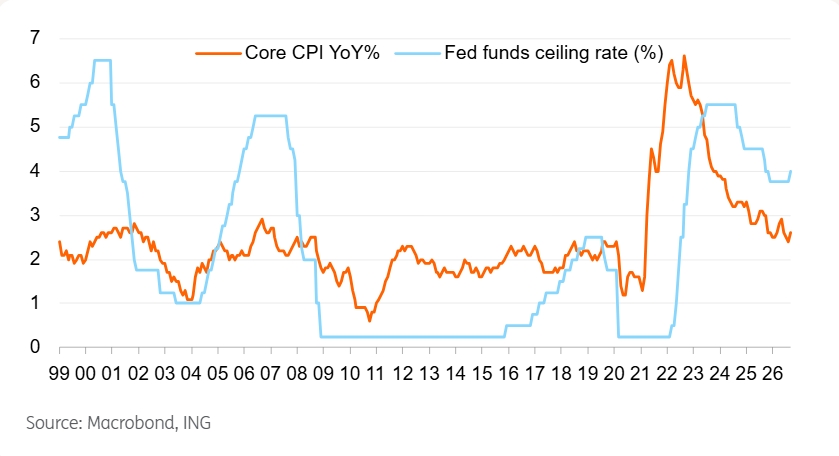
US core consumer price inflation YoY% versus the Fed funds policy rate
Looking towards December
We will have two jobs reports and one inflation print ahead of the December decision. The November CPI will be released the day after the Fed meeting, and officials will almost certainly get to see it. As such, they will have more information than the market does, meaning a surprise can’t be completely ruled out.
We are forecasting a 25bp rate hike at the December meeting (leaving the Fed funds target rate range at 4-4.25%) followed by a prolonged pause through to December 2027, when we have that December 2026 hike being reversed. This is in line with the current consensus forecast, while the Fed’s own projections (its central forecast) see one hike this year with rates left unchanged throughout 2027.
While the sharp move higher in Treasury yields and the firmer dollar are tightening financial conditions to a degree, our forecast path for the Fed assumes that in the couple of months following the midterm elections we see an agreement that improves the flow of energy from the Persian Gulf, but significantly, also allows for a sharp reduction in shipping and insurance costs. It's the latter point that is crucial to delivering lower pump prices at a time when refineries are working at capacity. If correct, this should meaningfully ease inflation pressures, and with US wage growth (the biggest cost input for corporate America) looking very benign at just 3% and the largest component of the inflation basket – housing at 35% by weight – set to experience more disinflation, we believe overall US inflation can fall back to 2% in the second half of 2027.
The risk to our view is clearly tilted towards a longer-lasting conflict rather than one that is resolved imminently. This means we would not rule out additional hike(s) in 1Q 2027, but with households experiencing a greater squeeze on spending power (weak wage growth amid rising energy costs) and bond yields likely pushing even higher – leading to new cycle highs for mortgage rates and corporate borrowing costs – the risks of a weaker economy will increase. As such, in this more stressed economic scenario, eventual cuts to policy rates will likely be swifter and more substantial in 2H 2027 than in our base case.
The Fed to leave well enough alone and let Treasuries do their own thing
A solid performance for US Treasuries in the past week has acted to reduce the prior tightening impulse that had gripped the market. The 10yr yield below 5% obviously contrasts dramatically with the prior break above 5.25%. We’re not convinced the more recent downward lurch is persisting. But its genesis lends itself to a softer approach from the FOMC at this meeting.
The risk-off tone creates a heightened risk profile for the US economy, raising the probability that the Fed holds at this meeting. The battering that the French bond market has been taking is another important impulse, as it heightens the broader sense of bond angst. And at the margin, it can add to systemic pressure. This is not the type of environment where the Fed would be inclined to add to concerns by tightening policy. It’s the perfect meeting to keep rates on hold.
Whether we remain below 5% for the 10yr yield is a whole other question. We're minded to expect it to snap back above, as we still have inflation, fiscal deficit, and AI-boom impulses at play. The Fed will no doubt remind us of these ongoing pressures. Plus, a break back above 5% will likely need a degree of calm in the risk space first. We think it should ultimately move back above 5%; the timing, however, is a tougher call. That being said, this is not the meeting to rock the boat on the bond market.
We’re likely still some way from the Fed spelling out a plan to shrink its balance sheet, which we know remains a policy objective for Chair Warsh. We expect recommendations from the various committees to surface closer to the turn of the year. Meanwhile, liquidity circumstances are stable, with repo behaving far better than it did a year ago.
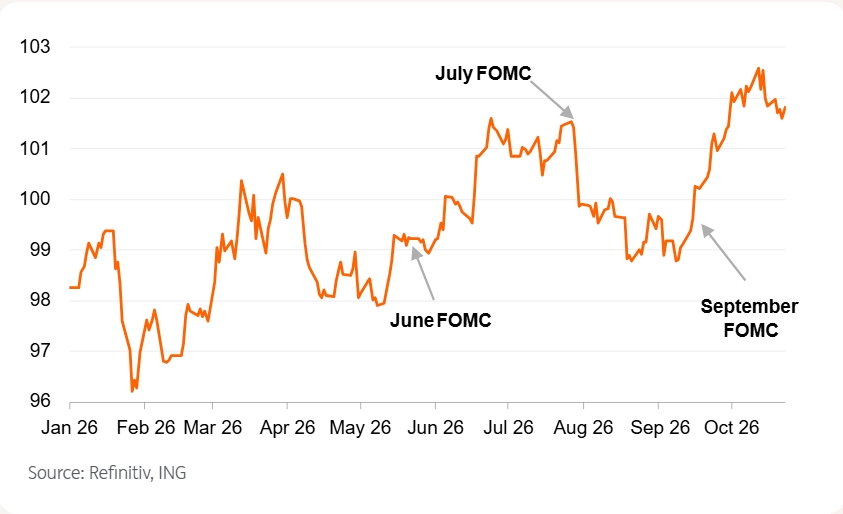
Warsh FOMC meetings have set the dollar tone since June
The dollar should be able to hold on to most of its September gains, as Fed communication is likely to remain supportive of higher US yields. If the dollar is to correct lower, a renewed tech-led risk-off move rather than a dovish shift in Fed messaging is the more likely catalyst.
After a sharp 4% run higher through September and into early October, the dollar has entered a more consolidative phase. Rate differentials are the most important driver at the moment, and these have moved slightly against the dollar this month as the US tech sell-off has pared back Fed tightening expectations.
Broadening out the lens, it looks like Warsh-led FOMC meetings have set the four-to-six-week trend for the dollar this year. June’s meeting was hawkish, July’s was seen as dovish, and the Fed delivered a hawkish hike in September.
We suspect that Warsh has learned from the criticism he received over July's FOMC meeting, where he implied that the bond market was doing the tightening (read as the Fed would not have to). That probably means he will not be drawn into concluding that wider credit spreads and softer equity prices mean tighter financial conditions now require fewer Fed hikes.
Assuming that Warsh sticks to the script that monetary policy credibility remains the Fed’s top priority, short-dated US yields can remain well-supported, and the dollar can largely hold on to the gains it has made since early September. And the euro looks like it has enough trouble with higher energy prices and French political risk to drag EUR/USD back to the lows of the year near 1.11.
Warsh FOMC meetings have set the DXY dollar trend

Comments
Log in or sign up to join the conversation.