

Last Wednesday, the Federal Reserve hiked rates yet again, from 1% to 1.25%. This follows rate hikes from 0.75% to 1% in March and from 0.50% to 0.75% in December, after what had been a prolonged period of abnormally low rates. Conventional wisdom suggested that these interest rate increases would herald a stronger dollar.In January, Larry Fink, the head of Blackrock, warned the audience at the World Economic Forum that "We all should be aware right now that we are going to be living in a world of a strong dollar." He was by far not the only one to make such a prediction.
However, shortly after the Federal Reserve’s December 2016 rate hike, REX Shares CEO Greg King posited that the predictions of a rate-driven “dollar rally” could be misplaced. While the logic behind these rate hike/strong dollar predictions may sound nice in theory, we noted that the relationship is not nearly so direct when historical returns are examined. Since that article was posted on December 20, 2016, we have witnessed a weakening dollar and a stronger Gold price, reaffirming that economic fundamentals, rather than rates and blanket assumptions, continue to drive dollar strength and weakness.
USD since November
Although the USD Index (DXY) strengthened sharply after the election in November, subsequent months have seen the dollar weaken against the basket of currencies included in DXY.
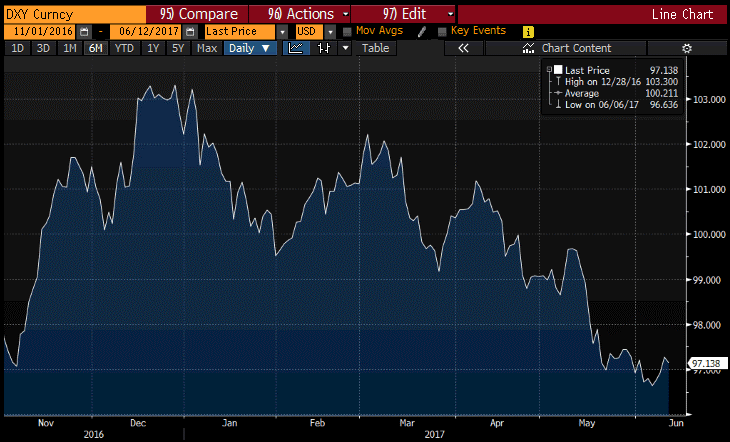
To be fair, some of this movement could be attributed to shifting fundamentals for the countries with currencies included in the DXY index – a strengthening Euro, for example, would also result in a relatively weaker dollar. However, the performance of the world’s premier non-fiat currency, Gold, has ALSO continued to strengthen versus the dollar.
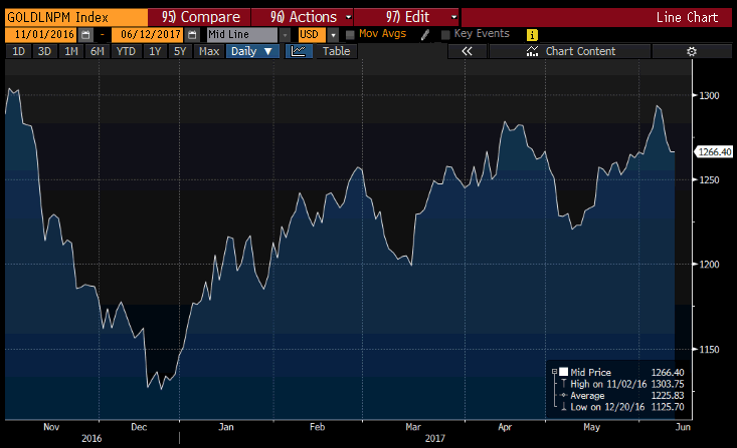
This performance would suggest that economic fundamentals may continue to play a greater role in determining the relative strength or weakness of the dollar.
The Fundamentals
April 12, 2017 President Donald Trump says the U.S. dollar “is getting too strong”
Much was made of President elect Trump’s plan for economic growth fueled by tax cuts, regulation cuts, and increased infrastructure spending. This led to a USD price rally from election night until the end of 2016. With little headway made on these campaign promises, Trump himself rooting for dollar weakness, and recent jobs data disappointing (NFP +138k versus survey of 182k for May), it’s no surprise the USD has sold off despite the three rate hikes since December.
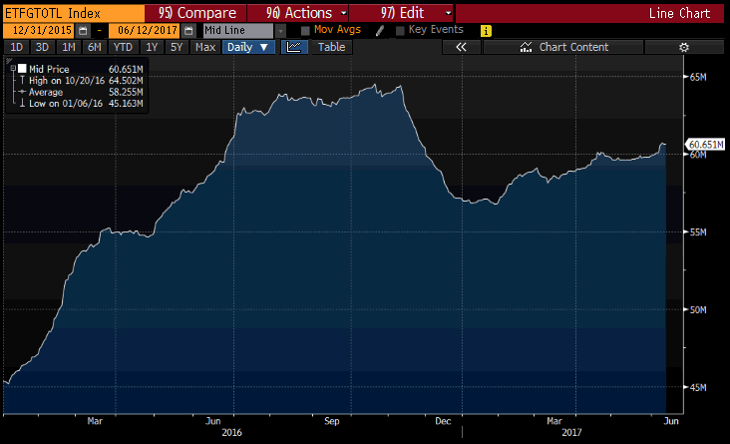
In addition to benefiting from USD weakness, Gold appears to have been supported by the breadth of uncertainty currently faced. Due to continuing geopolitical uncertainty and recent terrorist attacks around the globe, Gold continues to provide safe haven appeal. These events, together with Gold’s appeal as an inflation hedge, may well have contributed to the robust demand evidenced by asset flows into Gold. When discussing fundamentals, the law of supply and demand is about as fundamental as it gets.
Despite a sell-off after the election, Gold flows have resumed, as illustrated by Bloomberg’s Total Known Holdings of Gold by ETFs since 2016:
Conclusion
Commentators frequently assume a strong, direct relationship between interest rate hikes and the value of the dollar. However, the dollar’s performance over the course of the past two hikes has demonstrated that this relationship may not be so simple, as the dollar can indeed weaken even in light of interest rate increases. It may therefore be premature to suggest that the consequences of this third rate hike will be any different. Strategies that hedge against drops in the value of the dollar have therefore continued to demonstrate strong performance over the course of the past two rate hikes. For example, the REX Gold Hedged S&P 500 ETF (GHS) is up 19.15% since November 30, 2016, reflecting gains in both equity markets (SPX, on a total return basis, has gained 11.67%% during that time period) and in the price of Gold (Gold gained 7.50% during that time period). For investors concerned about the value of their dollars, the conventional wisdom that rate hikes drive a strong dollar may be worth reexamining.



Comments
Log in or sign up to join the conversation.