

Seagate Technology (STX) is the featured stock in May’s Safest Dividend Yields Model Portfolio.
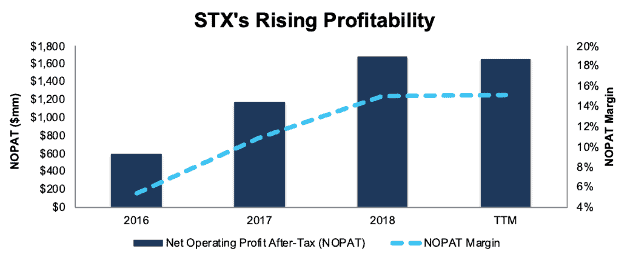
Since 2016, STX has grown after-tax operating profit (NOPAT) by an impressive 68% compounded annually. Over the trailing twelve months (TTM), NOPAT has grown 16% year-over-year. NOPAT margin has increased from 5% in 2016 to 15% TTM while return on invested capital (ROIC) has improved from 8% to a top-quintile 23% over the same time.
Figure 1: STX Profitability Since 2016
(Click on image to enlarge)
Sources: New Constructs, LLC and company filings
STX’s Free Cash Flow Supports Dividend Payments
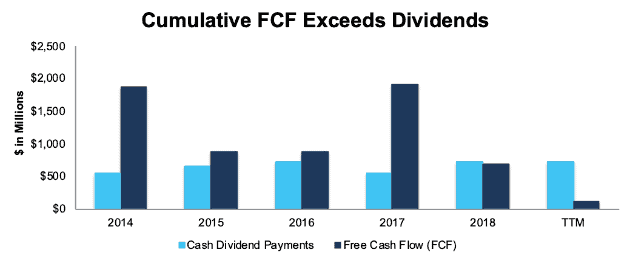
Over the past five years, STX has increased its annual dividend from $1.67/share to $2.52/share, or 11% compounded annually. This dividend payment has been supported by STX’s cumulative free cash flow. Despite lower FCF in the TTM period, STX generated cumulative $6.3 billion (53% of market cap) in FCF since 2014 while paying $3.2 billion in dividends.
Companies with strong free cash flow provide higher quality dividend yields because we know the firm has the cash to support its dividend. On the flip side, dividends from companies with low or negative free cash flow cannot be trusted as much because the company may not be able to sustain paying dividends.
Figure 2: STX’s FCF vs. Dividends Since 2014
(Click on image to enlarge)
Sources: New Constructs, LLC and company filings
STX’s Valuation Implies Permanent Profit Decline
At its current price of $43/share, STX has a price-to-economic book value (PEBV) ratio of 0.7. This ratio means the market expects STX’s NOPAT to permanently decline by 30%. This expectation seems pessimistic given that STX has grown NOPAT by 7% compounded annually since 2003.
If STX can maintain TTM NOPAT margins (15%) and grow NOPAT by just 1% compounded annually for the next decade, the stock is worth $57/share today – a 33% upside. See the math behind this dynamic DCF scenario.
Critical Details Found in Financial Filings by Our Robo-Analyst Technology
As investors focus more on fundamental research, research automation technology is needed to analyze all the critical financial details in financial filings. Below are specifics on the adjustments we make based on Robo-Analyst findings in Seagate Technology’s 2018 10-K:
Income Statement: we made $570 million of adjustments with a net effect of removing $494 million in non-operating expense (4% of revenue). See all adjustments made to STX’s income statement here.
Balance Sheet: we made $5.5 billion of adjustments to calculate invested capital with a net increase of $846 million. The most notable adjustment was $2.6 billion (41% of reported net assets) related to asset write-downs. See all adjustments to STX’s balance sheet here.
Valuation: we made $5.5 billion of adjustments with a net effect of decreasing shareholder value by $3.8 billion. Apart from $4.6 billion in total debt, which includes $73 million in off-balance sheet operating leases, the largest adjustment to shareholder value was $845 million in excess cash. This cash adjustment represents 7% of STX’s market value. See all adjustments to STX’s valuation here.
Comments
Log in or sign up to join the conversation.