

Federal Government deficit spending and the national debt, seem to be the most feared phenomenon in the investment universe. This fear is irrational, since as we will show, Federal Government spending is what keeps the economy expanding.
The chart below shows the Federal budget starting in 1990. Negative means the government is spending more than it takes in through taxes, and positive means it is taking in more than it is spending. The former means that the budget is in deficit, and the latter means that the budget is in surplus. The red lines indicate when the deficit is being reduced (Clinton took it to a surplus between 1997 and 2000), and the green lines indicate when the deficit is being increased.
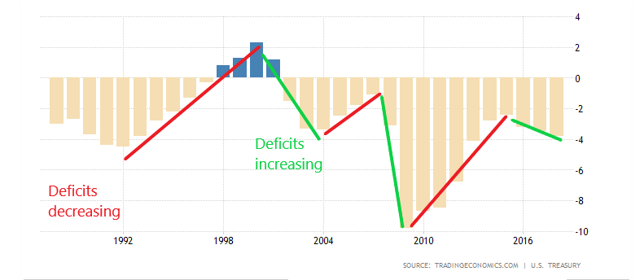
Historically, the tendency has been to reduce the deficit when the economy is expanding and is better able to handle increased taxation relative to spending, and then to increase spending and reduce taxation when the economy starts to contract.
This tendency, however, is what helps to generate boom and bust cycles. Taxing and reducing spending takes money out of the private sector, which has to be replaced through borrowing by the private sector if the economy is going to continue growing.
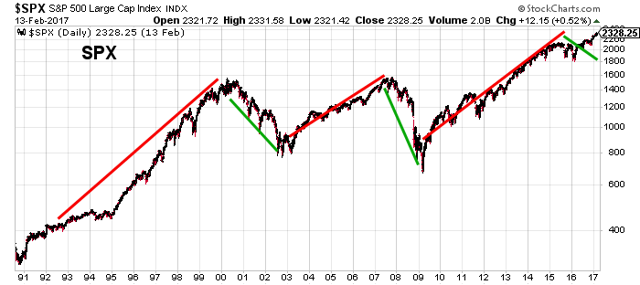
At some point, the private sector is unable to take on more debt, and even reaches a level of indebtedness that it can no longer maintain. At that point, the economy starts to contract (recession), and the government is forced to increase spending and reduce taxation in order to replace the money that it had removed from the system in the first place. The chart below shows how reducing the deficit eventually causes the stock market to contract.
This boom and bust cycling could be avoided if the government, which has a monopoly on money creation, would spend money into existence as long as inflation stayed under control.
Since government spending is equal to the private sector surplus, as long as the government is spending, the private sector will not have to borrow so much in order to save, invest and grow the economy. In 2015, deficit reduction brought us to the brink of recession, but fortunately increasing deficits saved us from that fate.
Now that the self-imposed debt ceiling has been lifted, and there is a bi-partisan, 2-year, $2 trillion spending agreement in place, the deficit will continue to increase which means that the private sector's surplus will increase. In response to this spending, the economy and the stock market will be on an expansionary binge for the duration of the agreement; adding $ trillion to private sector bank accounts has a way of doing that. Being afraid of that, is irrational.



Comments
Log in or sign up to join the conversation.