

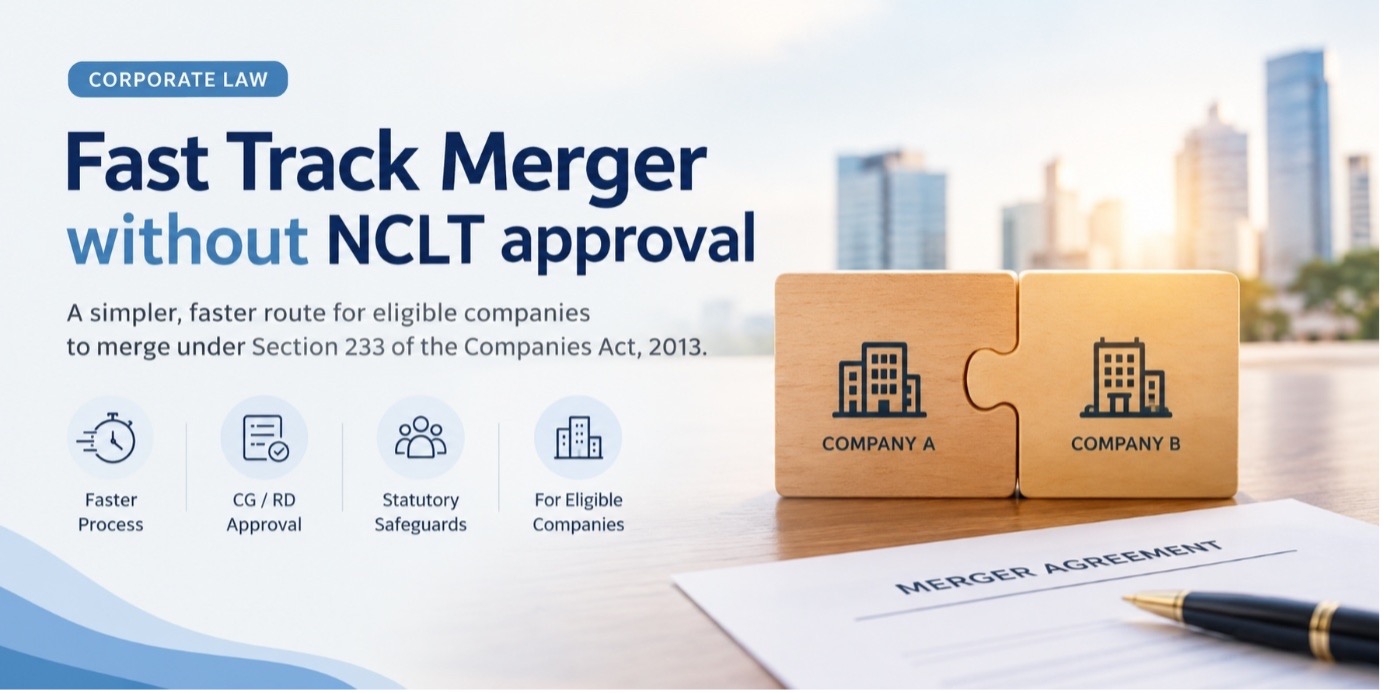
Corporate restructuring is increasingly being used by companies to simplify group structures, consolidate businesses, rationalise subsidiaries and align ownership with long-term business objectives. For certain categories of companies, the Fast Track Merger under Section 233 of the Companies Act, 2013 provides a statutory route that is distinct from the conventional merger process under Sections 230 to 232.
Planning a Fast Track Merger?
Before proceeding, it is important to confirm whether your company meets the eligibility requirements under Section 233 and Rule 25. Chhota CFO can help you assess the proposed merger structure, shareholder requirements, creditor thresholds and key compliance considerations.
The Fast Track Merger mechanism is intended to simplify the merger and amalgamation process for specified classes of companies while retaining statutory safeguards for shareholders, creditors, regulators and other stakeholders.
The framework has also evolved through subsequent amendments, including the Companies (Compromises, Arrangements and Amalgamations) Amendment Rules, 2025, which expanded the scope of companies that may potentially utilise the Fast Track route.
For promoters and management, however, the key question is not merely whether a company qualifies for a Fast Track Merger. The transaction must also be structured correctly from a Companies Act, tax, accounting, FEMA, GST, stamp duty, regulatory and commercial perspective.
What is a Fast Track Merger?
A Fast Track Merger is a statutory merger or amalgamation process undertaken under Section 233 of the Companies Act, 2013, read with Rule 25 of the Companies (Compromises, Arrangements and Amalgamations) Rules, 2016.
The mechanism provides an alternative route for specified classes of companies, instead of following the conventional merger process under Sections 230 to 232.
One of the principal characteristics of the Fast Track route is that the scheme is processed through the Central Government/Regional Director mechanism, with involvement of the Registrar of Companies and Official Liquidator, rather than following the ordinary NCLT approval process applicable to a conventional merger.
However, “fast track” does not mean that the transaction is automatic or that stakeholder approvals can be bypassed.
The process involves, among other matters:
Eligibility assessment;
Preparation of the Scheme of Merger;
Board approval;
Declaration of Solvency;
Notice to statutory authorities and affected persons;
Approval of members;
Approval of creditors;
Filing of the approved scheme;
Examination by statutory authorities; and
Confirmation by the Central Government/Regional Director.
Why Fast Track Merger Matters for Promoters
A merger can have consequences extending far beyond the Companies Act.
Before deciding on the Fast Track route, promoters should consider:
Area | Key Consideration |
Corporate law | Eligibility under Section 233 and Rule 25 |
Shareholding | Share exchange ratio and post-merger ownership |
Tax | Capital gains, carry-forward of losses and tax-neutrality conditions |
Accounting | Accounting treatment of assets, liabilities and reserves |
GST | Transfer of business, registrations and input tax credit implications |
FEMA | Foreign shareholders/investors and cross-border implications |
Contracts | Assignment, novation and change-of-control provisions |
Employees | Continuity of employment and transfer of employee-related obligations |
Licences | Transferability of sector-specific licences and registrations |
Borrowings | Lender consent, security and charge-related matters |
Stamp Duty | State-specific stamp duty implications |
Regulatory approvals | RBI, SEBI, IRDAI, PFRDA or other sectoral approvals, wherever applicable |
Accordingly, Fast Track Merger eligibility should be treated as the starting point, not the end point, of the transaction analysis.
Who Can Undertake a Fast Track Merger?
The eligibility framework under Rule 25 has been expanded through amendments over the years.
Broadly, the Fast Track route may be available to specified categories including:
1. Merger of Two or More Small Companies
Two or more companies satisfying the applicable definition of small company may undertake a Fast Track Merger, subject to the statutory requirements.
2. Holding Company and Wholly-Owned Subsidiary
A merger between a holding company and its wholly-owned subsidiary may qualify for the Fast Track mechanism, subject to the conditions prescribed under Rule 25.
This structure is commonly relevant where a corporate group intends to eliminate redundant entities and simplify its organisational structure.
3. Merger of Start-Up Companies
Two or more eligible start-up companies may utilise the Fast Track route, subject to applicable conditions.
4. Start-Up Company with Small Company
The framework also permits specified combinations involving one or more start-up companies and one or more small companies.
5. Certain Unlisted Companies
The 2025 amendments expanded the Fast Track framework to cover certain mergers involving unlisted companies, subject to prescribed conditions.
Among other requirements, the relevant companies must satisfy the applicable limits concerning outstanding loans, debentures and deposits and must not have defaulted in repayment of such borrowings.
An auditor’s certificate may also be required to establish compliance with the prescribed conditions.
Fast Track Merger Eligibility: A Practical Checklist
Before preparing the Scheme, management should document an eligibility assessment covering:
Status of the transferor company;
Status of the transferee company;
Small company eligibility, wherever applicable;
Start-up recognition, wherever applicable;
Holding-subsidiary relationship;
Wholly-owned subsidiary status;
Listed/unlisted status;
Outstanding loans;
Outstanding debentures;
Outstanding deposits;
Repayment history;
Section 8 status;
Regulatory approvals;
Sector-specific restrictions; and
Applicability of the amended Rule 25.
This preliminary assessment can prevent significant restructuring costs where a company is later found to be ineligible for the Fast Track route.
Procedure for Fast Track Merger under Section 233
Step 1: Conduct Legal and Financial Due Diligence
The first stage should be a structured review of both companies.
The review should typically cover:
Constitutional documents;
Shareholding;
Capital structure;
Financial statements;
Borrowings;
Charges;
Statutory dues;
Litigation;
Related-party transactions;
Material contracts;
Intellectual property;
Employees;
Licences;
Regulatory registrations;
Tax positions; and
Pending statutory compliances.
A Corporate Due Diligence exercise is particularly important where the merger is between unrelated entities or where investors, lenders or third-party stakeholders are involved.
Step 2: Determine the Appropriate Merger Structure
The proposed transaction should be evaluated from both legal and commercial perspectives.
The parties should determine:
Transferor and transferee;
Appointed date;
Consideration;
Share exchange ratio;
Treatment of existing shareholding;
Treatment of inter-company balances;
Treatment of assets and liabilities;
Employee transition;
Treatment of contracts;
Accounting treatment; and
Tax consequences.
Where shares are being issued as consideration, the valuation methodology and applicable valuation requirements should be reviewed before finalising the Scheme.
Step 3: Draft the Scheme of Merger
The Scheme is the central document governing the transaction.
Depending on the structure, it should address:
Background and rationale;
Definitions;
Appointed date;
Transfer and vesting of undertaking;
Transfer of assets and liabilities;
Consideration;
Share exchange ratio;
Treatment of existing shareholding;
Accounting treatment;
Employees;
Contracts and legal proceedings;
Tax matters;
Dissolution of the transferor company;
Authorised share capital;
Conditions precedent;
Regulatory approvals; and
Effective date.
The Scheme should be prepared with reference to the actual transaction structure rather than using a generic merger template.
Need Help Structuring Your Merger?
From due diligence and shareholding analysis to Scheme preparation, valuation, tax considerations and regulatory compliance, Chhota CFO can support your transaction through the key stages of a Fast Track Merger.
Talk to Our Corporate Restructuring Team
Step 4: Board Approval
The respective Boards of the companies should consider and approve the proposed Scheme and authorise the necessary actions.
The Board process should appropriately cover:
Approval of the Scheme;
Appointed date;
Share exchange ratio;
Authorisation for statutory filings;
Declaration of Solvency;
Notice to members and creditors; and
Appointment/authorisation of representatives.
The Board proceedings should be properly documented and maintained as part of the company’s statutory records.
Step 5: Declaration of Solvency – Form CAA-10
The companies undertaking the merger are required to comply with the statutory requirements relating to the Declaration of Solvency in Form CAA-10.
The declaration should be prepared after appropriate review of the company’s financial position.
Management should ensure consistency between:
Financial statements;
Books of account;
Outstanding liabilities;
Borrowings;
Statutory dues; and
The Declaration of Solvency.
Step 6: Issue Notice of Proposed Scheme – Form CAA-9
The company is required to issue notice of the proposed Scheme in Form CAA-9 to the prescribed authorities and persons.
The notice process provides an opportunity for objections and suggestions to be raised.
The statutory framework requires the prescribed notice period to be observed before proceeding further.
Depending on the nature of the companies and the transaction, relevant sectoral regulators may also need to be considered.
Step 7: ROC and Official Liquidator Review
The Registrar of Companies (ROC) and Official Liquidator (OL) may examine the Scheme and communicate their observations, objections or suggestions.
This stage is important because observations may relate to matters such as:
Statutory compliance;
Financial statements;
Share capital;
Related-party transactions;
Public interest;
Pending litigation;
Asset/liability transfer;
Regulatory compliance; or
Other matters arising from the Scheme.
The companies should respond to such observations carefully and within the prescribed framework.
Step 8: Approval by Members
The Scheme must obtain the approval prescribed under Section 233(1)(b).
The statutory threshold is approval by members or a class of members holding at least 90% of the total number of shares.
This requirement is materially important when planning a merger involving multiple shareholders, minority shareholders, institutional investors or dispersed ownership.
Accordingly, the shareholder structure should be reviewed before the Scheme is finalised.
Step 9: Approval by Creditors
The creditors must also approve the Scheme in accordance with Section 233.
The statutory framework requires approval by creditors or the relevant class of creditors representing nine-tenths in value of the creditors or class of creditors.
For this reason, a creditor mapping exercise should ideally be completed at the beginning of the transaction.
Particular attention should be given to:
Banks;
Financial institutions;
Debenture holders;
Fixed deposit holders;
Trade creditors;
Related-party creditors; and
Other material creditors.
Step 10: Filing of Approved Scheme – Form CAA-11
Following the requisite approvals, the approved Scheme and relevant meeting documents are filed in the prescribed manner, including Form CAA-11.
Copies are also required to be submitted to the relevant statutory authorities as prescribed.
The filing package should be checked carefully because deficiencies at this stage may result in additional observations or delays.
Step 11: Examination by the Central Government / Regional Director
The Scheme is examined through the Central Government/Regional Director mechanism prescribed under Section 233.
The authorities may consider:
Compliance with Section 233;
Compliance with Rule 25;
Objections raised by ROC;
Observations of the Official Liquidator;
Stakeholder objections;
Regulatory concerns; and
Public interest considerations.
Where the statutory requirements are satisfied, the Scheme may be confirmed in accordance with the Act and Rules.
Step 12: Confirmation Order – Form CAA-12
Upon satisfaction of the applicable requirements, the confirmation order is issued in Form CAA-12.
The order gives effect to the Scheme subject to the terms and conditions specified therein.
The transaction should thereafter move into the implementation and post-merger compliance phase.
Step 13: Post-Merger Compliance
Obtaining the confirmation order should not be treated as the end of the transaction.
A comprehensive post-merger implementation checklist should cover:
Updating statutory registers;
Share capital records;
Share certificates;
Accounting entries;
Bank accounts;
Charges;
PAN/TAN records;
Income-tax matters;
Contracts;
Licences;
Employee records;
Intellectual property;
Customer/vendor records;
Regulatory registrations; and
Other applicable statutory compliances.
Key Forms in a Fast Track Merger
Form | Purpose |
CAA-9 | Notice of proposed Scheme inviting objections/suggestions |
CAA-10 | Declaration of Solvency |
CAA-11 | Filing of approved Scheme and relevant documents |
CAA-12 | Confirmation Order |
Companies should always verify the latest MCA forms, filing requirements and applicable amendments before initiating a transaction.
Fast Track Merger vs Regular Merger
Particulars | Fast Track Merger – Section 233 | Regular Merger – Sections 230–232 |
Applicable companies | Specified eligible companies | Broader range of transactions |
Principal authority | Central Government / Regional Director mechanism | NCLT |
NCLT process | Not the ordinary approval route under Section 233 | Central to the process |
Declaration of Solvency | Applicable | Section 233 mechanism does not apply |
Member approval | 90% of total number of shares | Statutory threshold under Section 230 |
Creditor approval | 90% in value | Statutory threshold under Section 230 |
ROC/OL involvement | Yes | Yes |
Complexity | Generally, more streamlined | Generally, more extensive |
Eligibility assessment | Critical | Critical |
The appropriate route should therefore be determined after reviewing the transaction structure, eligibility, stakeholder composition and regulatory requirements.
Fast Track Merger: Common Issues Companies Should Address
1. Incorrect Eligibility Assessment
A company may assume that it qualifies based only on its broad category, without examining all conditions under Rule 25.
Solution: Prepare a written eligibility checklist before commencing the Scheme.
2. Shareholder Threshold
The 90% approval requirement can become challenging where there are multiple shareholders or minority investors.
Solution: Analyse the cap table at the initial planning stage.
3. Creditor Approval
The 90% creditor-in-value threshold requires careful creditor mapping.
Solution: Prepare a verified creditor statement and identify material creditors early.
4. Borrowing Conditions
For eligible unlisted-company combinations, the borrowing and repayment conditions under the amended framework require specific attention.
Solution: Obtain the necessary financial information and auditor certification before proceeding.
5. Tax Implications
A legally valid merger may nevertheless have significant tax consequences if the statutory conditions for tax neutrality are not satisfied.
Solution: Conduct a tax review before finalising the Scheme.
6. Stamp Duty
Stamp duty consequences can vary depending on the jurisdiction and the nature of the assets and transaction.
Solution: Conduct a state-specific stamp duty assessment.
7. Regulatory Approvals
A merger may involve sector-specific approvals even when it qualifies under Section 233.
Solution: Identify applicable regulators at the transaction-design stage.
Strategic Considerations for Start-Ups and Promoters
For start-ups, mergers are often connected with broader business restructuring.
A Fast Track Merger may form part of a restructuring involving:
Group consolidation;
IP transfer;
Founder restructuring;
Investor restructuring;
Subsidiary consolidation;
Business vertical consolidation;
ESOP restructuring;
Inter-company balances; or
Simplification before a new investment round.
However, founders should evaluate the cap table, investor rights, SHA provisions, ESOP arrangements, valuation and tax implications before initiating the merger.
A merger should be designed as part of the broader corporate structure rather than treated as an isolated Companies Act filing.
Fast Track Merger – Indicative Timeline
The timeline depends on the structure of the transaction and the processing of statutory authorities.
Stage | Indicative Timeline |
Eligibility and due diligence | 1–2 weeks |
Scheme preparation | 2–4 weeks |
Board approval | As scheduled |
CAA-9 notice process | Statutory period applies |
Member and creditor approvals | Based on statutory notice requirements |
CAA-11 filing | Within prescribed period |
ROC/OL/RD examination | Subject to processing and observations |
Confirmation Order | Subject to statutory and regulatory processing |
Post-merger implementation | As applicable |
The above is an indicative planning timeline and should not be construed as a statutory or guaranteed completion period.
Fast Track Merger – Due Diligence Checklist
Before commencing the transaction, management should consider obtaining the following:
Corporate Documents
MOA and AOA
Certificate of Incorporation
Shareholding pattern
Statutory registers
Board and general meeting records
Financial Documents
Audited financial statements
Management accounts
Borrowing statements
Details of deposits
Details of debentures
Outstanding statutory liabilities
Legal Documents
Material contracts
Litigation details
Intellectual property records
Licences and approvals
Charges
Tax and Regulatory
Income-tax compliance
GST compliance
TDS compliance
Sector-specific approvals
Transaction Documents
Draft Scheme
Valuation report, where applicable
Auditor’s certificates, where required
Declaration of Solvency
Board resolutions
Member/creditor notices
How Chhota CFO Can Assist with Fast Track Merger
A Fast Track Merger is not merely an MCA filing exercise. It requires coordination between corporate law, finance, taxation, accounting and regulatory compliance.
At Chhota CFO, we assist businesses and promoters with transaction structuring and compliance across the merger lifecycle, including:
Pre-Merger Advisory
Section 233 eligibility assessment
Corporate structure review
Merger route evaluation
Legal and financial due diligence
Shareholding and cap table review
Tax and regulatory assessment
Scheme & Transaction Support
Scheme structuring
Coordination for Scheme documentation
Board and shareholder documentation
Valuation coordination
Auditor certification requirements
Declaration of Solvency
CAA form and filing support
Regulatory Coordination
ROC compliance
Official Liquidator process support
Regional Director process coordination
Sectoral regulatory compliance
Stakeholder response management
Post-Merger Compliance
ROC filings
Statutory register updates
Share capital changes
Accounting coordination
GST and tax compliance
FEMA compliance, where applicable
Corporate records and governance updates
Our approach is to look at the entire transaction lifecycle, rather than treating the merger as a standalone filing.
Planning a Fast Track Merger?
Whether you are consolidating a group company, merging a wholly-owned subsidiary, restructuring a start-up or evaluating an eligible unlisted-company merger, the first step is to determine whether Section 233 is actually the appropriate route for your transaction.
A structured eligibility review can identify potential issues relating to shareholder approvals, creditor thresholds, borrowings, taxation, valuation, regulatory approvals and post-merger implementation before the Scheme is finalised.
Ready to Evaluate a Section 233 Fast Track Merger?
Whether you are consolidating a group company, merging a wholly-owned subsidiary, restructuring a start-up or evaluating an eligible unlisted-company merger, Chhota CFO can assist with eligibility assessment, transaction structuring, compliance and post-merger requirements.
Talk to Chhota CFO for a Section 233 Fast Track Merger assessment and end-to-end corporate restructuring support.
Contact Chhota CFO for Fast Track Merger Support
Chhota CFO – Your Partner from Incorporation to IPO & Beyond.
Website: www.chhotacfo.com
Comments
Log in or sign up to join the conversation.