
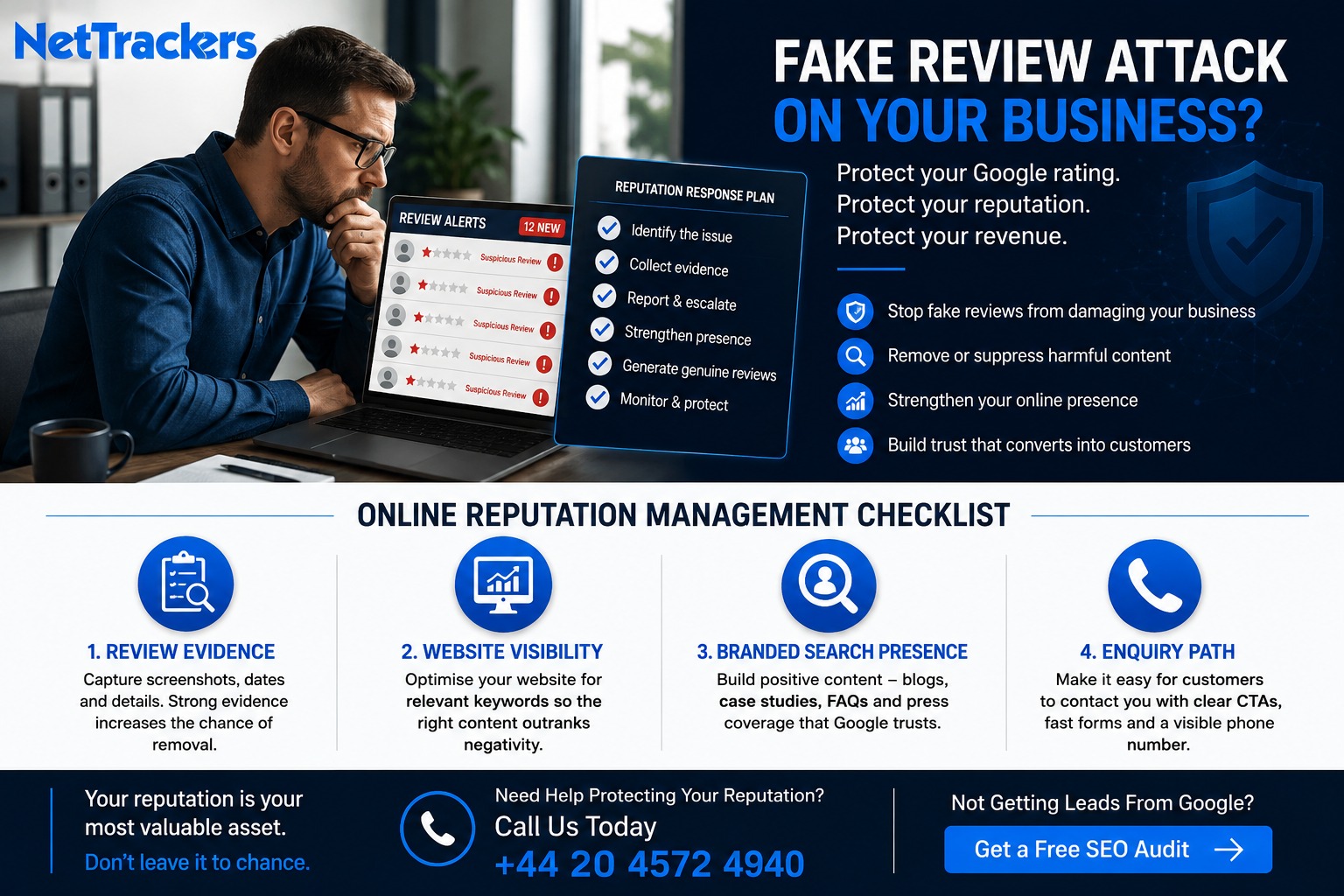
Online Reputation Management becomes urgent when a business starts receiving reviews that appear false, coordinated or disconnected from genuine customer experiences. The immediate goal is not to panic or argue publicly. It is to protect the credibility of your profile, document what is happening, respond proportionately and make sure prospective customers can still find enough trustworthy information to judge your business fairly. A strong response also looks beyond the rating itself because review problems can influence branded searches, click behaviour and the confidence of people deciding whether to call.
For a UK business that relies on Google visibility to generate enquiries, a review attack can quickly become a commercial problem. The strongest approach combines review monitoring, evidence gathering, careful responses, profile consistency and broader search visibility. That gives the business a defensible process instead of reacting differently to every new review.
Why a fake review attack can damage more than your star rating
A suspicious review can affect perception before a prospect reaches your website. Someone comparing providers may see the review, read the response and form an opinion within seconds. If several questionable reviews arrive close together, the problem can become more visible and can distract from the genuine feedback that previously represented the business.
That is why Online Reputation Management should treat reviews as one part of the wider search journey. A potential client may search your company name, look at your Google profile, scan third-party mentions, visit your website and then decide whether to call. If each of those touchpoints tells a consistent story, a small number of suspicious reviews has less power to define the whole reputation.
· Protect the accuracy and credibility of the business profile.
· Keep a clear record of questionable review activity and your response to it.
· Help genuine customers find enough context to make an informed decision.
· Maintain visibility across branded and service-related searches rather than relying on one profile alone.
What to do first when suspicious reviews appear
The first response should be procedural. Capture the review text, date, reviewer name as displayed, rating and any relevant internal information that helps you check whether the reviewer can be matched to a genuine interaction. Avoid making accusations you cannot substantiate. The point of the record is to create a consistent evidence trail that can be referred to later.
1. Screenshot or otherwise record the review and the profile state when you discover it.
2. Check your available customer, booking, order or enquiry records for a reasonable match.
3. Note any repeated wording, unusual timing or patterns across multiple reviews without presenting assumptions as facts.
4. Use the platform reporting route where you believe a review is inappropriate.
5. Prepare a calm public response when a response is useful, keeping customer privacy and professionalism in mind.
A public response is not a courtroom argument. Its real audience is often the next prospective customer. A concise reply that shows willingness to investigate can communicate professionalism without escalating the situation.
How Online Reputation Management protects search reputation
A focused Online Reputation Management strategy looks at the complete branded search footprint. Reviews matter, but so do the pages and profiles people encounter around them. This is where reputation work and SEO overlap. A business can strengthen its position by making sure its website, contact details, service information and location signals are clear and consistent.
For businesses competing in London, an experienced SEO consultant can also assess whether weak organic visibility is making the reputation issue feel larger than it is. If the website barely appears for relevant searches, prospects may rely too heavily on the Google profile alone.
Businesses that need a closer look at their visibility can speak with an SEO consultant London. The purpose is to identify where search visibility, conversion pathways and reputation signals are disconnected rather than treating every problem as a review-removal exercise.
Strengthen the search results around your reputation
Reputation defence is stronger when prospects can discover authoritative information about the business from more than one search result. Service pages should explain what you do, location pages should make geographic relevance clear, and the contact journey should make it easy for someone who is ready to enquire. This reduces dependence on a single review surface.
Not Getting Leads From Google? Get a Free SEO Audit. A review problem can sometimes expose a second issue: the website may have weak organic visibility or a poor enquiry path. Reviewing both areas together helps separate a reputation problem from a broader search-performance problem.
For companies targeting North West England, working with a digital marketing agency Manchester can help align local visibility, website content and reputation signals around the same commercial goals. If the immediate priority is speaking to a provider, the SEO company near me contact route provides a direct next step.
Common mistakes that make a review attack worse
The wrong response can create a second reputation problem on top of the first. Businesses are usually better served by a calm, repeatable process than by public confrontation.
· Arguing aggressively with reviewers in public before checking the facts.
· Posting private customer information in an attempt to prove a point.
· Assuming every negative review is fake simply because the feedback is uncomfortable.
· Ignoring genuine criticism while focusing only on suspicious reviews.
· Treating reputation management as separate from the website, SEO and conversion journey.
· Waiting until the rating falls sharply before creating a monitoring and response process.
An illustrative response plan for a UK service business
Consider an illustrative service company that suddenly receives several one-star reviews it cannot match to its normal customer records. The business records the reviews, checks its available records, reports the questionable entries through the relevant platform process and posts short, measured responses where appropriate. At the same time, it reviews its website and branded search presence so prospective customers can see clear service information and an easy route to make contact.
The value of this approach is control. The business cannot force every platform decision or control what every reviewer posts, but it can control documentation, public tone, website quality, search visibility and the speed at which genuine prospects can reach the team.
Key takeaways
· Capture evidence before reacting publicly.
· Treat suspicious reviews as a reputation and search-visibility issue, not only a star-rating issue.
· Keep public responses calm, factual and useful to future prospects.
· Strengthen your website and branded search presence so one review platform does not carry the entire trust burden.
· Use a repeatable monitoring and escalation process rather than improvising each time.
Frequently asked questions
What should I do if I think a Google review is fake?
Record the review, check whether you can match it to a genuine interaction, use the available reporting route when appropriate and keep any public response professional. Avoid making claims you cannot verify.
Can Online Reputation Management help if bad reviews are affecting enquiries?
Online Reputation Management can help organise the response to review problems while also examining the wider search presence that prospects use to judge the business, including website pages, branded results and contact pathways.
Should I reply to every suspicious review?
Not necessarily. The best response depends on the situation, but any public reply should be concise, professional and written for prospective customers as much as for the reviewer.
What if my business is visible on Google but calls are still low?
Review reputation, organic visibility and conversion pathways together. A business can rank yet still lose enquiries if trust signals are weak or the next step is unclear.
Protect your reputation before it becomes a lead problem
A fake review attack should trigger a disciplined response, not a public fight. NetTrackers can help you assess the wider search and reputation picture and identify where trust, visibility and conversion need attention. Not Getting Leads From Google? Get a Free SEO Audit or call +44 20 4572 4940 to discuss the problem and the next practical step.
Comments
Log in or sign up to join the conversation.