

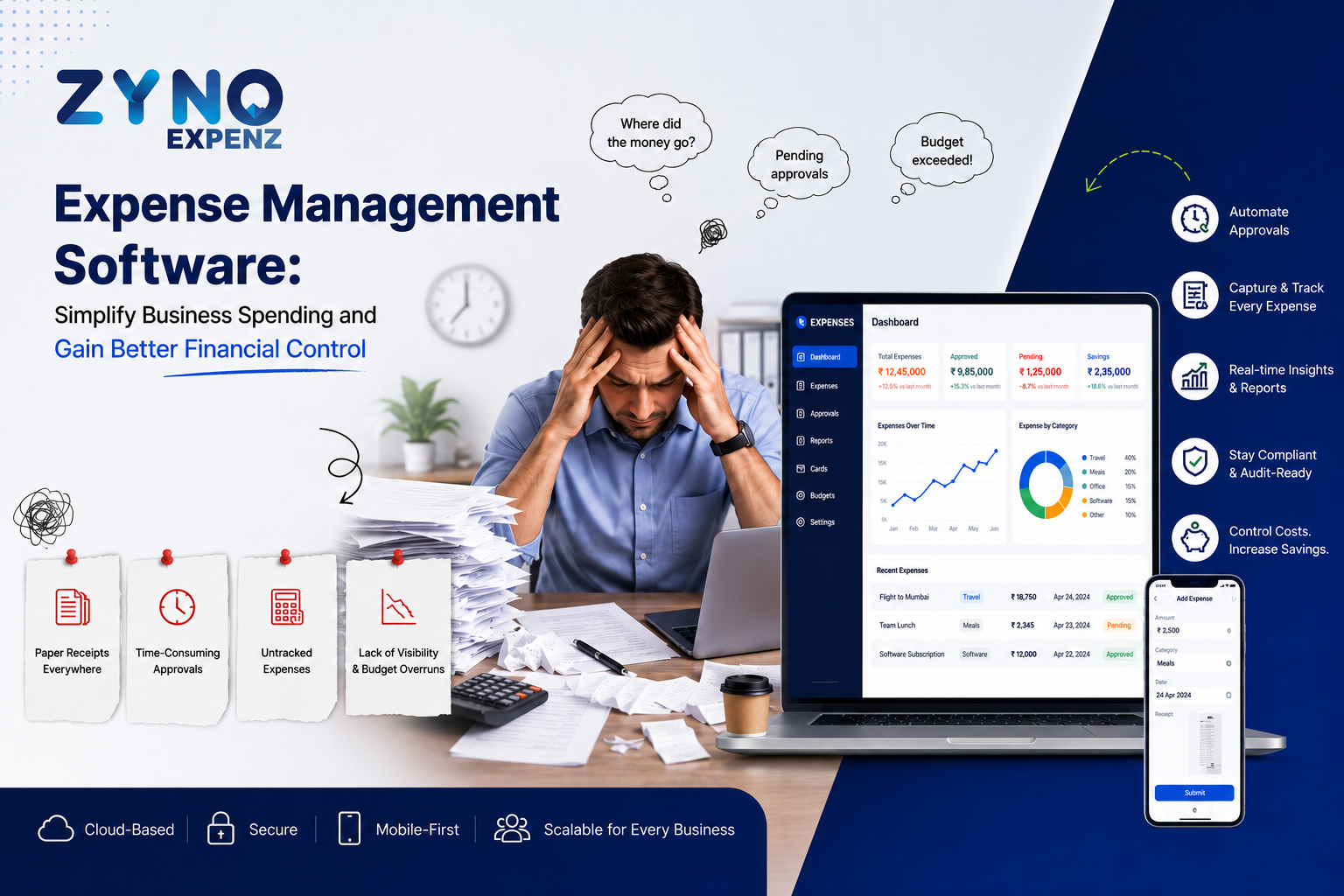
Managing business expenses manually is becoming increasingly difficult for modern organizations. From collecting receipts and approving reimbursements to maintaining compliance and tracking spending, finance teams often spend countless hours on repetitive tasks.
This is where Expense Management Software plays a crucial role.
An expense management system helps businesses automate expense reporting, track employee spending in real time, streamline approvals, and improve financial visibility. Whether you are a startup, SME, or enterprise, the right software can save time, reduce errors, and control unnecessary spending.
In this guide, we’ll explore how expense management software works, its key features, benefits, and how to choose the right solution for your business.
What is Expense Management Software?
Expense management software is a digital solution that helps businesses manage, track, approve, and reimburse expenses efficiently. Instead of relying on spreadsheets and paper receipts, companies can automate the entire expense lifecycle.
The software enables employees to submit expenses digitally while finance teams can review, approve, and analyze spending from a centralized dashboard.
Modern expense tracking software often includes AI-powered automation, OCR receipt scanning, accounting integrations, and real-time reporting capabilities. These features significantly reduce manual effort and improve accuracy. Research across the industry consistently highlights automation as one of the biggest drivers of efficiency in expense management.
Why Businesses Need Expense Management Software
Manual expense management creates several challenges:
Lost receipts and missing documents
Delayed approvals and reimbursements
Human errors in data entry
Lack of spending visibility
Policy violations
Difficulty during audits
As organizations grow, these issues become more complex. Expense management software solves these problems by automating workflows and enforcing company policies automatically. Businesses adopting automated expense management often gain better financial control and faster processing times.
Key Features of Expense Management Software
1. Automated Expense Reporting
Employees can upload receipts using mobile devices, while the software automatically extracts information such as vendor name, amount, and date using OCR technology.
This eliminates manual data entry and improves accuracy.
2. Receipt Scanning and OCR
Modern expense reporting software uses Optical Character Recognition (OCR) to convert receipts into digital records instantly.
Employees simply capture an image, and the system extracts expense data automatically.
3. Approval Workflows
Businesses can configure multi-level approval processes based on departments, expense types, or spending limits.
Automated workflows speed up approvals and reduce administrative work. Automated approval routing is considered a core capability of leading expense systems.
4. Real-Time Expense Tracking
Finance teams get instant visibility into company spending. Real-time dashboards help monitor budgets and identify unusual transactions before they become major issues.
5. Policy Compliance
Expense policies can be configured directly into the system. Any out-of-policy expenses are automatically flagged, ensuring better compliance and reduced fraud risk.
6. Accounting and ERP Integration
The best expense management solutions integrate seamlessly with ERP systems, accounting software, payroll platforms, and banking applications.
This ensures smooth data synchronization and eliminates duplicate entries.
7. Analytics and Reporting
Advanced reporting tools provide insights into spending patterns, department budgets, vendor expenses, and reimbursement trends.
These insights support smarter financial decision-making.
Benefits of Using Expense Management Software
Increased Efficiency
Automating expense submission, approval, and reimbursement significantly reduces manual workload for employees and finance teams.
Better Financial Visibility
Real-time expense data gives businesses complete visibility into spending patterns and cash flow.
This helps improve budgeting and forecasting accuracy. Real-time reporting is consistently identified as a major advantage of expense software.
Reduced Errors
Manual data entry often leads to mistakes. Automation reduces inaccuracies and improves data quality.
Faster Reimbursements
Employees no longer need to wait weeks for reimbursements. Automated workflows accelerate processing times.
Improved Compliance
Expense policies are enforced automatically, reducing policy violations and ensuring audit readiness.
Cost Savings
Businesses can identify unnecessary spending, prevent duplicate reimbursements, and optimize budgets more effectively. Studies and industry reports show that automated systems reduce processing costs and improve spend control.
Who Should Use Expense Management Software?
Expense management software is beneficial for businesses of all sizes, including:
Small and medium businesses (SMBs)
Large enterprises
Companies with traveling employees
Sales teams
Consulting firms
Manufacturing companies
IT and software companies
Organizations with frequent employee reimbursements or travel expenses gain especially high value from automation.
How to Choose the Best Expense Management Software
When selecting an expense management solution, consider the following factors:
Ease of Use
Choose software with an intuitive interface and mobile accessibility.
Scalability
Your software should grow alongside your business requirements.
Integration Capabilities
Ensure compatibility with your ERP, accounting software, and payroll systems.
Security
Financial data is highly sensitive. Look for encryption, access controls, and compliance standards.
Customization
Every business has unique policies. Select software that allows custom workflows and approval rules.
Customer Support
Reliable support ensures smooth implementation and faster issue resolution.
Future of Expense Management
The future of expense management is driven by AI, automation, and predictive analytics.
Modern platforms now offer:
AI-powered expense categorization
Fraud detection
Smart policy enforcement
Automated audits
Real-time spending insights
Businesses adopting intelligent expense management systems gain a competitive advantage through improved efficiency and better financial decision-making. Industry trends show increasing adoption of AI and automation across expense workflows.
Why Businesses are Moving Toward Automated Expense Management
As companies scale, manual processes become barriers to growth. Expense management software not only saves time but also improves transparency, accountability, and compliance.
Organizations that automate expense tracking can focus more on strategic growth rather than administrative tasks.
Whether you're managing employee reimbursements, travel expenses, or operational costs, investing in the right expense management solution can transform financial operations.
Businesses looking for sustainable growth should consider expense management software as an essential tool for modern finance management.
Looking for a smarter way to manage business expenses?
ZYNO Expenz helps businesses automate expense tracking, streamline approvals, ensure compliance, and gain real-time visibility into spending all from a single platform.
Must Read: Expense Management: The Complete Guide (2026)
Conclusion
Managing business expenses manually is no longer practical in today's fast-paced digital environment. An advanced Expense Management Software helps organizations automate expense reporting, improve compliance, reduce errors, and gain complete visibility into company spending.
Whether you're a startup or a large enterprise, investing in the right expense management solution can streamline financial operations, accelerate reimbursements, and support better decision-making. As businesses continue to embrace automation and AI-driven technologies, expense management software is becoming an essential tool for achieving operational efficiency and sustainable growth.
If you're looking for a smart and scalable solution, platforms like ZYNO Expenz can help simplify expense tracking, automate approvals, and provide real-time insights to keep your business finances under control.
Frequently Asked Questions (FAQs)
1. What is Expense Management Software?
Expense Management Software is a digital solution that helps businesses track, manage, approve, and reimburse employee expenses while automating financial workflows and improving compliance.
2. How does expense management software work?
The software allows employees to submit expenses digitally, upload receipts, and request reimbursements. Managers can review and approve expenses, while finance teams track spending through centralized dashboards.
3. What are the benefits of using expense management software?
Some key benefits include:
Automated expense reporting
Faster reimbursements
Better financial visibility
Reduced manual errors
Improved policy compliance
Real-time expense tracking
4. Is expense management software suitable for small businesses?
Yes. Small businesses can significantly benefit from expense management software by reducing administrative work, controlling spending, and improving financial accuracy.
5. Can expense management software integrate with ERP and accounting systems?
Most modern expense management solutions integrate with ERP systems, accounting software, payroll platforms, and banking applications to streamline financial operations.
6. How does receipt scanning work in expense management software?
The software uses OCR (Optical Character Recognition) technology to scan receipts and automatically extract details such as date, amount, vendor name, and category.
7. What is the difference between expense management software and accounting software?
Accounting software manages overall financial records, while expense management software specifically focuses on tracking employee expenses, reimbursements, approvals, and spending control.
8. How does expense management software improve compliance?
It enforces company expense policies automatically, flags policy violations, maintains audit trails, and ensures accurate record-keeping for regulatory compliance.
9. Can expense management software help manage travel expenses?
Yes. Many platforms offer Travel and Expense (T&E) Management features that allow businesses to track travel bookings, reimbursements, and employee travel expenses efficiently.
10. What features should businesses look for in expense management software?
Businesses should look for features such as:
Automated expense reporting
OCR receipt scanning
Approval workflows
Real-time analytics
ERP integration
Mobile accessibility
Policy management
AI-powered automation
Comments
Log in or sign up to join the conversation.