


HIGHER FOR LONGER
The Fed first announced a shift in emphasis regarding price stability and interest rate policy in March, 2022...
"In support of these goals, the Committee decided to raise the target range for the federal funds rate to 1/4 to 1/2 percent and anticipates that ongoing increases in the target range will be appropriate" (FOMC, March 16, 2022)
The financial press coined the exact phrase "higher for longer" shortly thereafter, and Powell himself confirmed the meaning and accuracy of its use at the September 2023 Federal Open Market Committee (FOMC) meeting, emphasizing that borrowing costs would remain elevated for much longer than investors initially hoped...
"Restoring price stability will likely require maintaining a restrictive policy stance for some time. The historical record cautions strongly against prematurely loosening policy." (J. Powell, Jackson Hole, Wyoming, August 2022)
In an interview two years ago, Powell said...
"I think instinctively - I can't prove this, we're going to learn about this empirically - but it seems to me that the neutral rate is probably higher than it was during the intra-crisis period. And so, rates will be higher."
CHARTS
Below are three charts, courtesy of the Federal Reserve Bank of St Louis (FRED). The charts depict the path of interest rates for 5-Year, 10-Year, and 20-Year U.S. Treasury Securities...
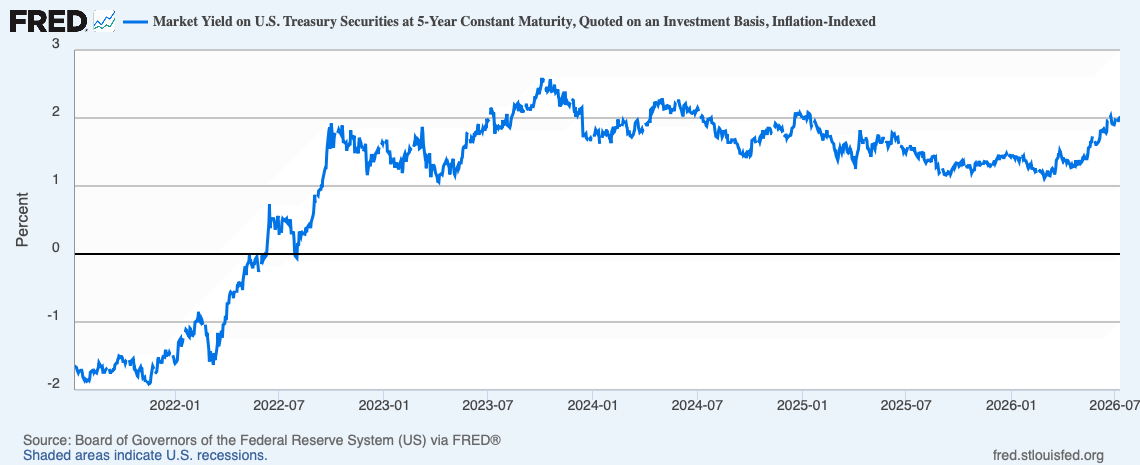
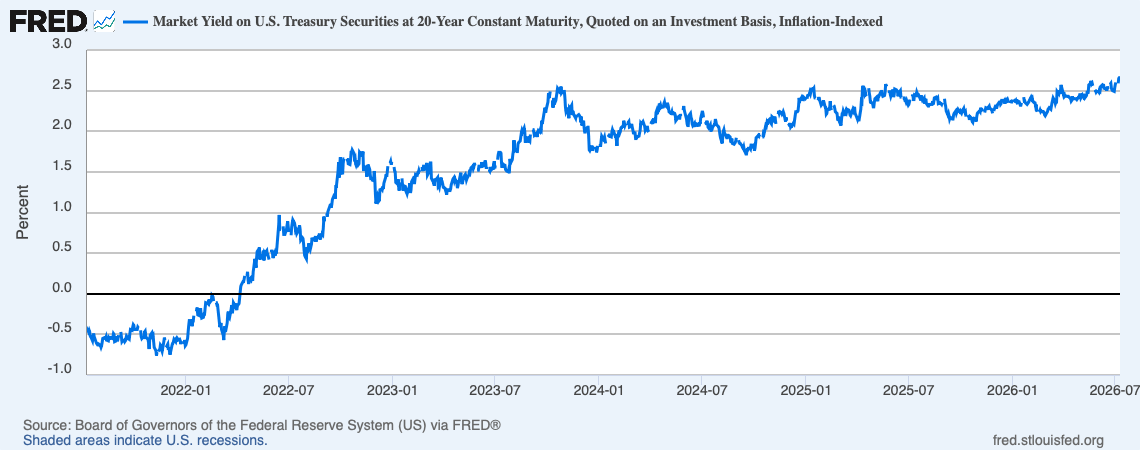
In all three cases, it is clear that interest rates have moved sharply higher and remained there for "much longer than investors initially hoped".
Since higher interest rates are correlated directly with lower bond prices, we should see the same pattern in reverse when looking at bond prices over the same time period - and we do.
From its high of 180 in early 2020, the TLT ETF has declined in price by more than 50%. This decline results from the increase in rates we have experienced over the past five years.
MORE DAMAGE TO COME
No matter the amount of collateral damage thus far and the potential for further harm to the financial markets and the economy, interest rates could go much higher. This is true regardless of Federal Reserve intentions. Here's why...
The Federal Reserve pursued a policy of abnormally low interest rates for nearly four decades. The Fed's action caused a misallocation of resources and an inefficient use of capital, which distorted markets. Cheap and easy credit became a way of life. (see Two Reasons The Fed Manipulates Interest Rates)
It wasn't always that way. Long-term historical averages for interest rates indicate a number somewhere between 6% and 8%. At 4-5% now, we are scarcely knocking on the door that opens into the lower end of the historical average range for interest rates.
HOW HIGH COULD RATES GO?
The answer to how high rates can go is mostly guesswork. But it might help to know how high interest rates went during the inflationary 1970s. Those higher rates were not the policy of the Federal Reserve. They were the result of market factors stemming from a half-century of Federal Reserve inflation.
The effects of inflation and concern about the dollar's loss of purchasing power drove bond prices down drastically and interest rates up steeply. Bond investors demanded higher returns to offset the inflation risk inherent in holding a fixed-income security.
At one point, investors eschewed even the very shortest-term securities. Interest rates on short-term (1 year or less) U.S. Treasury bills rose as high as 18%. The yield on 10-year bonds rose to 15%.
WHAT TO EXPECT
No one knows for sure, but investors would do well to consider the possibility that rates could go much higher.
That next wave higher could be triggered by a collapse in the credit markets. The credit collapse could propel the world economy into a severe economic depression.
Rates were previously forced to lower levels that were not economically efficient. The rates were held at those levels for too long. A cleansing of sorts has to occur before the economy can build momentum that reflects real and lasting growth.
The likelihood of much higher interest rates and lower bond prices is high and rising. (see The Looming Threat of Credit Collapse and Deflation)
Comments
Log in or sign up to join the conversation.