

As China continues down the path of capital market liberalization, many investors are confronted with a dizzying array of options: H-shares, B-shares, A-shares, P chips. Shares listed in Hong Kong, Shanghai, Shenzhen, Singapore and New York. While the economic rationale for investing in China may be straightforward, the means by which investors should be gaining access is not. In our view, given the diversity of opportunities in the market, any investor seeking “beta” exposure to Chinese equities should seek exposure via all means available.
China by the Numbers
The Chinese economy accounts for more than 15% of global gross domestic product (GDP) and 11% of global trade.1 When measured purely by market cap, China has the second largest equity market in the world.2 However, as a result of restrictions imposed by the Chinese government, these massive markets have generally been off limits for most investors. Over the last decade, Chinese policy makers led by President Xi Jinping have sought to gradually open Chinese markets to outside capital. As a result, China appears to offer an attractive mix of high growth rates, a burgeoning middle class and an economy poised to climb the value chain from export-oriented growth. In our view, China’s importance in global markets will only grow as the government transitions to increase integration among global investors.
Historically, exposure to Chinese equities for non-Chinese nationals was limited to companies that listed on international exchanges. After a variety of pilot programs and special institutional frameworks, China has made dramatic steps forward over the last several years to make mainland-listed companies more accessible to global investors. As a result, we believe investors should not necessarily limit themselves to certain listing venues when constructing exposure to China. As we show below, the S&P China 500 Index is one of the only broad-based indexes offering exposure to all flavors of Chinese stocks.
Chinese Equity Market Overview
(Click on image to enlarge)
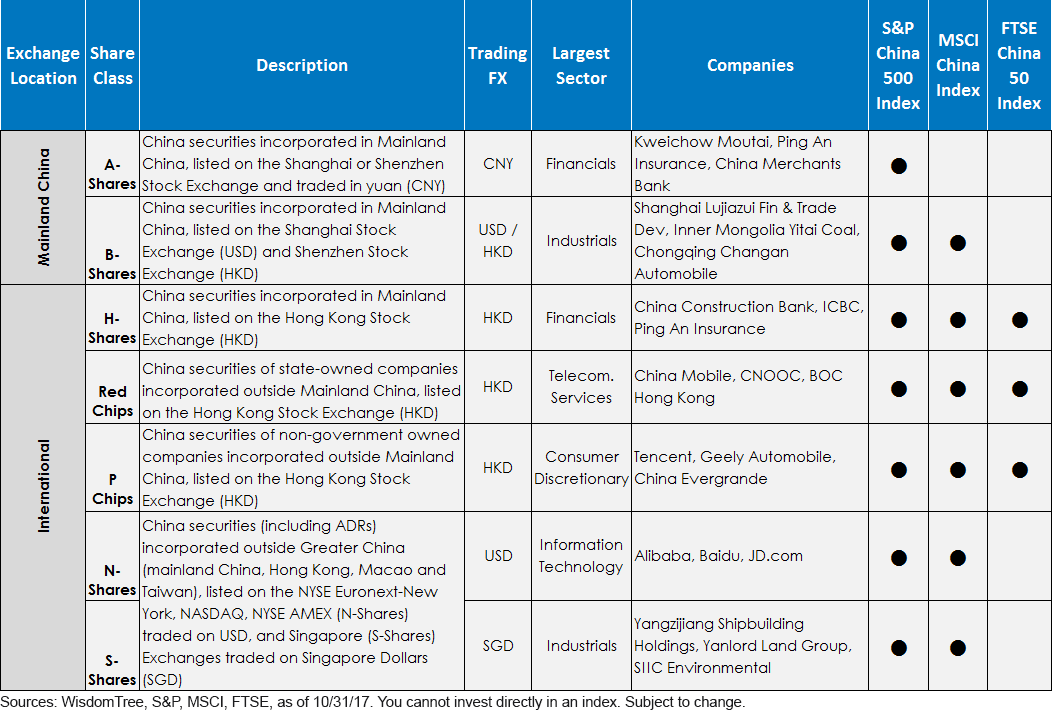
Additionally, the S&P approach targets a much broader number of securities (500+) for constructing the Index. In other approaches, as few as 50 stocks are expected to provide a diversified basket. Unfortunately, this currently means that investors would be forced to take a fairly concentrated position in information technology stocks by investing via the MSCI China Index or a nearly 50% weight to financials in the FTSE China 50 Index.
Index Sector Exposures as of 10/31/17
(Click on image to enlarge)

While MSCI’s China A-shares announcement last summer got investors thinking about these issues, the proposed changes won’t take effect until May 2018. For investors who are thinking about how to efficiently gain broad-based exposure to all flavors of Chinese stocks, we just launched an ETF that tracks the S&P China 500 Index, the WisdomTree ICBCCS S&P China 500 Fund (WCHN).



Comments
Log in or sign up to join the conversation.