


The EUR/USD pair trades in negative territory near 1.1165 during the early European session on Tuesday. The Euro (EUR) extends its downside against the US Dollar (USD) as France’s fiscal concerns renewed financial stress across the Eurozone. Traders will closely monitor the Federal Reserve (Fed) and European Central Bank (ECB) interest rate decisions later this week.
The Fed is anticipated to keep the benchmark interest rate unchanged on Wednesday. Traders are pricing in nearly 89.5% probability that policymakers will hold interest rates steady at the current target range of 3.75% to 4.0%, the CME FedWatch Tool showed.
"The fundamental issue with the euro hasn't changed and spreads have tightened," said Kit Juckes, chief global FX strategist at Societe Generale. "Euro is still vulnerable at this point because the growth outlook isn't good and energy prices are still elevated,” Kit added.
The ECB is likely to leave its deposit rate unchanged at 2.50% at its October policy meeting on Thursday but raise it by 25 basis points (bps) in December as inflation runs nearly double its 2% target, according to a Reuters poll.
USD firms as yield curve flattens and Brent retreats from recent highs
Analysts at Commerzbank highlight a more cautious tone in rates and commodities, noting that "the US Treasury yield curve flattened slightly, with the short-end higher [while] the long-end edged lower." At the same time, they point out that "Brent crude oil prices pulled back from a near six-month high as diplomatic activity around the US-Iran conflict offered some relief to energy markets," while "the USD was slightly firmer."
Warsh flags investment surge and AI risks but avoids pre-committing on policy
Fed Chair Warsh’s speech scores 5.6/10 on the FXS Speechtracker, modestly below the 6.1/10 historical average, signaling a slightly less impactful tone relative to the established baseline despite broadly steady messaging. The admission of being “over-scarred” from the global financial crisis underscores a cautious bias even as Warsh highlights structural growth and an investment surge driven by “good policies,” while firmly refusing to pre-judge upcoming FOMC decisions. Warsh’s focus on AI as a near-term demand-side force and a tool to strengthen data confidence, alongside attention to negative tailside risks, points to a balanced stance between optimism on innovation and vigilance on financial stability.
The FXS Fed Sentiment Index was unchanged, moving 0.00 points to a level of 127.51, leaving the overall policy tone firmly in hawkish territory despite the slightly softer FXS Speechtracker score. The stable, elevated index level suggests markets see Warsh’s caution and emphasis on price stability and investment strength as consistent with a bias toward maintaining or tightening policy rather than shifting toward a more dovish Dollar stance.
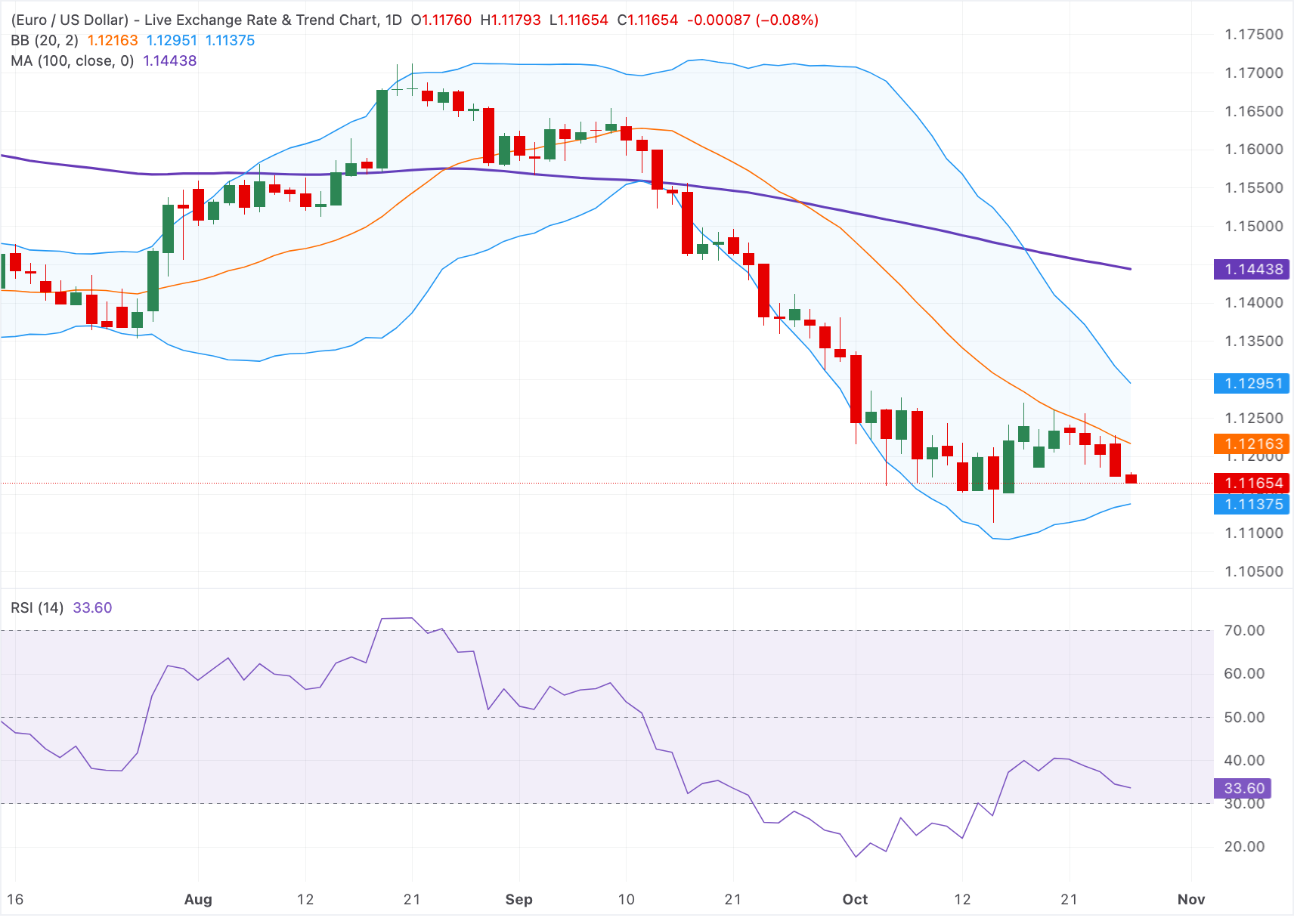
Technical Analysis: EUR/USD maintains a bearish outlook in the near term
In the daily chart, EUR/USD maintains a bearish near-term bias as spot holds beneath the 100-day Simple Moving Average (SMA) and below the Bollinger Bands’ middle line. The pair is slipping along the lower half of the volatility envelope, with price only marginally above the lower band, while the Relative Strength Index (14) at 33.6 hovers just above oversold territory, hinting that downside pressure persists but is becoming stretched.
On the downside, the lower limit of Bollinger band at 1.1140 offers immediate support level. Any follow-through selling below the mentioned level would expose the 1.1100 psychological level, followed by the May 12, 2025 low of 1.0951.
On the topside, initial resistance level is located at the Bollinger middle band around 1.1215, followed by the upper boundary of Bollinger band near 1.1295. A decisive break above this level could pave the way to the 100-day SMA at 1.1445, acting as a more distant cap that reinforces the broader bearish structure.



Comments
Log in or sign up to join the conversation.