

The EURUSD pair returned again to the inside range area that was active from July 27 until September 22.
Bears could not hold the price below $1.17000. The EURUSD has fallen down to the first support level at $1.16178 where it found buyers that stopped the price.
The pair needed only two strong bullish candles to get back above $1.17000 level which shows that the pair have buyers strong enough to hold the price from moving down. The price stopped at the old support level around $1.17200 and it needed almost a week to make its way further up.
You can see I have drawn downtrend lines to watch the price when it will break outside downtrend channel. The breakout started this week on Monday and throughout whole week price needed to get enough buyers to find its way further up.
After the breakout you can see on the H4 time frame that there was a bullish Pinbar next to downtrend resistance line that now acts as a support.
This bullish signal was a confirmation that the breakout from the downtrend channel is done and the price will move up.
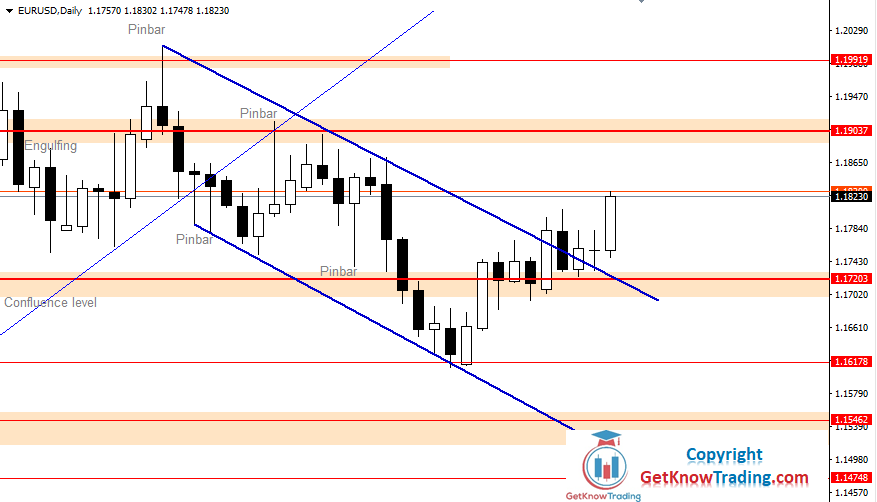
The price is now free to move up and first resistance that will hold the price from further move up is at $1.19000.
This price was a tough level to break above in the past. You can see the range area that lasted for two months could not find its way above even the price touched the $1.19000 four times.
First level where the price could find resistance before reaching $1.19000 is 1.18600 level. There we could see price stalling and making a pullback.
The EURUSD needs to break above $1.19000 level before thinking to reach next resistance level at $1.20000.
In bearish scenario we need the price below $1.17000. Until that happens I am bullish oriented. If the price gets back down below $1.17000, first support that needs to be broken is $1.16178.
After that the area around $1.15000 is the strong support that will hold the price.



Comments
Log in or sign up to join the conversation.