

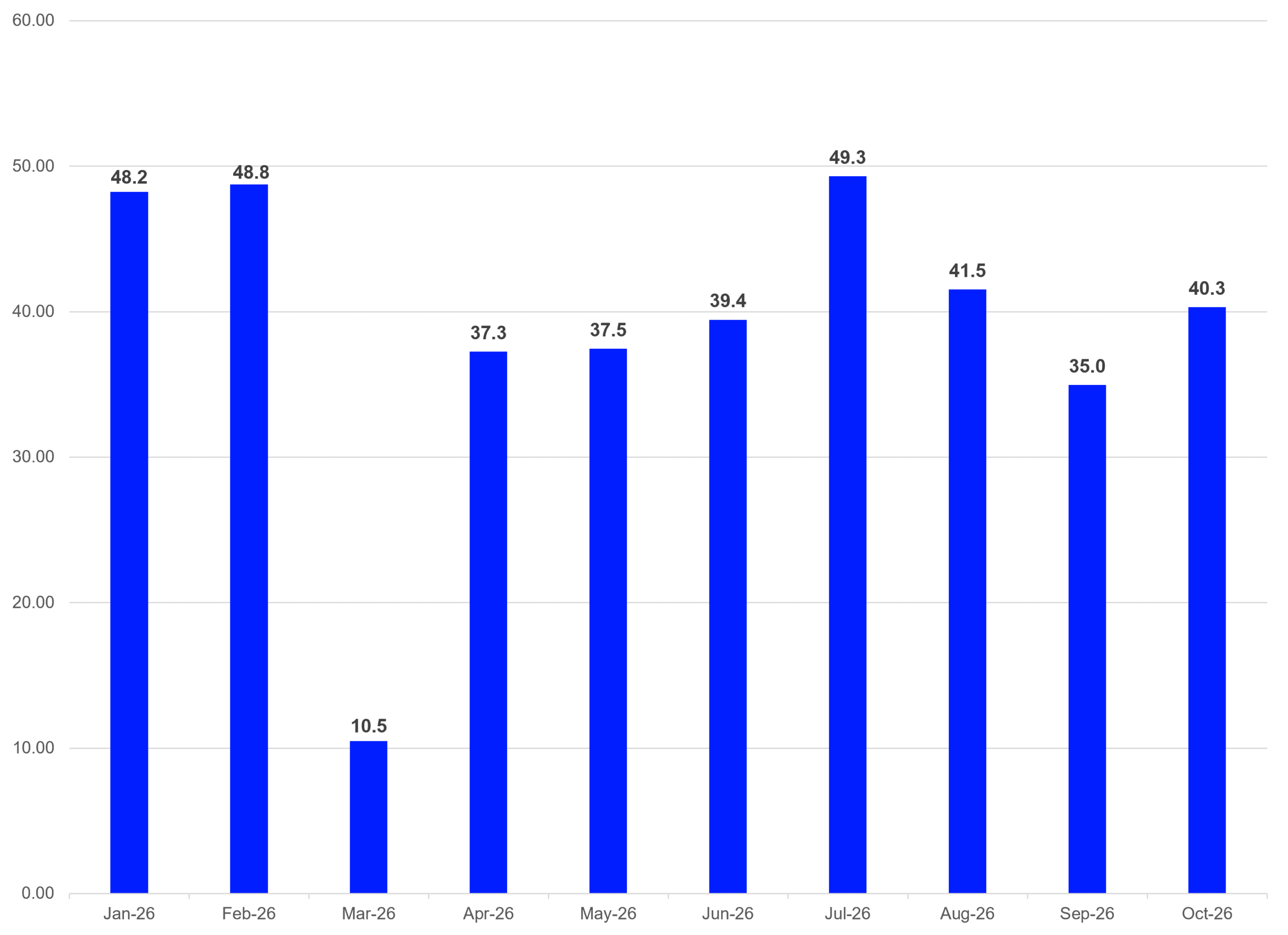
The inflows into the European ETF industry over the course of October (+€40.3 bn) proved that the trend of elevated inflows into ETFs in 2026 compared to previous years is further intact. This is also shown when comparing the inflows for October with the rolling 12-month average, as the estimated net inflows for October are above the rolling 12-month average flows (+€39.8 bn).
In addition to this, it is noteworthy that the general fund flow trend for the year is set to reach a new all-time high on an annual basis at the end of the year. In fact, the cumulative estimated net inflows for the first 10 months of 2026 (+€387.7 bn) have already surpassed the overall inflows for the year 2025 (+€332.5 bn). Hence, the European ETF ready is set to reach the third consecutive record for annual inflows. This shows that the popularity of ETFs among European investors is still growing despite the already generally higher inflows over the course of the record years 2024 and 2025.
Graph 1: Monthly Estimated Net Sales, January 1 – October 31, 2026 (Euro Billions)
Source: LSEG Lipper
When it comes to this, graph 1 shows that the estimated net flows in the European ETF industry were driven by an in general higher level of monthly inflows and not by a single month with exceptionally high inflows which increased the average monthly inflows. This flow pattern backs the assumption that the popularity of ETFs in Europe has further increased.
Despite the volatile market environment, it was not surprising to see that the estimated net inflows into ETFs were led by equity ETFs over the course of the month. Conversely, the relatively strong inflows into bond ETFs were somewhat surprising given the rather tough market environment for bonds. When it comes to this, the combination of inflows into bond and equity ETFs in this market environment might be seen as a sign that European investors are further in risk-on mode.
European ETF Flows by Asset Type
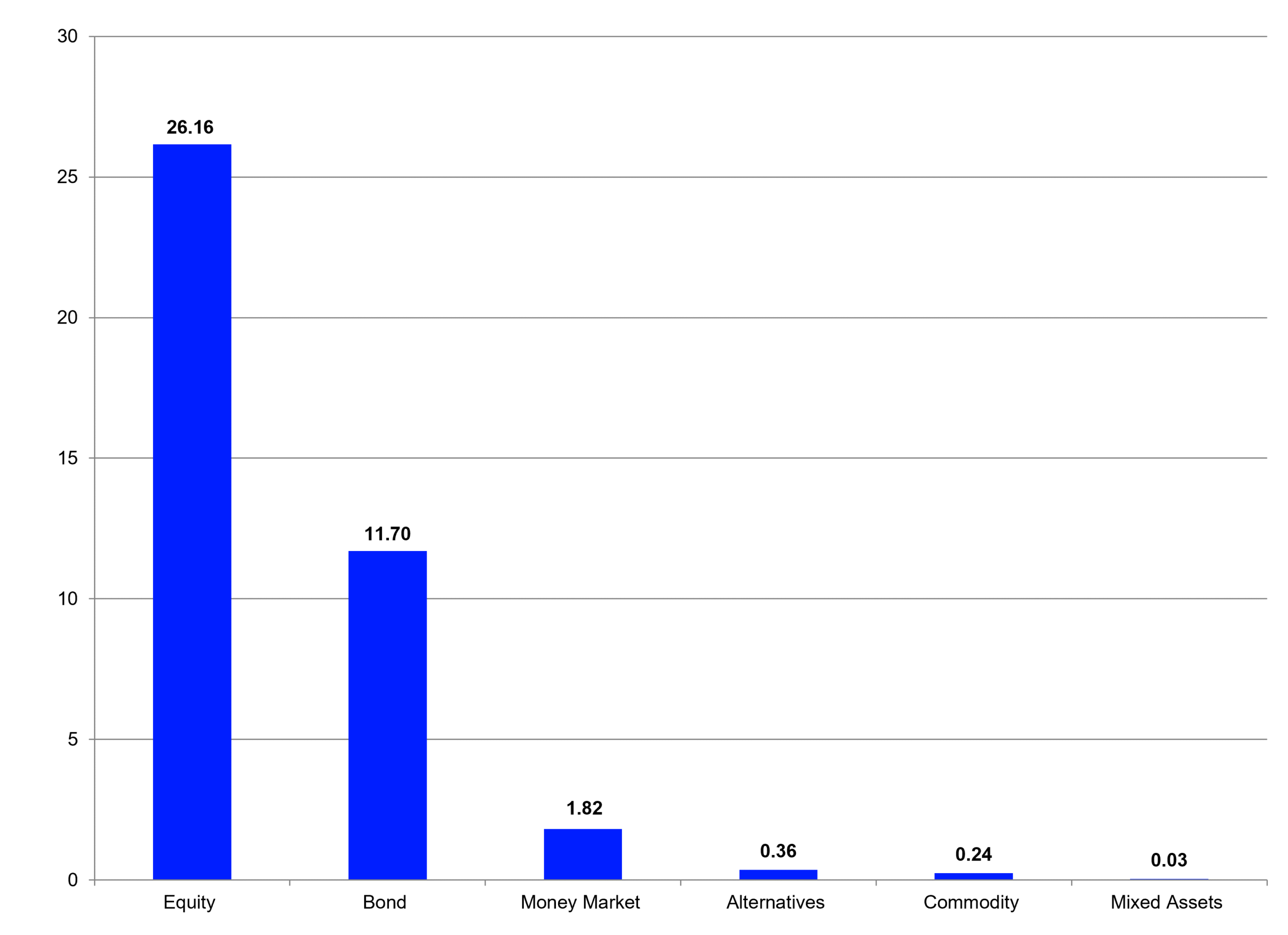
The inflows in the European ETF industry for October were driven by equity ETFs (+€26.2 bn), followed by bond ETFs (+€11.7 bn), money market ETFs (+€1.8 bn), alternatives ETFs (+€0.4 bn), commodities ETFs (+€0.2 bn), and mixed-assets ETFs (+€0.03 bn).
Graph 2: Estimated Net Sales by Asset Type, October 1 – October 31, 2026 (Euro Billions)
Source: LSEG Lipper
Despite the volatile market environment, it was not surprising to see that the estimated net inflows into ETFs were led by equity ETFs over the course of the month. Conversely, the relatively strong inflows into bond ETFs were somewhat surprising given the tough market environment for bonds. When it comes to this, the combination of inflows into bond and equity ETFs in this market environment might be seen as a sign that European investors are further in risk-on mode.
European ETF Flows by Lipper Global Classifications
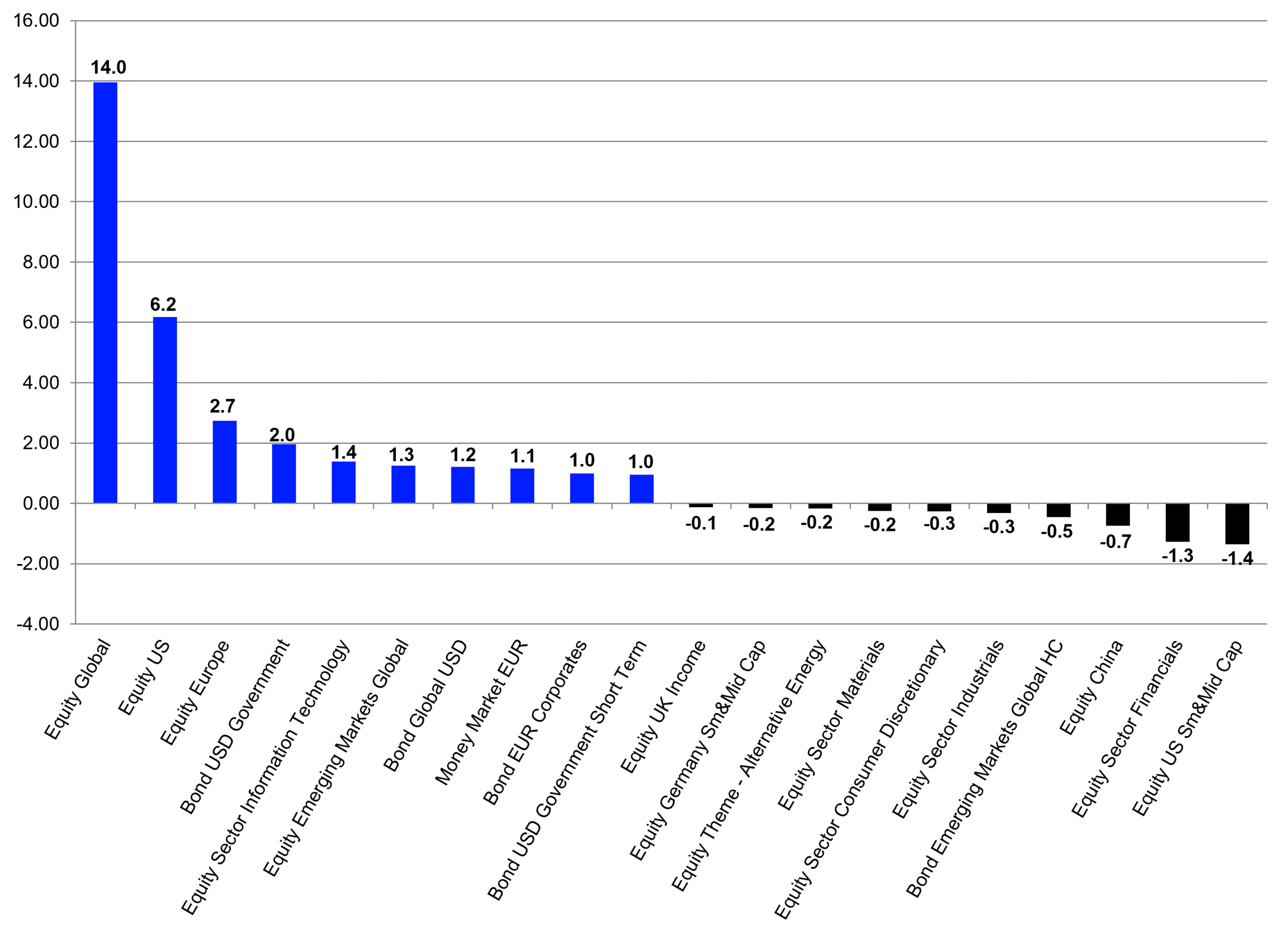
The net inflows of the 10 best-selling Lipper classifications accounted for €31.8 bn. In line with the overall sales trend for October, equity peer groups (+€25.5 bn) dominated the flows by asset type on the table of the 10 best-selling peer groups by estimated net inflows. That said, given the overall fund flows trend, it was not surprising to see four bond (+€5.1 bn) and one money market classification (+€1.2 bn) on the table of the 10 best-selling classifications for the month.
Given the overall fund flow trend in the European ETF industry, it was not surprising that Equity Global (+€14.0 bn) was the best-selling Lipper global classification for October. It was followed by Equity U.S. (+€6.2 bn), Equity Europe (+€2.7 bn), Bond USD Government (+€2.0 bn), and Equity Sector Information Technology (+€1.4 bn).
Graph 3: Ten Best- and Worst-Lipper Global Classifications by Estimated Net Sales, October 1 – October 31, 2026 (Euro Billions)
Source: LSEG Lipper
More generally, these numbers showed the European ETF segment is also highly concentrated when it comes to fund flows by Lipper classification. Generally speaking, one would expect the flows into ETFs to be concentrated since investors often use ETFs to implement their market views and short-term asset allocation decisions. These products are made and, therefore, are easy to use for these purposes.
On the other side of the table, the 10 classifications with the highest estimated net outflows for October accounted for €5.1 bn in outflows, which was in line with the outflows for September (-€5.2 bn).
Equity U.S. Small- and Mid-Cap (-€1.4 bn) was the classification with the highest outflows for the month. It was bettered by Equity Sector Financials (-€1.3 bn), Equity China (-€0.7 bn), Bond Emerging Markets Global in Hard Currencies (-€0.5 bn), and Equity Sector Industrials (-€0.3 bn).
More generally speaking, it can be said that European investors have reduced non-core risks in their portfolios, as the Lipper classifications which faced outflows over the course of the month were non-core asset classes.
Bond ETFs
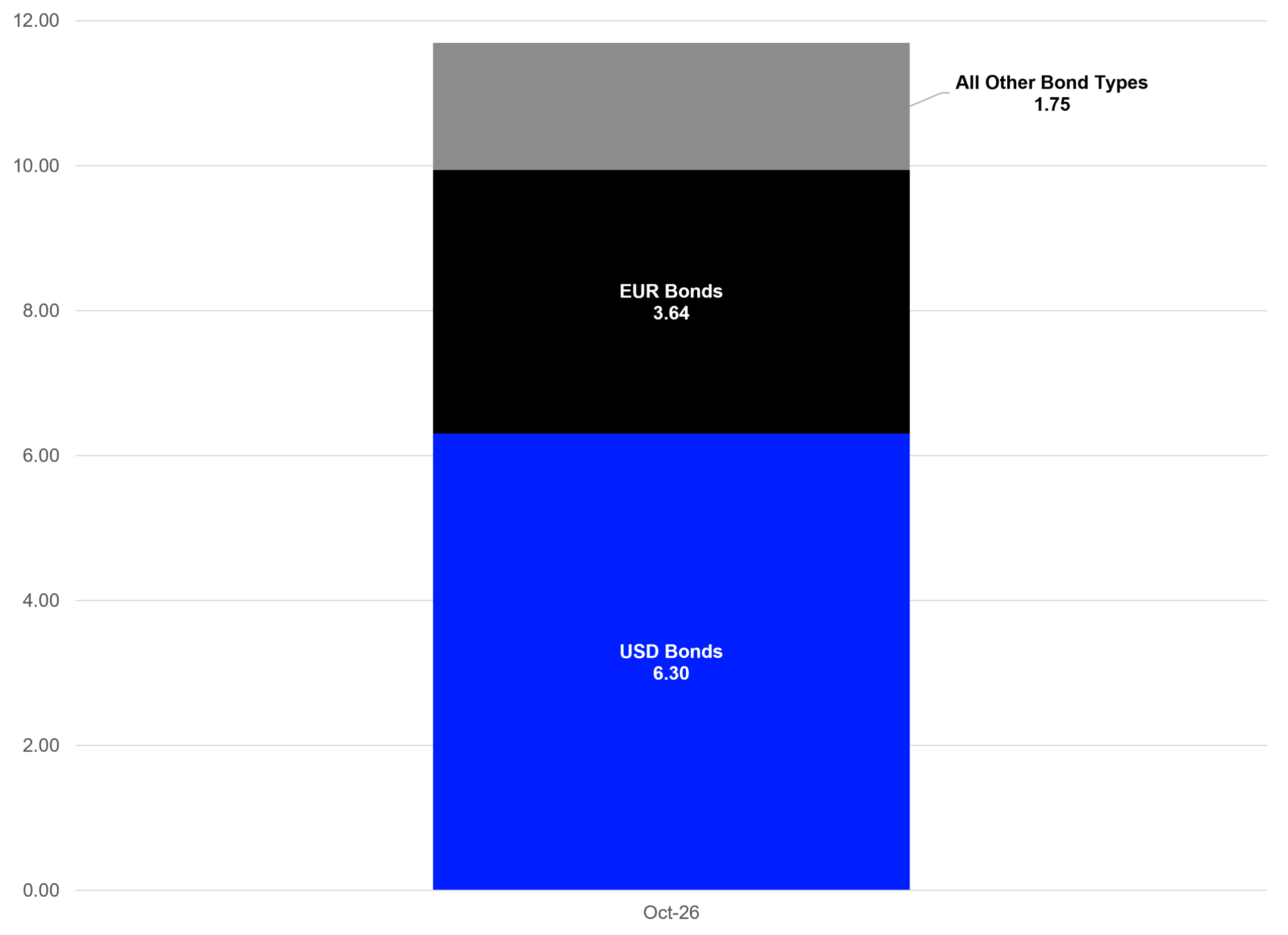
A view of the overall flows by asset type shows that European investors seem to prefer actively managed mutual funds over passive ETFs in the bond segment. A more detailed view of the flows into bond ETFs (+€11.7 bn) over the course of October 2026 shows that European ETF investors prefer U.S. dollar denominated bonds (+€6.3 bn) over EUR denominated bonds (+€3.6 bn). This may seem somewhat surprising, given the discussions around the steadily increasing amount of the overall U.S. deficit and the related debt financing with U.S. dollar government bonds.
That said, the discussions around the increasing debt have let to increasing interest rates for U.S. government bonds which seem to look like a tease to investors, as the majority of the inflows into bond ETFs in Europe was invested in U.S. dollar denominated bonds.
Graph 4: Cumulative Estimated Net Sales in Bond ETFs by Currency Exposure, October 1 – October 31, 2026 (Euro Billions)
Source: LSEG Lipper
In fact, one can see that increasing interest rates are driving the general trend toward bonds, as the number of bond classifications on the table of the best-selling Lipper classifications is increasing. At the end of October there were eight bond classifications on the table of the 20 best-selling Lipper classifications. In addition to this there were also money market funds on the table, which means that half the table of the 20 best-selling Lipper classifications for October was held by ETFs investing in bonds.
With regard to emerging market bonds, it looks like European investors have added some risk to their portfolios, as they sold ETFs classified as Bond Emerging Markets Global in Hard Currencies (-€0.5 bn) and bought ETFs classified as Bond Emerging Markets Global in Local Currencies (+€0.4 bn). These flows suit the thesis that European ETF investors were in risk-on mode over the course of October.
Equity ETFs
The high inflows into ETFs classified as Equity Global (+€14.0 bn) show that European ETF investors have no home bias when it comes to their portfolios. These flows also show that European investors like broad diversified products over regional or sector products given the wide margin of the lead for Equity Global. Nevertheless, Equity U.S. (+€6.2 bn) was the second best-selling Lipper classification for the month despite the high concentration of the market toward technology. When it comes to this, it might be somewhat surprising that ETFs classified as Equity Sector Information Technology (+€1.4 bn) enjoyed the fifth highest inflows given the high overlap of the respective sector indices with the leading U.S. equity indices. These flows might be seen as a sign that European investors were buying the dip since technology stocks showed an increasing volatility over the course of the month. This was driven by discussions around the increasing capex spending of the hyperscalers and within the overall AI ecosystem as the sticky inflation may lead to higher interest rates and, therefore, higher financing costs for the respective companies.
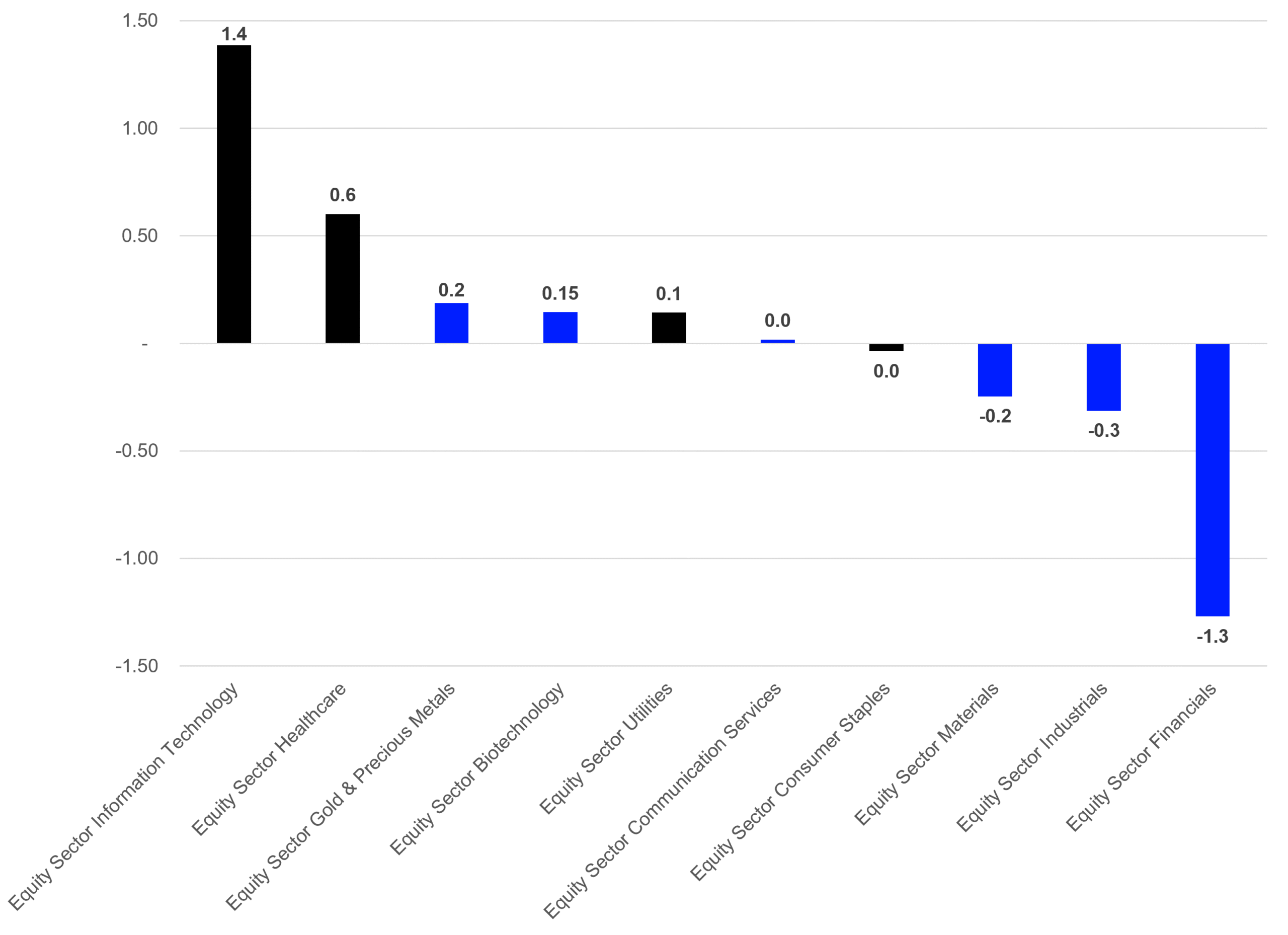
That said, one would expect that investors may switch their investment into more defensive sectors in times of increasing market volatility. This happened only on a small scale, ETFs classified as Equity Sector Healthcare (+€0.6 bn) and ETFs classified as Equity Sector Utilities (+€0.1 bn) enjoyed inflows, while ETFs classified as Equity Sector Consumer Staples faced slight outflows (-€0.1 bn). These flow trends could be seen as a further sign that European ETF investors were in risk-on mode over the course of October 2026.
Graph 5: Estimated Net Sales in Equity Sector Classification, October 1 – October 31, 2026 (Euro Billions)
Source: LSEG Lipper
It might be surprising that ETFs classified as Equity Sector Financials witnessed the second highest outflows of all Lipper classifications for the month, as possibly increasing interest rates are in general seen as positive for financials. That said, the outflows seem to be driven by profit taking, as financials were increasing over a long period of time and investors may not want to lose these gains in a market turmoil caused by the discussions around the profitability of the AI ecosystem. In addition to this, investors may fear that increasing interest rates may lead to higher default and, therefore, lower profitability rates in the banking sector.
Generally speaking, the fact that Equity Europe is on the table of the 10 best-selling Lipper classifications underpins that the negative trend for European equities has been reversed—October marks the fourth consecutive month with inflows into Equity Europe after three consecutive months with outflows.
Money Market ETFs
Generally speaking, money market is not considered a core asset type in the European ETF industry. That said, the steady inflows into money market ETFs drove the assets under management (AUM) held in money market products up to €61.5 bn. This means money market has overtaken commodities when it comes to the assets under management and became the third largest asset type by AUM in the European ETF industry at the end of October 2026.
Opposite to the bond sector, European investors preferred Money Market EUR (+€1.2 bn) over Money Market USD (+€0.6 bn) over the course of October 2026. Even as money market is in general considered as a safe haven, this flow pattern may underpin that European investors prefer to invest in their home currency when it comes to money market investments since they may not want to take any currency risk within short-term investment products. Hence, they may need the money invested in Money Market USD for long-term investments into U.S. dollar denominated assets in the future.


Comments
Log in or sign up to join the conversation.