
The Europe e-bike market is witnessing strong growth driven by expanding urban mobility initiatives, rising environmental awareness, and increasing demand for sustainable and efficient transportation solutions across key regions. The market size increased from USD 6.43 Billion in 2025 to USD 7.00 Billion in 2026 and is projected to reach USD 11.06 Billion by 2034, exhibiting a compound annual growth rate (CAGR) of 6.0% during 2026‑2034. Europe's accelerating shift toward green mobility, supported by government incentives, expanding cycling infrastructure, and technological advancements in battery and motor systems, is creating robust consumption patterns for e-bikes across the continent. This market is strategically important to Europe's economy as it directly supports the region's decarbonization goals, urban transportation transformation, and manufacturing sectors.
The Europe e-bike market is poised for sustained expansion, driven by favorable government policies, growing environmental consciousness, and rapid technological innovation. With a projected CAGR of 6.0% through 2034, the market presents significant opportunities for established manufacturers and new entrants focused on high‑performance, smart, and sustainable e-mobility solutions.
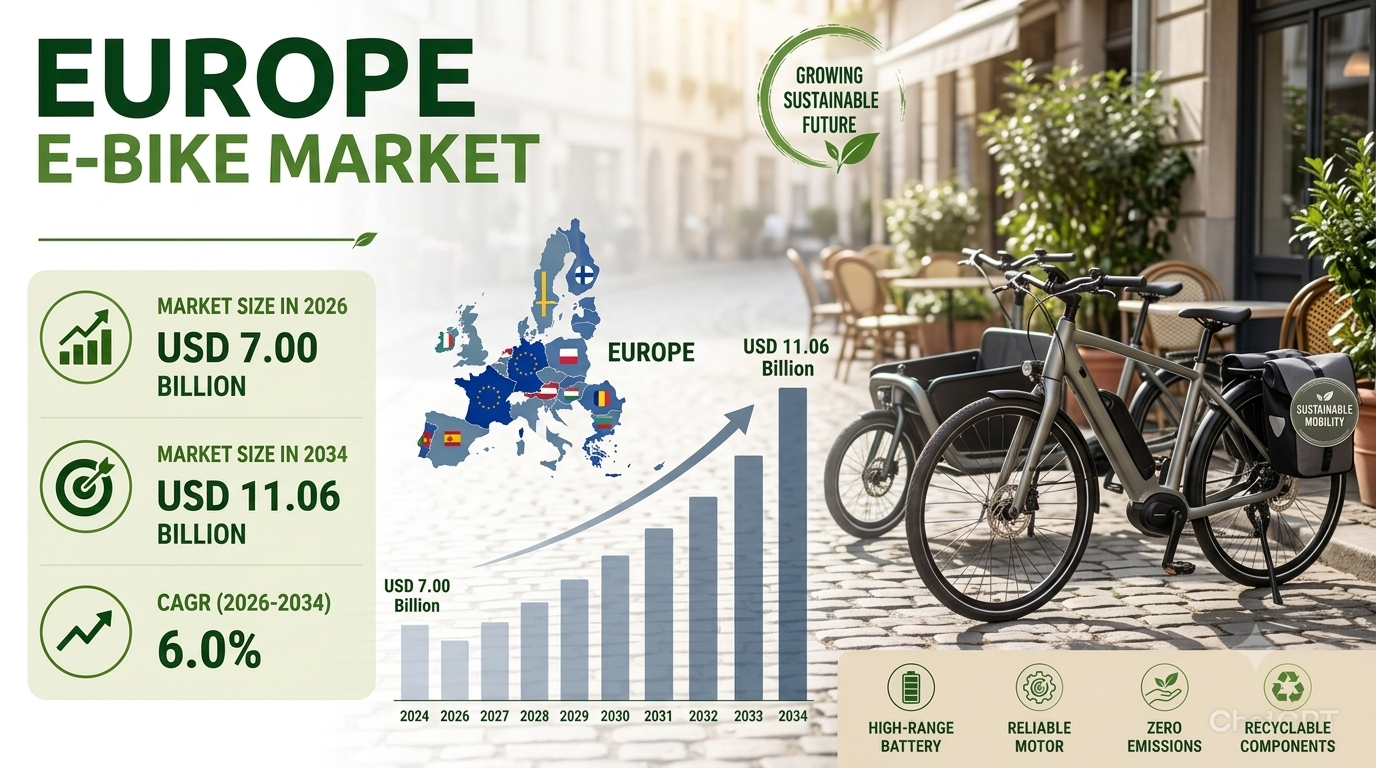
EUROPE E-BIKE MARKET SUMMARY
The Europe e-bike market encompasses a wide range of electrically assisted bicycles designed for personal transportation, recreation, fitness, and commercial delivery applications across urban and rural settings.
The ecosystem includes battery manufacturers, motor and drive system suppliers, frame and component producers, e-bike assemblers, distributors, retailers, and end‑use consumers.
Major segments identified in the market include product type (city/urban e-bikes, trekking e-bikes, mountain e-bikes, cargo e-bikes, speed pedelecs, and others), battery type (lithium‑ion, lithium‑iron‑phosphate, and others), motor type (mid‑drive, hub motor, and others), and end‑use (personal, commercial/fleet, and others).
The trekking and city/urban segments are the dominant categories, accounting for a significant share of total market volume, driven by commuter and leisure demand across Western and Northern Europe.
Germany, the Netherlands, France, Belgium, and Italy represent the largest country‑level markets, collectively contributing the majority of regional sales.
PORTER'S FIVE FORCES ANALYSIS – EUROPE E-BIKE MARKET
The competitive dynamics of the Europe e-bike market can be analyzed using Porter's Five Forces framework.
Porter's Five Forces Analysis – Europe E-Bike Market
Competitive Rivalry: High. Intense competition exists among established European brands (Accell Group, Pon.Bike, Giant, Trek, Specialized), emerging direct‑to‑consumer players, and low‑cost imports. Rivalry is driven by product innovation, battery range, pricing strategies, and brand loyalty. Business implication: Manufacturers must differentiate through technology leadership, design innovation, after‑sales service networks, and sustainable production practices to maintain market share.
Supplier Power: Moderate. Key components such as lithium‑ion cells, motors, and controllers are sourced from a limited number of global suppliers, primarily in Asia. However, growing European battery manufacturing capacity and diversification strategies are gradually reducing dependency. Business implication: Companies should develop strategic supplier partnerships, invest in local battery sourcing, and secure long‑term contracts to mitigate supply chain risks.
Buyer Power: Moderate to High. Consumers have access to a wide range of e‑bike options across price points, and switching costs are relatively low. Government subsidies and employer lease schemes further influence purchasing decisions. Business implication: Brands must build strong customer loyalty through quality, warranty offerings, digital connectivity features, and comprehensive service ecosystems.
Threat of Substitutes: Moderate. Traditional bicycles, public transportation, electric scooters, mopeds, and ride‑sharing services pose substitution threats. However, e‑bikes offer unique advantages in range, convenience, and cost‑effectiveness for medium‑distance commuting. Business implication: Industry players should emphasize the superior value proposition of e‑bikes, including health benefits, cost savings, and environmental advantages, while advocating for supportive urban mobility policies.
Threat of New Entrants: Moderate to High. Lower barriers exist for assembly and branding, but significant challenges remain in battery technology, regulatory compliance (EU safety and emissions standards), distribution networks, and brand establishment. Business implication: Established players should build defensible positions through proprietary technology, strong dealer networks, brand equity, and compliance expertise while monitoring emerging disruptors.
Competitive Rivalry – High (Intensifying)
Multi-tier competition spans established European manufacturers (Accell Group, Pon.Bike, Riese & Müller), global players (Giant, Trek, Specialized, Bosch eBike Systems), and emerging direct‑to‑consumer and budget‑focused brands — driving differentiation through battery range, smart connectivity, lightweight design, and sustainability credentials.
Strategic developments such as Pon.Bike's acquisitions, Accell Group's portfolio restructuring, and major investments in European battery production reflect active repositioning that is shaping the competitive ecosystem.
Request for Sample Report: https://www.imarcgroup.com/europe-e-bike-market/requestsample
MARKET GROWTH DRIVERS:
Several key factors are propelling the expansion of the Europe e-bike market. The growing environmental awareness and government incentives serve as powerful demand drivers. European governments are offering purchase subsidies, tax benefits, and employer lease schemes to promote e‑bike adoption as part of broader decarbonization strategies. The EU's commitment to reducing transport emissions by 90% by 2050 and the European Green Deal are creating a favorable policy environment. Additionally, the expanding urban mobility infrastructure is supporting e‑bike consumption, with cities across Europe investing heavily in cycling lanes, bike‑sharing programs, and secure parking facilities. The COVID‑19 pandemic accelerated this trend, with many commuters permanently shifting to e‑bikes for safe, socially distanced transportation.
The Europe e-bike market is also benefiting from accelerating technology adoption and evolving consumer demands. There is an accelerating shift toward smart e‑bikes with integrated GPS, anti‑theft systems, smartphone connectivity, and advanced battery management systems. Technological advancements in lithium‑ion batteries, mid‑drive motors, and lightweight frame materials are extending range, improving performance, and reducing charging times. Furthermore, the rising demand for cargo e‑bikes and commercial fleet solutions is creating a new growth segment, driven by last‑mile delivery services, logistics companies, and municipal fleet operators transitioning to sustainable transportation. The growing popularity of e‑bike leasing and subscription models is also democratizing access and driving volume growth across diverse consumer segments.
EUROPE E-BIKE MARKET SEGMENTATION
Segmentation analysis provides a detailed view of the Europe e-bike market by category:
Product Type Insights: City/Urban E-Bikes, Trekking E-Bikes, Mountain E-Bikes, Cargo E-Bikes, Speed Pedelecs, Others.
Battery Type Insights: Lithium‑Ion, Lithium‑Iron‑Phosphate, Others.
Motor Type Insights: Mid‑Drive, Hub Motor, Others.
End Use Insights: Personal, Commercial/Fleet, Others.
Regional Insights: Germany, Netherlands, France, Belgium, Italy, United Kingdom, Spain, Nordics, Rest of Europe.
COMPETITIVE LANDSCAPE
The Europe e-bike market features a competitive landscape with a mix of established European manufacturers, global bicycle companies, and emerging technology‑focused entrants. Key companies operating in the market include:
Accell Group N.V.
Pon.Bike
Giant Manufacturing Co., Ltd.
Trek Bicycle Corporation
Specialized Bicycle Components, Inc.
Riese & Müller GmbH
Bosch eBike Systems
Shimano Inc.
Brose Fahrzeugteile SE & Co. KG
Yamaha Motor Co., Ltd.
Strategic developments are shaping the competitive arena, notably Pon.Bike's continued expansion through acquisitions, Accell Group's portfolio optimization, and significant investments in European battery cell production to reduce dependency on Asian suppliers and enhance supply chain resilience.
REGIONAL ANALYSIS:
Regional dynamics within the Europe e-bike market are shaped by varying levels of cycling culture, government support, and infrastructure development.
Germany: The largest e‑bike market in Europe, driven by strong cycling culture, extensive dealer networks, and generous government incentives. Demand is particularly strong for trekking and city e‑bikes.
Netherlands: A mature market with high e‑bike penetration, supported by world‑class cycling infrastructure and a strong commuting culture. Speed pedelecs and cargo e‑bikes are gaining traction.
France: Rapidly growing market supported by government subsidies, expanding cycling lanes, and increasing environmental awareness. The Île‑de‑France region is a key demand center.
Belgium: Strong commuter e‑bike adoption driven by employer lease schemes and favorable tax treatment. Speed pedelecs are particularly popular for longer commutes.
Italy: Growing market with strong demand for e‑bikes in urban areas and tourism regions. Government incentives and bike‑sharing programs are supporting adoption.
United Kingdom: Expanding market despite regulatory uncertainties, driven by rising fuel costs, environmental concerns, and government cycling initiatives.
Spain: Emerging market with increasing e‑bike adoption in cities like Barcelona and Madrid, supported by municipal bike‑sharing programs and cycling infrastructure investments.
Nordics: High adoption rates in Denmark, Sweden, and Norway, driven by strong environmental consciousness, excellent cycling infrastructure, and supportive policies.
Rest of Europe: Includes Austria, Switzerland, Poland, and other markets with growing e‑bike penetration, supported by EU‑wide sustainability initiatives and cycling infrastructure development.
RECENT INDUSTRY DEVELOPMENTS
March 2026: The European Commission announced expanded funding for cycling infrastructure under the Connecting Europe Facility, allocating EUR 500 million for cross‑border cycling routes and urban mobility projects across member states.
January 2026: Bosch eBike Systems unveiled its next‑generation Performance Line motor with enhanced torque, reduced weight, and improved battery efficiency, setting new benchmarks for mid‑drive systems.
November 2025: Pon.Bike completed the acquisition of a major European e‑bike brand, strengthening its portfolio and distribution network across key markets.
September 2025: Accell Group announced a strategic partnership with a leading European battery manufacturer to secure domestic supply of lithium‑ion cells and reduce dependency on Asian suppliers.
June 2025: The German government extended its e‑bike purchase subsidy program with an additional EUR 100 million allocation, targeting commercial cargo e‑bikes and fleet conversions.
April 2025: Shimano Inc. launched its latest STEPS drive system with integrated connectivity features, over‑the‑air updates, and enhanced battery management for premium e‑bike segments.
Note: If you need any specific information that is not covered currently within the scope of the report, we will provide the same as a part of customization.
Request Customization: https://www.imarcgroup.com/request?type=report&id=2701&flag=E
Write this before about us –
Report Format, Delivery, and Customization Details
Report Format Mode: PPT, PDF, and Excel
Report Delivery Mode: Online Delivery, Physical Delivery
Report Delivery Time: Report Delivered Over Email within 24 to 48 hours. If requested by the client, a physical copy will be delivered within three to ten days.
Report Confirmation Mode: Yes via Email
Report Customization Mode: Yes via Email / Call
Report Table of Content: Yes
Report List of Figures: Yes
Report Methodology Mode: Yes
Request For Sample Report: Yes
Comments
Log in or sign up to join the conversation.