


The EUR/GBP cross trades with mild losses around 0.8345 during the early European trading hours on Tuesday. The British Pound (GBP) strengthens against the Euro (EUR) amid hawkish rate expectations from the Bank of England (BoE).
The BoE is likely to raise the Bank Rate to 4.0% from 3.75% at its November policy meeting on Thursday, according to economists polled by Reuters. This would be its first hike since August 2023, when inflation was still more than the BoE’s 2% target.
Traders will take more cues from the BoE Governor Andrew Bailey’s press conference. Any hawkish comments from the BoE policymakers could boost the British Pound (GBP) in the near term.
"While we don't expect a clear steer from the Committee on how many hikes they're planning, it's possible that the meeting minutes or Bailey ... signal that Bank Rate is unlikely to reach the level that is priced in by financial markets," said Alexander Harvey, UK economist at consultancy Oxford Economics.
Weaker-than-expected German Retail Sales data could weigh on the EUR. The figure fell by 2.0% MoM in September, versus a rise of 1.2% prior, below the market consensus of a 0.4% growth. On an annualized basis, Retail Sales arrived at -2.3% in September, compared to a 0.3% decline in August.
BoE seen kicking off tightening cycle but guidance may cap Pound gains
Strategists at Brown Brothers Harriman note that the upcoming “Bank of England (BoE) policy decision and Monetary Policy Report (MPR)” on Thursday is widely expected to mark the start of a new tightening phase, with the BoE “widely expected to start tightening with a 25bps hike to 4.00% after standing pat all year.” They point out that “firmer UK inflation and economic activity back the move,” while the vote is anticipated to split “7-2 with doves Alan Taylor and Swati Dhingra supporting a hold.”
However, BBH cautions that “BoE guidance and the updated MPR will test market expectations for 100bps of tightening over the next twelve months.” In their view, “persistent spare capacity across the forecast horizon would strengthen the case for pricing out hikes and limit GBP upside,” suggesting that even a hawkish policy shift may not translate into sustained Pound strength if the Bank’s projections remain subdued.
BoE’s Greene flags stalled wage disinflation, keeping GBP rate hike risks alive
BoE’s Greene speech scores 7.4 on FXS Speechtracker, exactly in line with Greene’s historic average, but the emphasis on stalled wage disinflation and greater risk of second-round effects marks a clear hawkish tilt. Greene’s focus on pay growth nearer 3.5%, wage disinflation stuck above levels consistent with 2% inflation, and an economy showing surprising resilience suggests limited appetite for rapid rate cuts and supports a firmer GBP bias.
The remark that labor market slack may have peaked reinforces the idea that underlying inflation pressures could persist, validating Greene’s call to proactively lean against second-round effects. Overall, the speech backs a narrative of sticky wage dynamics and resilient demand, which is supportive for GBP yields and keeps upside risks for the currency intact.
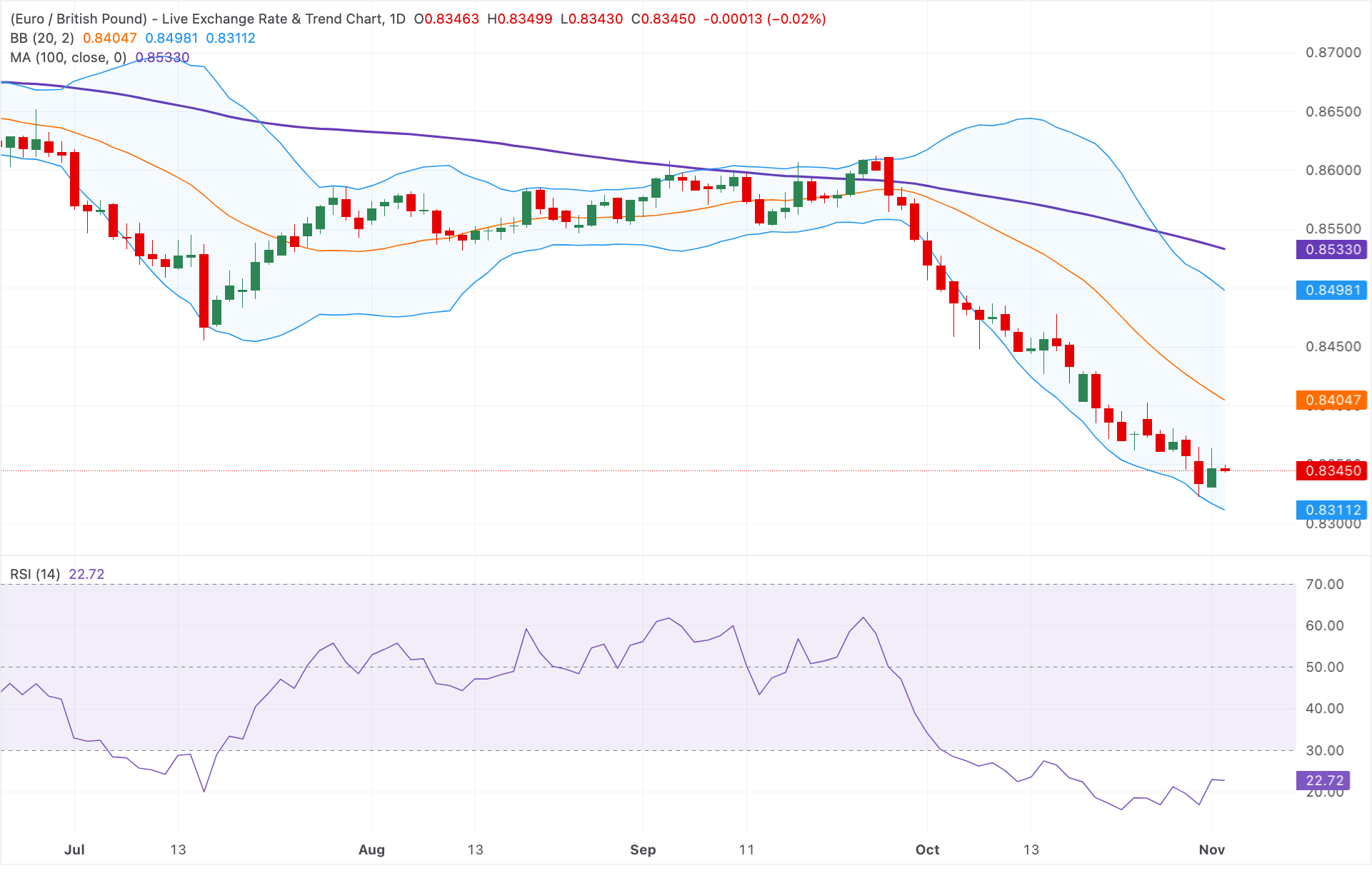
Technical Analysis: EUR/GBP retains a bearish vibe amid oversold conditions
In the daily chart, EUR/GBP remains under clear bearish pressure as price sits below the 20-period Bollinger middle band and the 100-day moving average, keeping rallies capped by a dense overhead cluster. The Relative Strength Index (14) around 22.7 is embedded in oversold territory, which hints that while downside momentum is still strong, the pair could be vulnerable to short-covering bounces rather than a sustained recovery unless key resistance is reclaimed.
On the topside, initial resistance appears at the Bollinger middle band near 0.8405, followed by the upper band around 0.8500, while the 100-day moving average at 0.8535 marks a more significant barrier for any corrective advance. On the downside, the lower Bollinger band at approximately 0.8310 offers immediate support; a decisive break below this level would open the door to a continuation of the downtrend toward fresh lows.


Comments
Log in or sign up to join the conversation.