


This currency pair has become a tug-of-war between two central banks with opposing policy signals, leaving traders suspended in genuine uncertainty about which narrative will win. EUR/USD defended the 1.16 level on Friday as buyers staged a session recovery, but the currency pair now sits at an inflection point where the structural misalignment between Fed rate guidance and ECB forward expectations masks the vulnerability of any directional commitment until Wednesday's policy announcement.
Fed Rate Decision as Catalyst
The Federal Reserve's policy decision on Wednesday is the near-term catalyst that will determine whether consolidation friction finally breaks into a committed directional move. Rate divergence between the Fed and ECB remains the primary driver of EUR/USD positioning. Should the Fed signal higher-for-longer messaging or suggest a pause in rate cuts, the dollar will likely strengthen, pushing EUR/USD lower. Conversely, if the Fed hints at dovish pivot or rate cuts sooner than expected, euro strength could accelerate toward resistance levels.
Technical Levels in Focus
EUR/USD has been consolidating around the 1.16 level, with the 50-day exponential moving average (EMA) providing dynamic support at 1.1580. The 200-day simple moving average (SMA) sits higher, around 1.1750, acting as a ceiling for near-term upside. This sandwich between moving averages suggests that institutional money is testing both the upside and downside before committing to a directional break. Volume patterns show that large speculators are positioning defensively, neither aggressively buying nor selling into strength.
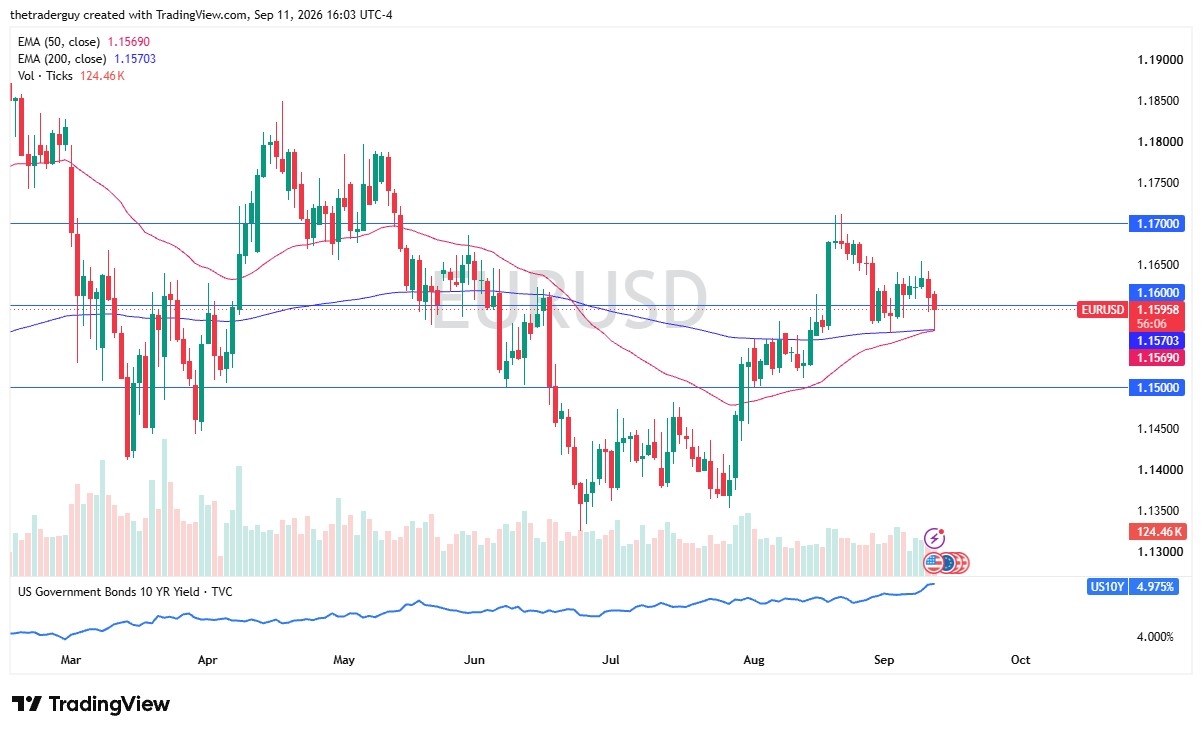
EUR/USD Price Chart
Geopolitical and Energy Supply Risk
Middle East geopolitical tensions continue to weigh on energy markets, which in turn affects EUR/USD through the risk-on/risk-off dynamic. Energy disruptions directly hamstring European growth expectations, where energy dependency remains elevated relative to other developed economies. Should oil prices spike unexpectedly, safe-haven demand could push the dollar higher and EUR/USD lower, creating a secondary headwind for the euro beyond rate differentials. This geopolitical overlay adds structural unpredictability to an already uncertain rate environment.
US-German Yield Spreads as a Market Signpost
The yield spread between US 10-year Treasuries and German Bunds has been a reliable barometer for EUR/USD direction. Widening spreads favor dollar strength, while narrowing spreads typically support the euro. Currently, the spread remains in a holding pattern, reflecting the market's uncertainty ahead of the Fed decision. Watch for any significant move in this spread on Wednesday afternoon or Thursday morning, as it will likely precede or accompany a EUR/USD breakdown.
When Consolidation Breaks
The consolidation thesis hinges on EUR/USD respecting the 1.16–1.1750 range through Wednesday's Fed decision. Should EUR/USD decisively clear 1.1650 on a daily close with volume confirmation, the upside invalidation signals either Fed dovishness or a geopolitical risk-off rally. Conversely, a break below 1.1550 would indicate either safe-haven demand triggered by Fed hawkishness or an escalation in Middle East tensions that reprices growth expectations lower. Either breakout would confirm that consolidation friction has finally resolved into institutional conviction, ending the current tug-of-war dynamic between the two central banks.
H2 Key Sessions and Data Points Ahead
Wednesday's Fed rate decision and Powell presser represent the primary event risk for EUR/USD direction. Thursday brings the Bank of Japan policy meeting, which could amplify or dampen dollar strength depending on BoJ guidance and carry-trade unwinding dynamics. Watch US-German yield spreads in real-time during the Fed announcement; a sudden widening would confirm dollar strength, while a narrowing would support euro recovery. Oil prices and Middle East headlines will provide secondary confirmation signals. The consolidation at 1.16 will likely persist until one of these catalysts forces institutional traders to make a committed directional choice.
EUR/USD consolidates between Fed-ECB rate divergence, geopolitical energy risk, and the 1.16 technical fulcrum, testing whether institutional conviction will break toward 1.1650 or below 1.1550. The 1.16 zone remains the true balance point; watch Wednesday's Fed presser and Thursday's BOJ for the first genuine breakdown signal. Until then, the middle of consolidation absorbs both bullish rate differentials and geopolitical supply concerns, leaving the next directional commitment to whoever blinks first on policy.
Comments
Log in or sign up to join the conversation.