


EUR/USD extends its decline on Wednesday as the Euro (EUR) remains under broad selling pressure, while the US Dollar (USD) strengthens alongside surging US Treasury yields. At the time of writing, the pair trades around 1.1195, down 0.57% on the day, hovering near its lowest level in 17 months.
The US Dollar Index (DXY), which tracks the Greenback’s value against a basket of six major currencies, trades around 102.30, at levels last seen in April 2025. Meanwhile, the benchmark 10-year US Treasury yield climbs to 5.365%, its highest level since 2002, before easing toward 5.31%.
Higher Oil prices, concerns over rising government debt and a resilient US growth outlook are contributing to the increase in borrowing costs. The rise in Treasury yields supports demand for US Dollar-denominated assets, while elevated energy prices keep inflation risks tilted to the upside and strengthen the case for the Federal Reserve (Fed) to maintain a restrictive policy stance.
Markets now await the minutes of the Federal Open Market Committee’s (FOMC) September meeting, due at 18:00 GMT. The Fed raised interest rates by 25 basis points (bps) last month, lifting the federal funds target range to 3.75%-4.00%. However, the latest employment and Personal Consumption Expenditures (PCE) inflation figures came in softer than expected, reducing pressure on the Fed to raise interest rates again at its October 27-28 meeting.
On the Eurozone side, concerns over France’s public finances remain a major drag on the shared currency. The uncertainty has pushed French borrowing costs higher and widened bond spreads.
Strategists at ABN Amro highlight that the Euro “tends to weaken when government bond yields in a major Eurozone country, or in several countries, rise sharply because of political and/or fiscal concerns.” In such episodes, “there was some fear of contagion, and this impacts the currency as well.” ABN Amro argues that “periods of fiscal and political uncertainty in the Eurozone often coincide with speculators holding net short Euro positions and a lower EUR/USD,” pointing to the “recent relationship between the ten-year French-German government bond spread and the Euro” as a clear illustration of how widening spreads and political risk have been feeding into currency weakness.
Turmoil in Eurozone bond markets could limit the scope for aggressive tightening by the European Central Bank (ECB). Markets nevertheless continue to price in additional rate increases as elevated energy prices keep inflation risks firmly in focus, even as policymakers maintain a cautious tone.
ECB policymaker Álvaro Santos Pereira said headline and core inflation remain “far below” the levels seen during the 2022 energy shock, while other goods prices show no signs of inflation expectations becoming de-anchored.
Euro Price Today
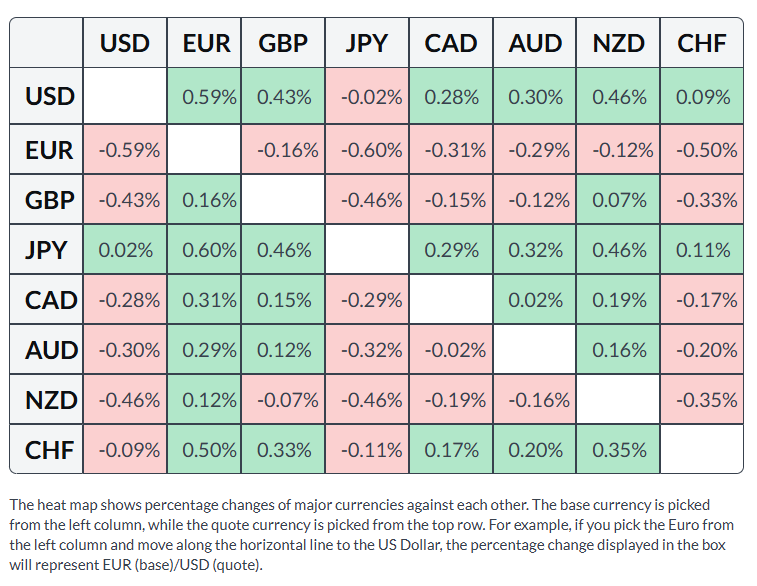
The table below shows the percentage change of Euro (EUR) against listed major currencies today. Euro was the strongest against the New Zealand Dollar.


Comments
Log in or sign up to join the conversation.