

The global Ethanol Price market witnessed mixed performance in 2026 as supply-demand dynamics varied across major producing and consuming regions. Ethanol prices were shaped by several macroeconomic and sector-specific factors, including agricultural feedstock costs, fuel blending mandates, biofuel policies, industrial demand, export volumes, and logistics constraints.
According to ChemAnalyst Ethanol Price: - https://www.chemanalyst.com/Pricing-data/ethanol-13
Ethanol remains a strategically important commodity across multiple industries. It is widely used as a transportation fuel additive, industrial solvent, pharmaceutical ingredient, sanitizer component, and raw material for chemical manufacturing. As governments continue to promote renewable energy and carbon reduction strategies, ethanol demand remains structurally strong despite short-term pricing fluctuations.
In Q1 2026, North America and Europe experienced price declines due to adequate supply and weaker downstream demand, while South America recorded notable gains because of tightening supply and stronger export activity. Meanwhile, the Asia-Pacific market remained relatively stable with modest downward corrections.
This Ethanol Price Trend Analysis examines market movements across key global regions, major price drivers, and the forecast outlook for the coming quarters.
Global Ethanol Market Size and Industry Outlook
The global ethanol market continues expanding as renewable fuel adoption accelerates worldwide. Rising environmental regulations and increasing demand for cleaner-burning fuels are encouraging greater ethanol blending in gasoline.
Key sectors driving ethanol consumption include:
Fuel blending and biofuels
Beverage and food processing
Pharmaceuticals
Cosmetics and personal care
Industrial chemicals
Sanitization and healthcare
Growth in the renewable energy sector is particularly influential. Many countries have introduced ethanol blending mandates ranging from 5% to 27%, increasing structural demand for fuel-grade ethanol.
Additionally, volatility in crude oil prices impacts ethanol economics, as ethanol often serves as a cost-effective oxygenate and octane enhancer in fuel blends.
Key Factors Affecting Ethanol Price
Several interconnected variables influence global Ethanol Price movements.
Feedstock Costs
Feedstock remains the largest cost component in ethanol production. Corn dominates production in the United States, while sugarcane is the primary feedstock in Brazil. Wheat, molasses, and cassava are also used in select regions.
Price increases in agricultural commodities directly raise ethanol production costs.
Key feedstocks include:
Corn
Sugarcane
Molasses
Wheat
Cassava
Poor harvest yields, droughts, flooding, and crop disease can sharply affect supply and pricing.
Energy and Production Costs
Ethanol production is energy-intensive. Rising costs of electricity, natural gas, steam, and transportation significantly influence production margins.
Major cost contributors include:
Fermentation energy usage
Distillation fuel requirements
Storage costs
Freight charges
Port handling expenses
Higher utility prices often translate into upward pressure on ethanol prices.
Government Biofuel Policies
Regulations strongly influence ethanol demand worldwide.
Examples include:
Fuel blending mandates
Carbon reduction policies
Renewable fuel standards
Tax credits and subsidies
Changes in policy can rapidly alter regional demand and pricing.
Trade and Export Dynamics
Global ethanol trade plays a critical role in balancing regional shortages and surpluses. Import tariffs, shipping costs, sanctions, and currency fluctuations influence cross-border price competitiveness.
Export-oriented economies such as Brazil are particularly sensitive to international demand changes.
Read the LinkedIn Article: - https://www.linkedin.com/pulse/ethanol-price-trend-analysis-2026-global-market-size-regional-singh-5gppc/
Regional Ethanol Price Analysis
North America Ethanol Price Trend
USA Ethanol Price Analysis
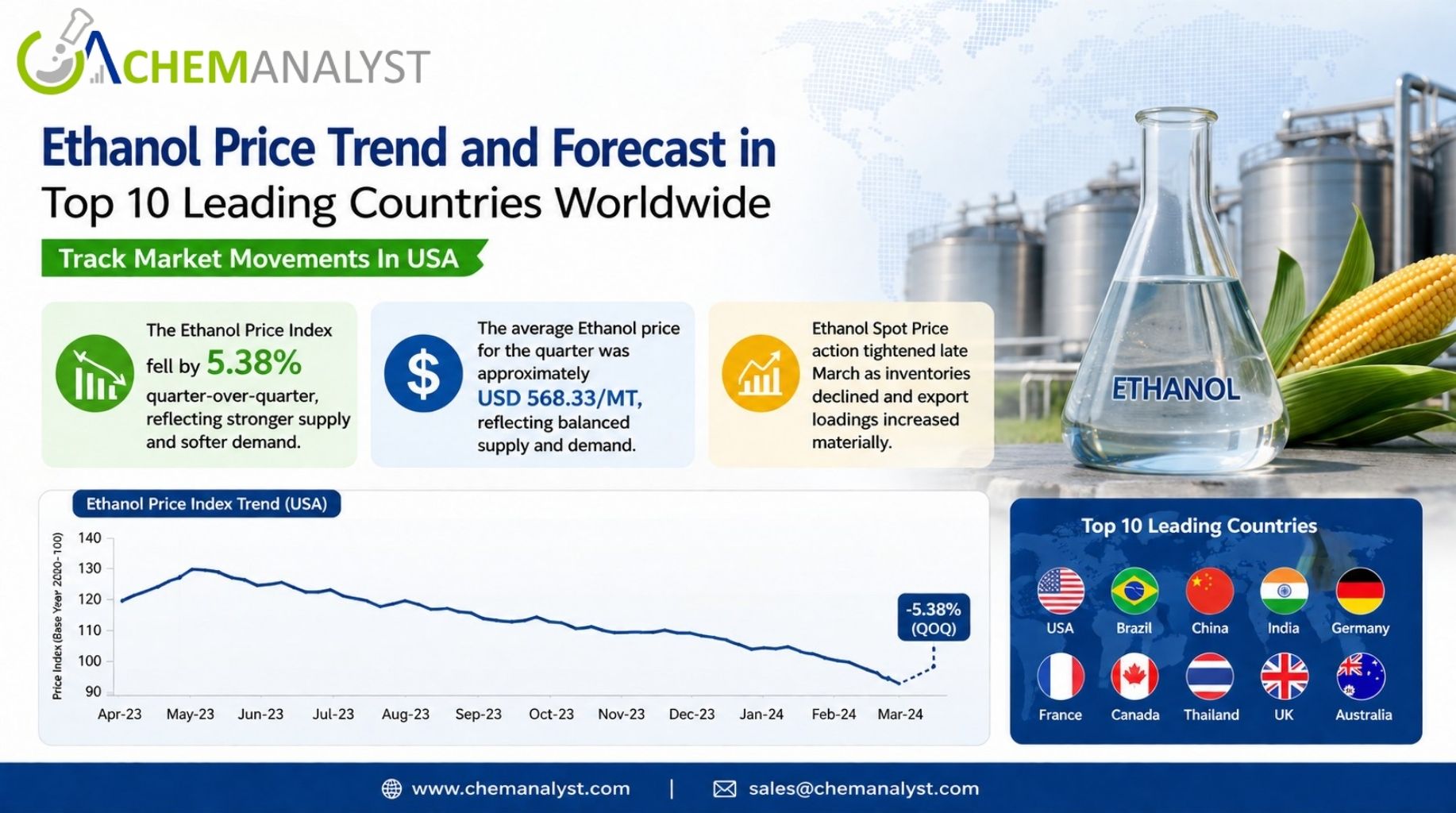
In the United States, the Ethanol Price Index fell by 5.38% quarter-over-quarter during Q1 2026.
The average ethanol price reached approximately USD 568.33/MT, indicating a softer pricing environment compared with the previous quarter.
Several factors contributed to the decline.
Strong Supply Conditions
Corn harvest availability remained strong, allowing ethanol producers to maintain healthy production levels. Sufficient feedstock availability improved operational efficiency and kept inventories elevated.
Higher production rates increased market liquidity and reduced pricing pressure.
Softer Fuel Demand
Demand from fuel blenders weakened due to moderate gasoline consumption and seasonal inventory adjustments.
Lower blending urgency reduced spot market activity.
Inventory Pressure
Large ethanol stockpiles added downward pressure to the market. Producers competed aggressively to clear inventories, resulting in price corrections.
Despite the quarterly decline, the long-term outlook remains positive due to sustained renewable fuel demand.
APAC Ethanol Price Trend
South Korea Ethanol Price Analysis
In South Korea, the Ethanol Price Index fell by 0.91% quarter-over-quarter.
The average price stood at approximately USD 688.00/MT, based on CFR Ulsan assessments.
Compared with other regions, APAC showed relatively stable price movement.
Stable Import Flows
South Korea relies heavily on imported ethanol. Import volumes remained consistent, ensuring adequate supply across industrial sectors.
Steady arrivals prevented significant supply shortages.
Balanced Industrial Demand
Demand from pharmaceuticals, chemicals, and food processing remained steady. No major consumption spikes were observed during the quarter.
This balance helped limit price volatility.
Freight Stabilization
Shipping costs across Asian routes showed limited fluctuations, reducing the impact of logistics on overall ethanol pricing.
South Korea’s market reflected equilibrium between import availability and industrial demand.
Europe Ethanol Price Trend
Germany Ethanol Price Analysis
In Germany, the Ethanol Price Index declined by 2.80% quarter-over-quarter.
Average ethanol prices were approximately USD 682.00/MT, based on weighted spot and contract benchmarks.
The European market experienced moderate downward pressure.
Softer Import Competition
Imported ethanol became increasingly competitive, pressuring domestic suppliers to adjust pricing.
This reduced producer margins.
Weak Industrial Margins
Downstream manufacturers remained cautious due to economic uncertainty and compressed profitability.
Lower purchasing urgency weakened spot transactions.
Supply Availability
Ample regional availability contributed to balanced supply conditions.
Despite declining prices, ethanol demand from sustainability-focused sectors remains robust across Europe.
South America Ethanol Price Trend
Brazil Ethanol Price Analysis
Brazil emerged as the strongest-performing ethanol market in Q1 2026.
The Ethanol Price Index rose by 4.98% quarter-over-quarter, significantly outperforming other major regions.
Average ethanol prices reached approximately USD 801.33/MT.
Strong Export Interest
Brazil continued to benefit from strong global ethanol demand. Export activity remained elevated, tightening domestic availability.
Growing overseas demand supported higher prices.
Seasonal Supply Constraints
Sugarcane harvest cycles created temporary supply tightness, limiting ethanol production volumes.
Reduced output increased pricing power among suppliers.
Domestic Fuel Demand
Brazil’s domestic fuel market remained strong due to widespread flex-fuel vehicle adoption.
Robust local consumption added further upward pressure to ethanol prices.
Brazil remains a critical global price indicator because of its large export capacity.
Ethanol Price Forecast 2026–2027
The future Ethanol Price Forecast suggests moderate volatility with an overall upward bias in key exporting regions.
Factors Likely to Support Prices
Potential bullish factors include:
Rising corn and sugarcane costs
Increased biofuel mandates
Higher crude oil prices
Strong export demand
Seasonal production constraints
These conditions could tighten supply and support price recovery.
Factors That Could Pressure Prices
Potential bearish risks include:
Oversupply in major producing regions
Weak industrial demand
Falling energy costs
Improved crop yields
Lower gasoline blending demand
These factors may limit price growth.
Short-Term Ethanol Price Outlook
In the near term, analysts expect:
Stable to slightly weaker prices in North America
Balanced pricing across APAC
Moderate volatility in Europe
Continued strength in Brazil
Market participants should closely monitor agricultural supply and policy developments.
Long-Term Market Opportunities
Long-term growth prospects for ethanol remain favorable due to global decarbonization efforts.
Key growth drivers include:
Sustainable aviation fuel development
Renewable chemical production
Green industrial manufacturing
Transportation decarbonization
Expanding bio-refineries
As climate-focused investment increases, ethanol demand is expected to rise structurally.
Conclusion
The global Ethanol Price market in 2026 reflects a complex interplay of supply fundamentals, energy economics, trade flows, and policy support.
North America saw notable price declines due to oversupply and softer fuel demand, while South Korea and Germany recorded moderate corrections amid balanced supply conditions. Brazil stood out as the strongest market, driven by export demand and seasonal supply constraints.
Looking ahead, ethanol prices will remain sensitive to feedstock costs, crude oil movements, regulatory changes, and global trade patterns. As renewable energy adoption accelerates, ethanol’s strategic importance is expected to grow further.
Businesses, investors, and procurement professionals should continue monitoring regional price trends to optimize sourcing strategies and manage market risk effectively.
Contact -
Address:
420 Lexington Avenue, Suite 300
New York, NY 10170
United States
Phone: +1 332 258 6602
Website: www.chemanalyst.com
LinkedIn: https://www.linkedin.com/company/chemanalyst/
X (Twitter): https://x.com/chemanalysts
Facebook: https://www.facebook.com/ChemAnalysts/
Comments
Log in or sign up to join the conversation.