

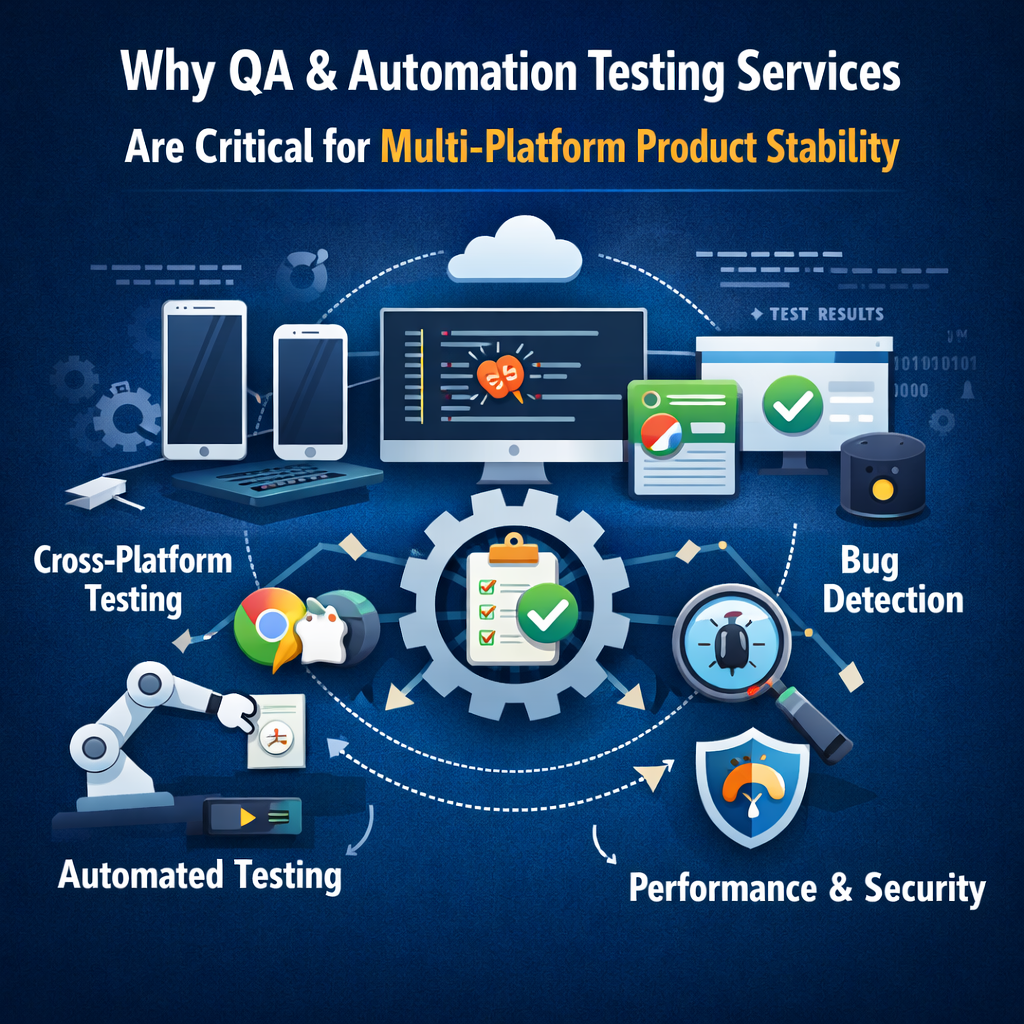
Modern products run everywhere. Web. Mobile. Tablet. Desktop. Embedded devices. Cloud.
If your product works well on one platform but fails on another, users lose trust fast.
QA & Automation Testing Services help teams ship stable software across devices, operating systems, and environments. They reduce risk. They improve release speed. They protect brand value.
This article explains why structured quality assurance and automation testing are essential for multi platform product stability.
The Multi Platform Challenge
Today, users expect:
Fast load time
Smooth UI
Zero crashes
Consistent features
Strong security
But every platform behaves differently.
Platform Type | Common Stability Risks |
Web apps | Browser compatibility issues |
Android apps | Device fragmentation |
iOS apps | OS version conflicts |
Desktop apps | Hardware dependency issues |
Embedded systems | Driver and firmware failures |
Cloud apps | API and scalability issues |
According to the National Institute of Standards and Technology, software defects cost the US economy an estimated $2.08 trillion annually due to failures and rework.
The cost of poor quality is real. It affects revenue, reputation, and customer retention.
What Are QA & Automation Testing Services?
QA services focus on structured validation of software quality.
Automation testing uses tools and scripts to execute test cases repeatedly without manual effort.
Together, they ensure:
Functional accuracy
Cross platform compatibility
Performance stability
Security compliance
Regression safety
Automation does not replace human testers. It strengthens repeatable validation.
Why Manual Testing Alone Is Not Enough
Manual testing works well for:
Exploratory testing
UX validation
Edge case review
But it struggles with:
Large regression cycles
Frequent releases
Multi device combinations
API testing at scale
If your team releases weekly or biweekly, manual-only testing increases risk.
Automation testing allows you to test:
Hundreds of device scenarios
Multiple OS versions
Repeated builds
Continuous integration pipelines
This is essential for stable multi platform deployment.
Core Benefits of QA & Automation Testing Services
1. Faster Release Cycles
Automation reduces regression testing time by up to 70 percent in mature CI environments.
That means faster go to market without increasing risk.
2. Better Cross Platform Stability
Automation ensures consistent validation across:
Chrome, Firefox, Safari
Android versions
iOS updates
Windows and macOS builds
This reduces platform-specific failures.
3. Lower Long Term Cost
Fixing a bug after release costs significantly more than fixing it during development.
IBM research shows that late-stage defect fixes can cost up to 30 times more than early-stage fixes.
QA processes detect issues early in the lifecycle.
4. Stronger Security Assurance
Security testing within QA includes:
Vulnerability scanning
API validation
Access control testing
Data protection checks
The Cybersecurity and Infrastructure Security Agency recommends proactive vulnerability management to reduce system risks.
Automation helps run security regression tests consistently.
5. Improved Customer Experience
Stable products lead to:
Higher ratings
Lower churn
Better retention
Stronger brand loyalty
User experience stability directly affects business growth.
Automation Testing in DevOps and CI CD
Modern engineering teams use DevOps pipelines.
Automation testing integrates into:
Git based workflows
Continuous integration systems
Containerized environments
Cloud testing frameworks
Automated test suites run during:
Code commits
Pull requests
Build generation
Deployment stages
This ensures no unstable code reaches production.
The US Digital Service promotes automated testing practices to improve federal digital services' reliability.
Automation is now a baseline standard for mature teams.
Multi Platform Stability Requires a Structured QA Strategy
A strong QA & Automation Testing Services model includes:
Test Strategy Planning
Risk assessment
Platform mapping
Coverage definition
Test Environment Management
Real device testing
Virtual environments
Cloud device labs
Automated Test Development
UI automation
API automation
Performance scripts
Regression frameworks
Continuous Monitoring
Production log tracking
Crash analytics
Performance monitoring
Stability is not a one-time activity. It is ongoing.
Real World Impact of Weak Testing
Common failure scenarios:
App works on Android 12 but crashes on Android 14
Web app fails in Safari
API breaks under load
Embedded firmware fails during OTA update
Without automation testing:
Bugs go unnoticed
Release delays increase
Support costs rise
Stability issues hurt investor confidence and product credibility.
Key Metrics That QA & Automation Improve
Metric | With Weak QA | With Strong QA & Automation |
Defect leakage | High | Low |
Release confidence | Low | High |
Regression risk | Frequent | Controlled |
Mean time to detect | Slow | Fast |
Customer complaints | High | Reduced |
These improvements directly affect operational efficiency.
When Should You Invest in QA & Automation Testing Services?
You should consider it if:
Your product supports multiple platforms
Your release cycle is less than one month
You face recurring regression bugs
Your product integrates with hardware
Your customer base is growing
For embedded and hardware based products, stability matters even more. Firmware level issues are harder to patch.
If you operate in IoT, medical devices, industrial automation, or smart hardware, quality assurance must include cross layer validation.
FAQ Section
What is the difference between QA and testing?
QA is a broader process that ensures quality standards across the lifecycle. Testing is one part of QA that validates product behavior.
Why is automation testing important for multi platform apps?
Automation ensures consistent validation across browsers, devices, and operating systems. It reduces regression errors and improves release confidence.
Does automation replace manual testing?
No. Automation handles repetitive validation. Manual testing supports usability, edge cases, and exploratory checks.
How much does QA & Automation Testing Services cost?
Costs vary based on product size, platforms, and coverage depth. However, the return on investment comes from reduced production failures and faster releases.
Can automation testing improve product security?
Yes. Automated security and API tests help detect vulnerabilities early. This reduces compliance and data risk.
Final Thoughts
Multi platform products are complex. Stability cannot depend on luck or last minute testing.
QA & Automation Testing Services provide structure, repeatability, and measurable quality control. They reduce long term cost and protect product reputation.
For companies building advanced systems, including embedded and custom hardware platforms, quality must span from firmware to application layers. A reliable engineering partner ensures stability across the stack.
If your organization values predictable releases, strong system performance, and long term product success, structured QA is not optional. It is foundational.
For companies building Linux, Android, or custom hardware products, working with a technically strong engineering partner like eByte Logic ensures stability is built into the product from the start.
Comments
Log in or sign up to join the conversation.