


A Car That Flips The Script
At its October 15th demonstration, Tesla sent its new Roadster up a curved ramp until it was driving upside down. The car flipped free, righted itself with cold-gas thrusters and settled back onto its wheels:
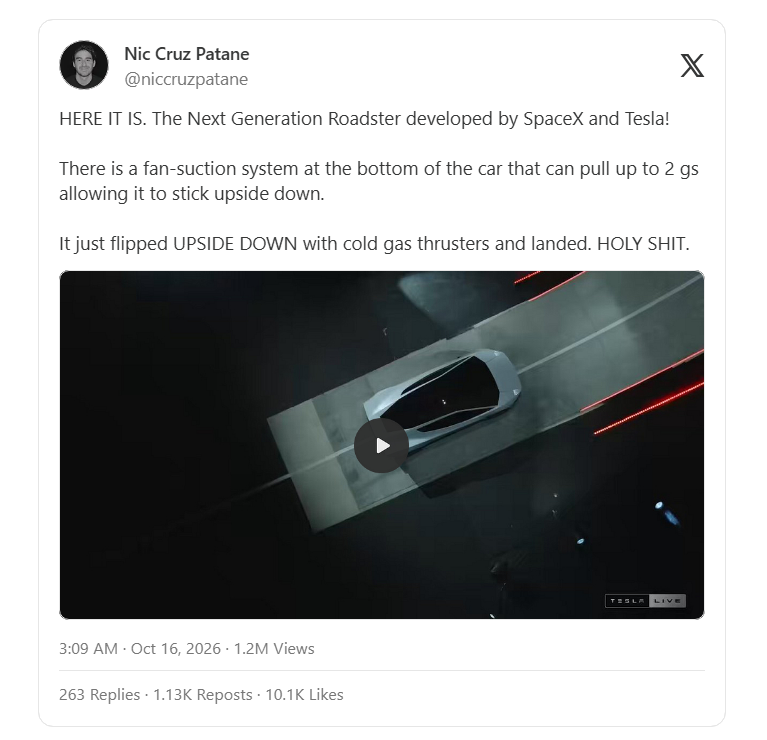
Two days earlier, Musk gave investors a tip about a company supplying memory for Tesla’s AI hardware.
A Customer Endorsement With Teeth
Elon Musk’s praise for Micron Technology (MU 4.03%↑) goes straight to its business model. On October 13th, he said Micron had been reasonable about future memory prices, criticized other suppliers’ pricing, and argued that Micron was building long-term customer loyalty:
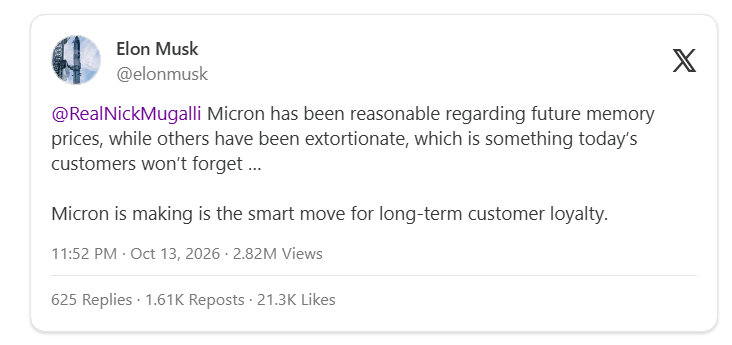
I like that approach. A shortage gives a supplier pricing power; treating customers fairly can help it keep their business when the shortage ends. Micron’s latest results show that customer goodwill and enormous profits can coexist.
Its September 30th earnings release reported fiscal fourth-quarter revenue of $54.23 billion, up from $41.46 billion in the previous quarter, adjusted earnings of $33.42 per share, and an 87% adjusted gross margin. For the current quarter, management guided to revenue of $61.5 billion, plus or minus $1.5 billion, and adjusted earnings of $38.15 per share, plus or minus $1.
Customers Are Committing To The Buildout
Micron has 26 multi-year, take-or-pay agreements with customers and $32 billion in financial commitments, the vast majority of which are cash deposits. Those commitments give the demand story substance.
The company has also completed agreements covering the vast majority of its calendar 2027 high-bandwidth memory supply, with significant year-over-year price increases. It expects memory and storage supply-demand conditions to be tighter in 2027 and 2028 than in 2026. Initial wafer output from its first Idaho fab is expected in mid-2027; its second is expected to follow in late 2028.
My view is that Micron’s earnings peak is still ahead. More capable models, longer conversations and more simultaneous AI users consume more memory. Customers are securing supply while new factories take years to build. That’s a compelling business to own.
Strong Demand, Tighter Financing
Taiwan Semiconductor Manufacturing Company (TSM) reported on October 15th that third-quarter revenue reached $46.72 billion, up 41.2% from a year earlier. It guided to $52.3–$54.3 billion for the fourth quarter, citing continued strong demand for its leading-edge technologies. Demand for advanced chips keeps growing.
AI stocks sold off sharply early on Thursday amid financing strains at data-center operators such as CoreWeave (CRWV 6.39%↑). They recovered substantially after Nvidia CEO Jensen Huang defended CoreWeave’s financial position, although AI stocks remained lower overall by the close. Higher financing costs can slow new capacity. For Micron, the cash-backed customer commitments above are an important part of my thesis.
I Bought The (Non-Flying) Car, Too
I bought a Tesla Model Y in September, and my subscribers and I are also long Tesla via options. Its Full Self-Driving (Supervised) system has impressed me most. On September 23rd, a juvenile black bear ran across a rural New Jersey road in front of my car, and FSD slowed the car to avoid it. I described the encounter in my Bear Witness trade alert.
Experiencing useful AI on an ordinary road strengthens my conviction in both Tesla and the companies supplying the hardware behind it. Micron has a direct connection: semiconductor research firm TechInsights found Micron memory in its teardowns of Tesla’s HW3 FSD computer and HW4 FSD computer.
Tesla’s current FSD requires driver supervision. Micron’s longer-term opportunity extends to more autonomous vehicles: in its earnings remarks, it said Level 4 and higher systems typically contain more than 200GB of memory and multiple terabytes of storage. Physical AI adds another source of demand alongside data centers.
Robots add to that opportunity. Counterpoint Research forecasts that humanoid robots’ demand for dynamic random-access memory (DRAM) will grow more than twentyfold from 2026 through 2030, according to Chosun’s October 11th report.
A Bullish Thesis Needs An Entry Point
I’ve been bullish on memory since last year. In my July memory-stock article, I focused on the timing of the earnings peak and the supply commitments supporting the upcycle. My quantitative approach adds two tests: Portfolio Armor ranks stocks by their estimated six-month returns, net of hedging costs, and my technical screens help time entries after a correction.
Micron was Portfolio Armor’s #1 name as of the October 9th close and passed my technical entry criteria. On October 12th, we added a new bullish trade. The alignment of a strong business, Portfolio Armor’s ranking and an actionable entry setup is why we bought before Musk’s October 13th endorsement.
We’ve Traded Micron Successfully Before
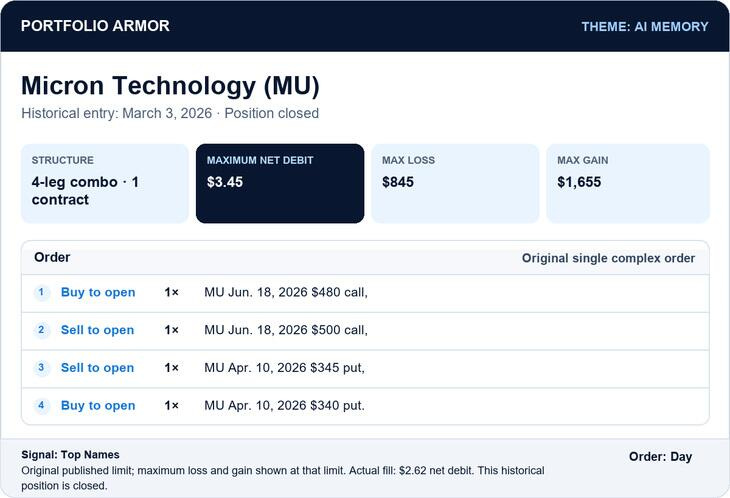
Our March 3rd Micron trade illustrates how we’ve expressed that view with options. Here’s the original entry card. We paid a $2.62 net debit, below the published maximum:
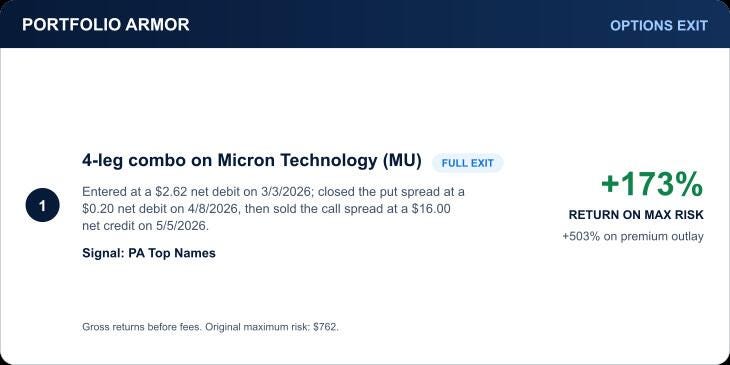
We closed the put spread in April and the call spread in May, completing the trade for a 173% return on its original maximum risk:
I’ll keep looking for compelling ways to trade the AI buildout, from the software you can experience to the memory that makes it work.



Comments
Log in or sign up to join the conversation.