

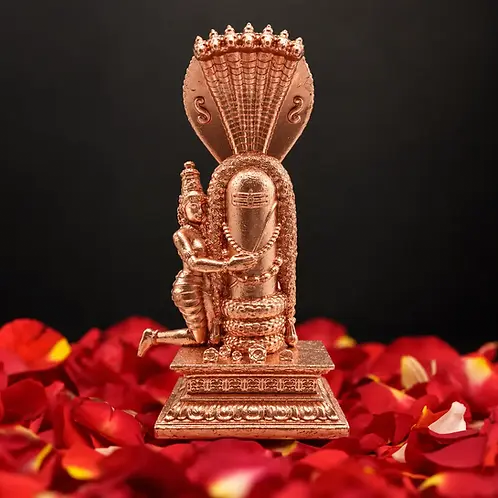
Ekambareswarar Shiva Statue brings home one of the most quietly powerful forms of Lord Shiva in Tamil tradition — the earth-bound deity of the ancient Ekambareswarar Temple in Kanchipuram. Unlike the cosmic dancer Nataraja or the fiery Arunachaleswarar, Ekambareswarar represents Shiva in his most grounded and enduring form, worshipped for over a thousand years as the Lord of the sacred mango tree and the guardian of the earth element itself.
For devotees drawn to stability, patience and the union of divine masculine and feminine energy, Ekambareswarar holds a special place. His story is really the story of Goddess Parvati's devotion — a tale of penance, trials and a marriage that gave Kanchipuram its name as a city of temples. Bronze idols of this form are increasingly sought after for home pooja spaces, and IdolBronze brings this tradition to devotees who wish to bring a piece of Kanchipuram's sacred energy into their own homes.
Who Is Ekambareswarar?
Ekambareswarar, also called Ekambaranathar, is the presiding deity of the Ekambareswarar Temple in Kanchipuram, Tamil Nadu — one of the oldest and largest temple complexes in India. Here, Shiva is not represented by a carved stone lingam alone but by the Prithvi Lingam, an earthen form that ties the deity directly to the element of soil and land. The temple has been revered since at least the 7th century, sung about by the Nayanmar saints in the Tevaram hymns, and remains one of the most visited Shiva shrines in South India.
Ekambareswarar and Elavarkuzhali – The Divine Couple
In this temple's own tradition, Shiva's consort is honored as Elavarkuzhali. Other popular retellings of the legend link this same story to the Goddess Kamakshi, worshipped at the nearby Kamakshi Amman Temple in Kanchipuram — a separate shrine closely associated with Ekambareswarar through shared mythology and festival tradition. Either way, the presence of the goddess is central: this is a temple built around her penance, not his.
Ekambareswarar Among the Pancha Bhoota Sthalams
Ekambareswarar is one of the five Pancha Bhoota Sthalams, temples where Shiva is worshipped as one of the five primordial elements. Jambukeswarar at Thiruvanaikaval represents water, Arunachaleswarar at Tiruvannamalai represents fire, Srikalahasteeswarar at Kalahasti represents air, and Nataraja at Chidambaram represents space or ether. Ekambareswarar alone represents earth — a distinction that shapes every part of his symbolism and worship.
The Symbolism of the Prithvi Lingam
What "Ekambareswarar" Means
The name itself tells the story. "Eka" means one, "amra" means mango, and "natha" or "eswarar" means lord — together, Ekambareswarar translates to "Lord of the single mango tree." It is a rare instance where a deity's name commemorates not a cosmic feat, but a tree that still stands in the temple complex today.
Earth, Stability and the Sand Lingam
Unlike most Shiva lingams carved from granite or black stone, the original lingam at this temple was fashioned from riverbank sand and earth by Parvati herself. This earthen origin is why Ekambareswarar is inseparable from the idea of groundedness — patience, fertility, endurance and the quiet strength of the soil that supports all life. Devotees often turn to this form of Shiva when seeking stability in the home, family harmony, or steadiness through difficult times.
The Legend of Parvati's Penance at Kanchipuram
The Divine Disruption
The story begins with a moment of playfulness that had cosmic consequences. As Shiva sat immersed in the eternal work of creation and destruction, Parvati, in a lighthearted mood, covered his eyes with her hands. For the time his eyes stayed closed, the universe's cycle of creation and dissolution came to a halt. Shiva, disturbed by this interruption to cosmic order, asked Parvati to descend to earth and perform penance to atone for it.
Penance Under the Mango Tree
Parvati travelled to Kanchipuram, on the banks of the river running through the town, and chose a spot beneath a mango tree to begin her penance. There, she shaped a lingam out of riverbank sand and began worshipping it with unwavering devotion, determined to be reunited with Shiva.
The Trials of Fire and the Sacred River
Shiva, wishing to test the depth of her devotion, sent a shower of fire toward her penance. Parvati sought the help of her brother Vishnu, who is said to have used the cooling light of the moon to shield her from the flames. Undeterred, Shiva then sent the river Ganga to disturb her penance further. Parvati calmed Ganga by appealing to her as a sister devoted to the same supreme power, and Ganga relented, leaving Parvati's penance undisturbed.
The Embrace That Won Shiva's Heart
In the best-known version of the story, the river beside the mango tree began to swell and threatened to wash away the sand lingam Parvati had so carefully built. Rather than let it be destroyed, Parvati threw her arms around the lingam and held it close, shielding it with her own body even at personal risk. Moved by this act of complete surrender, Shiva appeared before her in person and married her on that very spot — earning him the Tamil name Tazhuva Kuzhainthaar, "the one who melted in her embrace."
Ekambareswarar Temple – The Sacred Shrine in Kanchipuram
The Ekambareswarar Temple traces its origins to around 600 CE, believed to have begun as a modest shrine under the Pallava king Mahendravarman, before being expanded significantly by the Chola dynasty and later by the Vijayanagara king Krishnadeva Raya in the early 1500s. Today the complex spans roughly 25 acres, making it one of the largest temple sites in India, with four gateway towers or gopurams — the tallest being an 11-storey southern tower rising close to 58 metres, among the highest temple towers in South India.
Inside, a thousand-pillared hall (Aayiram Kaal Mandapam) leads visitors through the complex, and the temple is home to the Sahasra Lingam, a striking sculpture of 1,008 miniature Shiva lingams carved into a single stone. The original mango tree associated with the legend still stands beside the sanctum, now protected, and is said to be around 3,500 years old, with four branches traditionally described as bearing four different-tasting mangoes representing the four Vedas.
Every year, during the Tamil month of Panguni (March–April), the temple holds a ten-day festival culminating in the Kalyanotsavam, a grand re-enactment of the wedding of Shiva and Parvati that draws thousands of devotees. The temple also houses the Nilathingal Thundam Perumal shrine, a Vishnu temple counted among the 108 sacred Divyadesams — making Ekambareswarar's complex sacred to both Shaivite and Vaishnavite traditions.
Spiritual Significance of Ekambareswarar
Grounding and Stability – As the earth form of Shiva, Ekambareswarar is invoked for steadiness, patience and resilience through life's changes.
Union of Shiva and Shakti – The temple's entire legend centers on divine reunion, making this form a symbol of marital harmony and devoted partnership.
The Power of Devotion and Surrender – Parvati's penance, trials and final embrace represent the idea that unwavering faith can overcome any obstacle.
Why Is Ekambareswarar Different from Other Shiva Forms
Where Nataraja embodies the cosmic dance of creation and dissolution, and Arunachaleswarar represents the blazing pillar of fire, Ekambareswarar is defined by stillness rather than motion. His central legend is not one of Shiva's own austerities but of Parvati's — making this one of the few major Shiva shrines built entirely around the goddess's devotion. The lingam's origin in sand rather than carved stone, and the deity's identity tied to a literal tree rather than a cosmic symbol, give Ekambareswarar a uniquely earthy, intimate character compared to Shiva's more dramatic, elemental forms elsewhere in Tamil Nadu.
Conclusion
Ekambareswarar stands apart among Shiva's many forms — not as a distant cosmic force, but as a deity whose story is rooted in a real tree, a real river, and an act of devotion that could not be shaken. As the earth element among the Pancha Bhoota Sthalams, he represents everything that is steady, patient and enduring in both nature and faith. For anyone seeking that same grounded energy in their home, a bronze Ekambareswarar idol offers a lasting connection to one of Tamil Nadu's oldest and most beloved temple traditions.
Comments
Log in or sign up to join the conversation.