
Direct answer
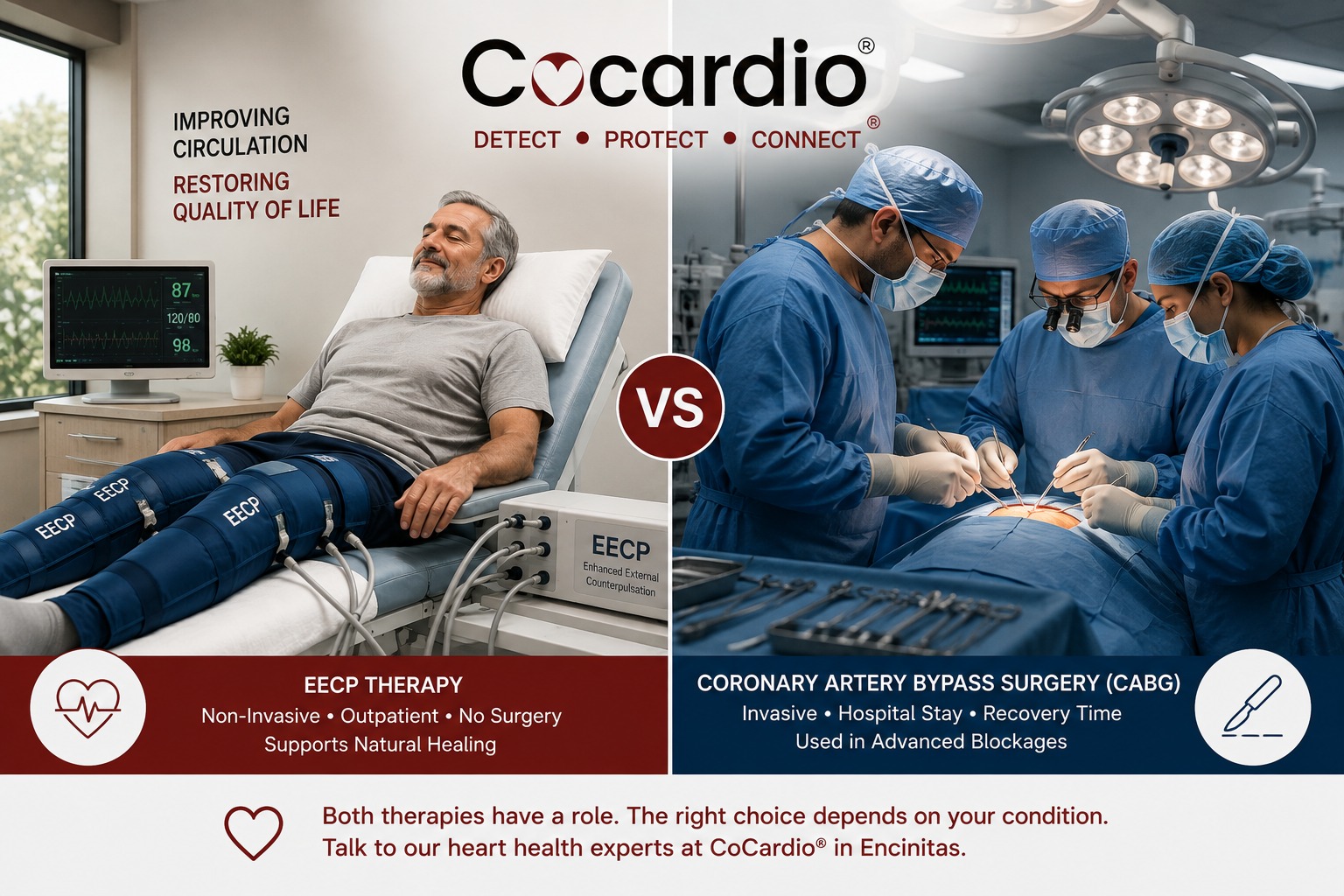
EECP is generally less physically invasive and involves far less recovery burden than coronary artery bypass grafting, but that does not make it ‘more effective’ for patients who have a clear surgical indication. CABG directly creates new routes for blood to reach heart muscle beyond blocked coronary arteries, while EECP is a non-invasive therapy mainly used to relieve refractory angina symptoms when other options are unavailable or unsuitable.
Cost also cannot be compared with one universal price. CABG is an inpatient operation with surgeon, hospital, anesthesia and recovery costs; EECP is delivered as a series of outpatient treatment sessions. Insurance coverage, clinical eligibility, location and the number of services involved can substantially change what a patient actually pays.
EECP and bypass surgery solve different clinical problems
eecp therapy for angina is a non-invasive counterpulsation treatment designed to improve symptom burden and functional capacity in selected people with chronic angina. It does not place a graft around a blockage and does not remove plaque.
Coronary artery bypass grafting, or CABG, is open-heart surgery in which a surgeon uses an artery or vein from elsewhere in the body to create a route around a narrowed or blocked coronary artery. CABG is used when revascularization is clinically appropriate, including certain patterns of complex or high-risk coronary disease.
The 2023 AHA/ACC chronic coronary disease guideline therefore does not position EECP as a direct competitor to CABG. It says EECP may be considered for refractory angina in patients with no other treatment options. In contrast, the same guideline contains detailed revascularization recommendations for PCI and CABG based on anatomy, symptoms, comorbidities and expected clinical benefit.
Which option is less painful
For the procedure itself and the immediate recovery period, EECP is usually the less painful and less invasive experience. There are no surgical incisions and no chest opening. Patients lie on a treatment table while cuffs around the calves, thighs and lower body inflate and deflate in time with the cardiac cycle.
EECP is not necessarily sensation-free. Some patients can experience pressure from the cuffs, muscle discomfort, skin irritation or bruising, and treatment requires repeated visits. Suitability also depends on cardiovascular and other medical factors that should be screened before treatment.
CABG involves anesthesia, a major operation and postoperative recovery. NIH MedlinePlus lists risks including bleeding, infection, arrhythmias, heart attack, stroke and kidney failure. Postoperative chest and incision discomfort are expected parts of recovery, although pain control and rehabilitation are built into modern surgical care.
So if the question is purely ‘which is less painful,’ EECP has the clear advantage. If the question is ‘which treatment is medically appropriate for my coronary disease,’ pain should not be the deciding factor.
Which option is more effective
There is no single winner because effectiveness depends on the treatment goal. CABG is a revascularization procedure. In selected coronary disease populations, randomized and long-term evidence supports important clinical benefits, and for certain anatomical patterns CABG can improve outcomes beyond symptom relief.
EECP has evidence for reducing angina and improving exercise-related outcomes in selected patients, but its evidence base is smaller and the 2023 AHA/ACC guideline gives it a Class 2b recommendation for refractory angina when no other treatment options remain. That is a fundamentally different level and type of recommendation from revascularization.
A 2021 EECP meta-analysis reported significant improvement across a range of angina and functional measures, but the authors called for larger controlled studies. Earlier systematic reviews found more limited randomized evidence and uncertainty over long-term effectiveness. This is why a responsible comparison should say that EECP may be effective for symptom relief in the right patient, not that it is universally more effective than bypass surgery.
Where eecp for coronary artery disease prevention fits
Searches for eecp for coronary artery disease prevention often mix symptom management with prevention. They are related, but they are not the same goal.
The prevention of future cardiovascular events relies heavily on guideline-directed therapy and control of risk factors such as LDL cholesterol, blood pressure, diabetes, smoking and physical inactivity. EECP should not replace these measures. It may be integrated into a broader care plan for an appropriately selected patient, particularly when angina remains limiting.
Likewise, people searching for ways to reverse heart disease naturally should be cautious with the word ‘reverse.’ Lifestyle and medical therapy can substantially reduce risk and can influence atherosclerotic disease biology, but no responsible treatment plan should promise that EECP will erase established coronary plaque.
Cost comparison between EECP and bypass surgery
CABG and EECP have very different cost structures. CABG involves an inpatient hospitalization, operating room, anesthesia, surgeon and hospital services, postoperative monitoring, medication, follow-up and often cardiac rehabilitation. EECP is an outpatient course billed across multiple sessions and generally does not involve inpatient recovery.
Public US hospital-cost data illustrate the scale difference but should not be mistaken for current patient prices. An AHRQ HCUP analysis using 2014 inpatient data reported an average hospital cost of about $41,900 for CABG. That figure is historical, reflects hospital cost rather than a current billed charge or patient out-of-pocket amount, and does not predict what a person would pay in 2026.
For EECP, Medicare maintains national coverage criteria for severe stable angina and identifies HCPCS code G0166 in current compliance materials. Actual reimbursement and patient responsibility depend on eligibility, the treatment setting, supplemental coverage and the patient’s plan. A fair comparison therefore requires individualized insurance verification rather than a generic cash-price claim.
Factor | EECP | CABG |
Setting | Outpatient repeated sessions | Inpatient major surgery |
Incisions | None | Surgical incisions required |
Primary role | Symptom relief in selected refractory angina | Coronary revascularization when clinically indicated |
Recovery burden | Usually low between sessions | Substantial postoperative recovery and rehabilitation |
Evidence position | May be considered when no other options remain | Established revascularization option for defined indications |
Cost structure | Multiple outpatient treatments | Hospital, surgeon, anesthesia, postoperative care and follow-up |
What a patient should ask before choosing either path
1. Do I have coronary anatomy for which CABG or PCI is expected to improve symptoms or outcomes?
2. Have I received guideline-directed medical therapy for chronic coronary disease and angina?
3. Is my angina truly refractory, and have reversible or urgent causes been addressed?
4. Am I a candidate for EECP based on my cardiovascular status and other health conditions?
5. What outcome are we trying to improve: survival, myocardial infarction risk, angina frequency, exercise tolerance, or quality of life?
6. What will my insurer cover, and what are my expected out-of-pocket costs for the complete episode of care?
Finding non-invasive treatment near you
If your cardiologist has told you that your symptoms are chronic and stable, and you are exploring a non invasive heart treatment, EECP may be worth discussing when the clinical criteria fit. It should not be used to avoid a revascularization procedure that your heart team believes is necessary.
A search for ECP therapy near me can help identify nearby services, but proximity does not establish candidacy. Evaluation should include your diagnosis, prior testing, symptoms, medications and revascularization history.
For patients in Encinitas and greater San Diego who search ECP therapy near me, CoCardio® offers consultation-based assessment and CoCardio Boost™ ECP services at 162 S Rancho Santa Fe Rd, Suite B55, Encinitas, CA 92024.
The user-supplied External counterpulsation therapy link leads to CoCardio’s contact form for people who want to ask about evaluation and next steps.
Common mistakes to avoid
· Treating EECP and CABG as interchangeable treatments simply because both relate to coronary blood flow.
· Choosing the less painful option without considering anatomy, ischemic risk or the potential survival benefit of indicated revascularization.
· Using a historical hospital-cost figure as if it were a current 2026 patient quote.
· Assuming insurance coverage is automatic for EECP or bypass surgery.
· Using marketing claims such as ‘reverse heart disease’ as a substitute for a cardiologist’s assessment and evidence-based prevention plan.
Key takeaways
· EECP is less invasive and generally less painful than CABG, but it is not a surgical substitute.
· CABG directly revascularizes the heart and can be the more effective option when a patient has a clear revascularization indication.
· EECP is mainly a symptom-relief option for selected refractory angina patients, especially when other options are exhausted.
· CABG usually carries a much larger episode-of-care cost burden, but actual patient cost depends on insurance and clinical circumstances.
· The right choice should be made with a cardiologist or heart team, not from pain or price alone.
Frequently asked questions
Is EECP safer than bypass surgery
EECP avoids the major operative risks of open-heart surgery, but ‘safer’ still depends on the patient. CABG has recognized surgical risks, while EECP also has contraindications and can cause pressure-related discomfort or bruising. The relevant question is which option is appropriate for the patient’s disease and risk profile.
Can EECP replace CABG if I want to avoid surgery
Not automatically. If CABG is recommended because coronary anatomy or risk makes revascularization beneficial, EECP should not be substituted solely to avoid surgery. Current US guidelines position EECP mainly for refractory angina when no other treatment options remain.
Which works faster for chest pain
The timing of symptom improvement varies. CABG restores blood flow through new grafts as part of the operation, while EECP is delivered as a course of repeated outpatient sessions and symptom response can develop over the treatment period. Individual response is not guaranteed with either approach.
Is EECP cheaper than bypass surgery
EECP generally has a lower-intensity outpatient cost structure than a major inpatient operation, but no single national price accurately describes what every patient will pay. Insurance coverage, treatment eligibility, facility contracts, deductibles and supplemental plans all affect out-of-pocket costs.
Who is a typical EECP candidate
A typical guideline-based use is a patient with chronic coronary disease and refractory angina whose symptoms remain limiting despite medical therapy and who has no other suitable treatment options. A clinician must still screen for appropriateness and contraindications.
Conclusion
EECP wins the pain and invasiveness comparison, while CABG can win the effectiveness comparison when a patient has coronary anatomy for which surgical revascularization is indicated. Cost usually favors the lower-intensity outpatient pathway, but treatment choice should never be reduced to a price contest.
If your goal is to understand whether eecp therapy for angina is appropriate after standard evaluation and treatment, CoCardio® can discuss non-invasive options alongside your existing cardiology care.
Medical disclaimer This comparison is educational and does not determine whether you need EECP, PCI or coronary bypass surgery. Treatment decisions require review of symptoms, testing, coronary anatomy, overall health and patient preferences by licensed clinicians. New or worsening chest pain requires urgent medical evaluation.
Comments
Log in or sign up to join the conversation.