
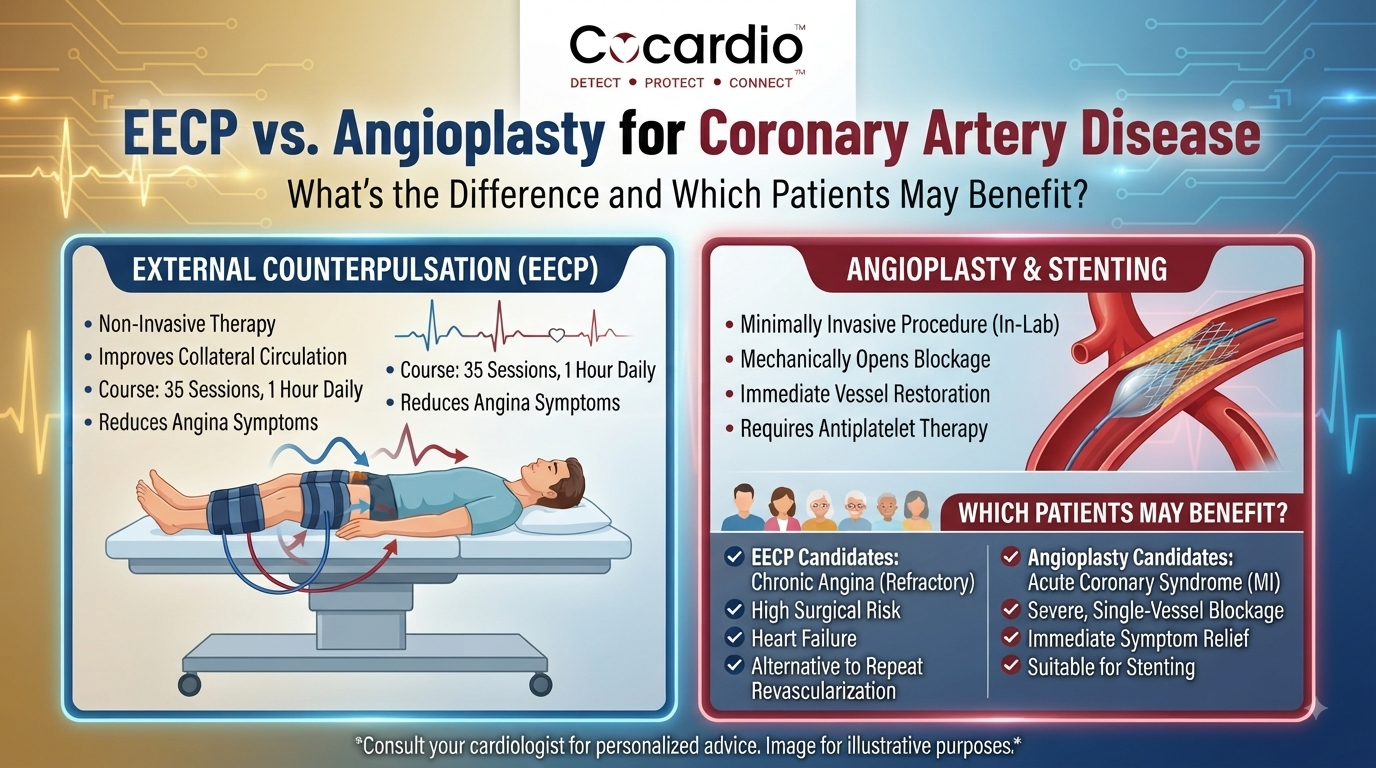
When coronary artery disease begins restricting blood flow to the heart, treatment depends on the severity of the disease, symptoms, coronary anatomy, and the patient's overall cardiovascular risk. Angioplasty, also called percutaneous coronary intervention or PCI, is an invasive procedure designed to mechanically open a narrowed coronary artery, while EECP works externally and does not place anything inside the arteries. People researching EECP for coronary artery disease prevention should understand that these treatments are not interchangeable and often serve different clinical purposes. EECP is most commonly discussed for chronic or refractory angina when symptoms persist despite appropriate medical therapy and conventional revascularization options may be limited. Research suggests EECP can improve angina-related outcomes in selected patients, although the evidence base has limitations and treatment decisions should remain individualized.
What Is Angioplasty?
Coronary angioplasty is a catheter-based procedure used to open a narrowed or blocked coronary artery and restore blood flow. During PCI, a cardiologist guides a catheter into the coronary circulation, and a balloon is inflated at the narrowed area to widen the vessel. A coronary stent is commonly placed to help keep the treated artery open after the balloon is removed. Angioplasty therefore directly addresses a specific anatomical narrowing rather than attempting to improve circulation indirectly. Depending on the clinical situation, PCI can be used in acute coronary syndromes as well as selected patients with chronic coronary disease.
What Is a Coronary Stent?
A stent is a small mesh-like tube positioned inside a coronary artery during PCI. Modern drug-eluting stents release medication intended to reduce excessive tissue growth that could narrow the treated area again. Once implanted, the stent remains inside the artery to help maintain blood flow through that segment. Patients generally require specific medication after PCI, and following the prescribed antiplatelet regimen can be particularly important. A stent treats the targeted coronary narrowing, but it does not eliminate atherosclerosis throughout the rest of the cardiovascular system.
What Is External Counterpulsation Therapy?
External counterpulsation therapy, commonly known as EECP, is fundamentally different from angioplasty because it is performed externally without a catheter or coronary implant. Inflatable cuffs are wrapped around the patient's lower extremities and synchronized with the heartbeat using ECG monitoring. The cuffs inflate during diastole and rapidly deflate around the beginning of systole, increasing venous return and augmenting diastolic pressure while changing the workload placed on the heart. Researchers have also investigated longer-term effects involving endothelial function, vascular signaling, and collateral blood flow. EECP has primarily been studied as a symptom-relief strategy for patients with chronic or refractory angina.
How Is an EECP Session Different From Angioplasty?
Angioplasty takes place in a catheterization laboratory and involves accessing the cardiovascular system through an artery, whereas EECP is delivered as a series of non-invasive outpatient sessions. A typical EECP protocol in the published literature involves approximately 35 one-hour sessions rather than a single procedure. During EECP, the patient remains awake while the cuffs repeatedly inflate and deflate according to the cardiac cycle. There is no incision into a coronary artery and no stent is implanted. This makes EECP less invasive, but being less invasive does not automatically make it a substitute for PCI when revascularization is medically indicated.
EECP vs. Angioplasty — The Most Important Difference
The central difference between EECP and angioplasty is what each treatment is designed to accomplish. Angioplasty mechanically opens a narrowed coronary artery, while EECP changes cardiovascular hemodynamics externally and may improve symptoms and functional capacity without physically removing an obstruction. For this reason, EECP for coronary artery disease prevention should not be interpreted as a non-invasive version of angioplasty. A patient with an artery that requires urgent or clinically appropriate revascularization may still need PCI or another intervention. EECP becomes particularly relevant when chronic angina remains difficult to control and further revascularization is limited or unsuitable.
Does EECP Open Blocked Arteries?
EECP does not physically open a coronary blockage. Research has explored mechanisms such as improved endothelial function and collateral circulation, but these biological effects are not equivalent to inserting a balloon and stent into a narrowed artery. Claims that EECP “clears,” “cleans,” or directly removes coronary plaque therefore misrepresent how the treatment works. Symptom improvement can occur without the original coronary plaque disappearing. This distinction is especially important when comparing EECP directly with PCI.
When Is Angioplasty Used for Coronary Artery Disease?
The decision to perform PCI depends on factors including symptoms, the location and severity of coronary disease, ischemia, previous treatment, and the broader clinical context. Modern chronic coronary disease guidance emphasizes patient-centered treatment and shared decision-making rather than using one approach for every person with CAD. Revascularization can have an important role when symptoms remain lifestyle-limiting despite appropriate treatment and the coronary anatomy is suitable for intervention. PCI is also used in acute settings where restoring coronary blood flow can be urgently necessary. Patients should therefore avoid viewing angioplasty simply as a treatment to be replaced whenever a non-invasive option becomes available.
Angioplasty Does Not Cure Atherosclerosis
Opening one narrowed coronary artery does not eliminate the underlying process responsible for coronary artery disease. Atherosclerosis may exist elsewhere in the coronary circulation and can continue to progress after successful PCI. Long-term cardiovascular management can therefore remain necessary after a stent, including medication, healthy nutrition, physical activity, smoking cessation, blood-pressure control, and lipid management as clinically appropriate. Current chronic coronary disease guidance emphasizes healthy dietary habits and exercise as important nonpharmacologic components of ongoing care. A successful PCI should therefore be understood as one component of cardiovascular management rather than a permanent cure for CAD.
When Is EECP Considered for Coronary Artery Disease?
EECP has been studied particularly in patients with refractory angina who remain symptomatic despite medical therapy and standard revascularization approaches. Reviews describe it as a non-invasive option for selected patients whose symptoms remain difficult to control and who may have limited conventional revascularization options. This means EECP for coronary artery disease prevention is best understood within a broader cardiovascular strategy rather than as a procedure that prevents every future blockage. The appropriate goal may be reducing angina, improving exercise tolerance, or improving daily function in a carefully selected patient. Medical evaluation is necessary to determine whether those goals are realistic.
What Is Refractory Angina?
Refractory angina describes chronic angina that continues despite appropriate medical treatment and available conventional revascularization options. These patients may have undergone previous PCI or bypass surgery yet continue experiencing chest discomfort that restricts ordinary activity. Some have complex or diffuse coronary disease that makes another intervention difficult, while other mechanisms can also contribute to persistent ischemic symptoms. Contemporary reviews emphasize that refractory angina can arise from obstructive and non-obstructive mechanisms and requires individualized assessment. EECP is therefore most relevant after clinicians understand why the symptoms remain.
Can EECP Prevent Coronary Artery Disease From Progressing?
The term EECP for coronary artery disease prevention needs careful interpretation because EECP has not been established as a stand-alone therapy that prevents atherosclerosis from developing or guarantees that existing CAD will not progress. Studies have investigated potentially beneficial vascular effects, including improved endothelial function, but this is different from proving prevention of future coronary disease. Established cardiovascular risk management remains essential whether or not someone receives EECP. Patients should continue following recommendations related to cholesterol, blood pressure, diabetes, smoking, exercise, nutrition, and prescribed medication. EECP may complement a broader heart-care plan for selected symptomatic patients, but it should not replace evidence-based prevention.
Symptom Improvement Is Not the Same as Disease Reversal
Someone may walk farther or experience fewer episodes of chest discomfort following EECP while still having underlying coronary atherosclerosis. Likewise, someone may feel substantially better after angioplasty even though disease remains elsewhere in the coronary circulation. Symptoms and disease burden are related but are not identical measures of cardiovascular health. This is why ongoing preventive care matters regardless of which treatment improves the patient's angina. Long-term cardiovascular management should address both quality of life and future risk.
Is EECP Effective for Angina?
Clinical research suggests that EECP may improve several outcomes in appropriately selected patients with angina. A 2022 systematic review and meta-analysis of 17 studies found significant clinical advantages across outcomes including angina episodes, walking distance, Canadian Cardiovascular Society angina class, daily nitrate use, and exercise treadmill time. An earlier meta-analysis reported that 85% of patients across the included studies improved by at least one CCS angina class, although study heterogeneity and limitations need to be considered when interpreting that figure. Other systematic evaluations have been more cautious and concluded that stronger controlled evidence is needed to establish effectiveness and cost-effectiveness firmly. The most accurate interpretation is therefore that EECP has evidence of potential symptomatic benefit, but individual outcomes cannot be guaranteed.
How Long Can EECP Benefits Last?
Some observational research suggests that improvements can persist well beyond the active treatment course. In a long-term registry study involving 1,427 patients, 78% improved by at least one CCS angina class immediately after treatment, and benefits were sustained in many patients during a median follow-up of approximately three years. However, registry data are observational and cannot establish the same level of causality as a well-designed randomized controlled trial. Individual durability may also depend on disease severity, diabetes, heart function, lifestyle, and other cardiovascular factors. Patients should therefore view long-term figures as research findings rather than a guarantee of how long their own relief will last.
Is EECP Safer Than Angioplasty?
It is more accurate to say that EECP is less invasive than PCI rather than simply declaring one treatment “safer.” The procedures are used in different clinical situations and have different risks, benefits, and therapeutic goals. EECP does not require arterial catheterization or coronary stent implantation, but patients can experience cuff-related adverse effects and certain medical conditions can make counterpulsation inappropriate. Systematic evaluations have also highlighted limitations in the available safety and effectiveness evidence. The safest treatment is the one that appropriately addresses the patient's actual cardiovascular problem after individualized assessment.
Non-Invasive Does Not Mean Risk-Free
EECP produces substantial repeated pressure around the lower body and changes venous return and cardiovascular hemodynamics. A clinician therefore needs to consider cardiovascular status, blood pressure, rhythm, vascular health, and other relevant conditions before recommending treatment. Patients should disclose their complete medical history and current medications during the assessment. Treatment should also be stopped and evaluated if concerning symptoms develop. Responsible candidate selection matters even when no surgery is involved.
Can EECP Replace Angioplasty?
EECP should not be promoted as a universal replacement for angioplasty. If a patient's coronary anatomy and clinical condition indicate that PCI is appropriate, choosing EECP simply because it is non-invasive could delay necessary treatment. Conversely, some people with refractory angina may have already undergone PCI or bypass surgery and no longer have a suitable revascularization option. Research on EECP specifically includes these difficult-to-treat patient populations. In those circumstances, EECP may offer an additional strategy for symptom management rather than competing directly with angioplasty.
Can EECP Help Someone Who Already Had Angioplasty?
Yes, previous angioplasty does not automatically rule out EECP. In the International EECP Patient Registry long-term study, 88% of participants had undergone prior percutaneous or surgical revascularization and 82% were considered unsuitable for further coronary intervention. That population demonstrates why EECP is often discussed after conventional procedures rather than instead of them. Persistent chest pain following PCI still needs evaluation because recurrent symptoms can have several possible causes. Once the cause has been assessed, a clinician can determine whether EECP is a reasonable option.
EECP vs. Angioplasty After a Previous Stent
A patient who develops angina after stenting should not assume that another stent is automatically necessary, but they also should not assume EECP is automatically appropriate. Symptoms could relate to progression of disease elsewhere, incomplete revascularization, or other mechanisms of myocardial ischemia. Modern reviews emphasize the complexity of persistent angina and the need to identify the underlying mechanism before choosing additional treatment. If another treatable coronary obstruction is identified, PCI may remain an option, while patients without suitable further revascularization may be evaluated for therapies such as EECP. The choice depends on what is causing the symptoms rather than simply which treatment the patient prefers.
EECP Does Not Repair a Stent
External counterpulsation cannot physically change an implanted coronary stent. It does not reposition the device, enlarge it, or remove tissue from inside it. Any suspected problem involving a previous stent requires appropriate cardiology assessment and potentially additional diagnostic testing. EECP may subsequently be considered for persistent stable angina if the patient is an appropriate candidate. Keeping these roles separate prevents unrealistic expectations about what counterpulsation can achieve.
EECP vs. Angioplasty for Quality of Life
Quality of life can be an important treatment goal for people whose chronic angina limits walking, work, exercise, travel, or family activities. PCI may improve symptoms when a suitable obstructive coronary lesion is responsible, while EECP may improve symptoms for certain patients with refractory angina who have limited conventional options. EECP studies have reported improvements in physical capacity and health-related quality of life, including benefits maintained during follow-up in some patient populations. The most meaningful outcome for an individual patient may be being able to walk farther, climb stairs, or complete daily activities with fewer symptoms. These goals should be discussed before treatment so that improvement can be evaluated realistically.
Treatment Goals Should Be Measurable
Patients considering EECP can record how frequently angina occurs before treatment and which activities trigger it. Other useful measures may include walking distance, exercise duration, prescribed rescue medication use, and the number of daily activities limited by symptoms. These practical measures can help determine whether treatment is making a meaningful difference. Cardiovascular testing may also be appropriate depending on the patient's condition and treatment plan. A clearly defined baseline makes it easier to judge progress.
How Much Does EECP Therapy Cost Compared With Angioplasty?
Direct price comparisons between EECP and angioplasty can be misleading because they are fundamentally different treatments delivered in different settings. EECP therapy cost can depend on the treatment schedule, insurance coverage, clinical indication, provider, and individual benefits, while angioplasty costs depend on factors such as the facility, procedure complexity, number of stents, and insurance plan. EECP typically involves repeated outpatient sessions, so patients should ask whether a quoted amount covers one visit or the complete recommended course. Published economic analyses have also found uncertainty around EECP's long-term cost-effectiveness because estimates depend heavily on how long quality-of-life benefits persist. Patients should obtain individualized cost and coverage information rather than choosing between therapies based on generalized online price estimates.
Does Insurance Cover EECP?
Coverage can depend on the diagnosis, severity of angina, previous treatment, medical necessity, and the patient's specific insurance policy. Prior authorization or clinical documentation may be required before a course begins. Patients should ask the treatment provider what information is submitted to the insurer and what out-of-pocket responsibility may remain. Medicare and private insurers can have specific eligibility criteria, so coverage should be verified before treatment starts. Financial eligibility and medical suitability are separate questions, and both need to be addressed.
How Long Does Each Treatment Take?
Angioplasty is generally performed as a procedure in a cardiac catheterization setting, with the overall hospital or outpatient experience depending on the complexity of the case and recovery requirements. EECP, by contrast, is delivered through repeated outpatient treatments rather than one intervention. Many published EECP studies use a course of 35 one-hour sessions, often administered over several weeks. This difference matters for people balancing treatment with employment, travel, or caregiving responsibilities. Convenience should be considered, but it should not override the clinical reason for choosing one treatment over another.
Why Does EECP Require Multiple Sessions?
EECP is designed around repeated counterpulsation rather than a single exposure. Proposed longer-term vascular effects are associated with the repeated hemodynamic and endothelial stimulus created across a treatment course. Most clinical evidence therefore evaluates patients after a structured series of sessions rather than after one isolated appointment. Completing the recommended course can require a meaningful time commitment. Patients should understand that schedule before beginning treatment.
What Are the Advantages of EECP?
The principal practical advantage is that EECP is non-invasive and does not require a catheter, coronary incision, or implanted stent. Patients remain awake during treatment and typically attend on an outpatient basis. Research suggests that some patients with refractory angina can experience fewer symptoms, improved exercise tolerance, and better quality of life. This can make EECP particularly interesting for people who remain symptomatic after conventional therapy and have limited further revascularization options. Its advantages should nevertheless be considered alongside the limitations of the evidence and individual contraindications.
What Are the Limitations of EECP?
EECP cannot mechanically open an obstructed coronary artery, remove plaque, repair a stent, or guarantee prevention of future cardiovascular events. The evidence base also includes many observational studies, and systematic reviews have reached differing conclusions about the strength and certainty of clinical benefit. Treatment requires repeated visits, and not every patient is an appropriate candidate. Some people may experience substantial symptom improvement while others may experience limited benefit. These limitations should be discussed before treatment begins.
What Are the Advantages of Angioplasty?
PCI can directly treat a suitable coronary narrowing by restoring the vessel lumen and improving blood flow through the targeted area. This anatomical effect is something EECP cannot reproduce. In appropriate clinical situations, revascularization can be an important part of treating chronic coronary disease and is central to the management of certain acute coronary syndromes. Modern guidelines emphasize selecting treatment according to the patient's clinical presentation, anatomy, symptoms, and goals. For someone who needs mechanical revascularization, the fact that EECP is non-invasive does not make it an equivalent alternative.
What Are the Limitations of Angioplasty?
PCI is invasive and requires vascular access, catheterization, and frequently stent implantation. It treats targeted coronary lesions but does not eliminate the systemic atherosclerotic process that caused them. Patients can therefore still require long-term medication and cardiovascular risk-factor management after a successful procedure. Symptoms can also recur or persist for reasons unrelated to the particular lesion that was treated. Long-term care remains important regardless of procedural success.
Which Treatment Is Better — EECP or Angioplasty?
There is no responsible universal answer because the treatments serve different purposes. Angioplasty may be appropriate when a clinically important coronary narrowing is suitable for mechanical revascularization, whereas EECP is more commonly considered for selected patients with persistent or refractory angina, particularly when standard treatments have not adequately controlled symptoms or further intervention is unsuitable. The 2023 chronic coronary disease guideline emphasizes patient-centered decision-making because chronic coronary disease encompasses a diverse group of conditions and clinical circumstances. Treatment should therefore follow diagnosis, coronary assessment, symptom evaluation, and consideration of the patient's broader cardiovascular health. Asking which treatment fits the individual clinical problem is more useful than asking which treatment is universally “better.”
Questions to Ask Before Choosing a Treatment
Patients should ask what is actually causing their current symptoms and whether a specific coronary narrowing requires treatment. It is also useful to understand whether medication has been optimized, whether additional PCI or bypass surgery is technically appropriate, and what improvement each proposed treatment is expected to provide. If EECP is being considered, ask about candidacy, the treatment schedule, contraindications, expected outcomes, and insurance coverage. If PCI is recommended, ask what lesion will be treated, why revascularization is expected to help, and what medications and follow-up will be required afterward. Shared decision-making works best when the differences between the options are clearly understood.
When Should You Search for ECP Therapy Near Me?
People often search for ECP therapy near me after learning that another non-invasive option may exist for persistent angina. Location matters because a typical EECP course requires repeated visits over several weeks, making travel time an important practical consideration. However, proximity should not be the only criterion used when selecting a treatment center. Patients should look for appropriate screening, realistic explanations of benefits and limitations, and coordination with existing cardiovascular care when necessary. A responsible provider should never promise that EECP will automatically eliminate coronary disease or replace every future intervention.
What Should You Ask an EECP Provider?
Ask how the center determines whether someone is an appropriate candidate and what medical information needs to be reviewed before treatment. Find out how progress is monitored and what happens if chest discomfort changes during the treatment course. The provider should clearly explain expected benefits, potential adverse effects, contraindications, scheduling, and costs. Be cautious of guaranteed claims involving permanent disease reversal or complete removal of arterial plaque. Evidence-based communication is especially important when discussing chronic cardiovascular disease.
Frequently Asked Questions About EECP vs. Angioplasty
Is EECP Better Than Angioplasty?
Neither treatment is universally better because they address different clinical situations. Angioplasty mechanically treats a coronary narrowing, while EECP is a non-invasive therapy primarily studied for symptom relief in chronic or refractory angina. EECP may be particularly relevant when further conventional revascularization is limited or unsuitable. A cardiologist or appropriate cardiovascular clinician should determine which approach fits the patient's diagnosis and coronary anatomy. Treatment should not be chosen solely according to which option sounds less invasive.
Can EECP Prevent the Need for Angioplasty?
EECP cannot be guaranteed to prevent a future angioplasty. Some patients receiving EECP already have limited revascularization options, which is one reason the treatment is considered in refractory angina. If clinically significant coronary disease develops that requires PCI, EECP should not be used to delay necessary intervention. Preventing future cardiovascular problems requires comprehensive risk management rather than reliance on one therapy. Patients should continue appropriate cardiovascular follow-up even if symptoms improve.
Does EECP Remove Coronary Plaque?
No. EECP does not physically remove atherosclerotic plaque from the coronary arteries. Its mechanisms involve cardiovascular hemodynamics and potentially longer-term effects on vascular function and collateral circulation. This is fundamentally different from angioplasty, which mechanically widens a narrowed coronary segment. Improved symptoms after EECP should therefore not be interpreted as proof that plaque has disappeared.
Can You Have EECP After Angioplasty?
Yes, previous PCI does not automatically prevent someone from being evaluated for EECP. Long-term registry research included a large proportion of patients who had already undergone percutaneous or surgical revascularization before receiving EECP. Persistent symptoms should first be evaluated to determine why angina remains. EECP may then be considered if the symptoms are stable and the patient is an appropriate candidate.
How Many EECP Treatments Are Needed?
A commonly studied treatment course consists of approximately 35 one-hour sessions delivered over several weeks. The exact schedule should be determined by the treating provider based on the patient's clinical circumstances and protocol being used. EECP should not be viewed as a single-session alternative to angioplasty. Patients should understand the full time commitment before treatment begins.
EECP for Coronary Artery Disease in Encinitas
For patients in Encinitas and the greater San Diego area who continue experiencing chronic angina, CoCardio provides information about EECP and non-invasive cardiovascular care. People researching EECP for coronary artery disease prevention can discuss how counterpulsation differs from angioplasty and whether it has an appropriate role within their broader heart-care plan. EECP is particularly relevant to conversations about persistent symptoms when medications or previous coronary procedures have not provided adequate relief and additional revascularization may be limited. Evidence suggests potential improvements in angina and functional outcomes for selected patients, while also highlighting the need for realistic expectations and individualized evaluation. A consultation should focus on the patient's actual cardiovascular condition rather than assuming that a non-invasive treatment is automatically preferable.
Conclusion
EECP and angioplasty should not be treated as competing versions of the same therapy. Angioplasty mechanically opens a narrowed coronary artery, while EECP uses externally applied counterpulsation and has primarily been studied as a symptom-management option for selected patients with chronic or refractory angina. EECP for coronary artery disease prevention may support a broader cardiovascular care strategy, but EECP does not physically remove plaque or guarantee that coronary disease will stop progressing. Research suggests meaningful symptom and functional improvements are possible for some patients, while systematic reviews also underline limitations in the evidence and the need for further high-quality research. The right approach depends on symptoms, coronary anatomy, previous procedures, medical therapy, overall cardiovascular health, and an individualized clinical assessment.
Medical Disclaimer
This article is for general educational and informational purposes only and is not a substitute for professional medical advice, diagnosis, or treatment. Whether angioplasty, EECP, medication, bypass surgery, or another approach is appropriate depends on an individual's cardiovascular condition and should be determined by qualified healthcare professionals. Never delay recommended PCI, stop prescribed medication, or change an existing cardiovascular treatment plan because of information contained in this article. New, severe, worsening, or rest-related chest pain can require urgent medical evaluation and should not be managed by scheduling an outpatient EECP session. If you believe you may be experiencing a heart attack or another medical emergency, call 911 immediately.
Comments
Log in or sign up to join the conversation.