
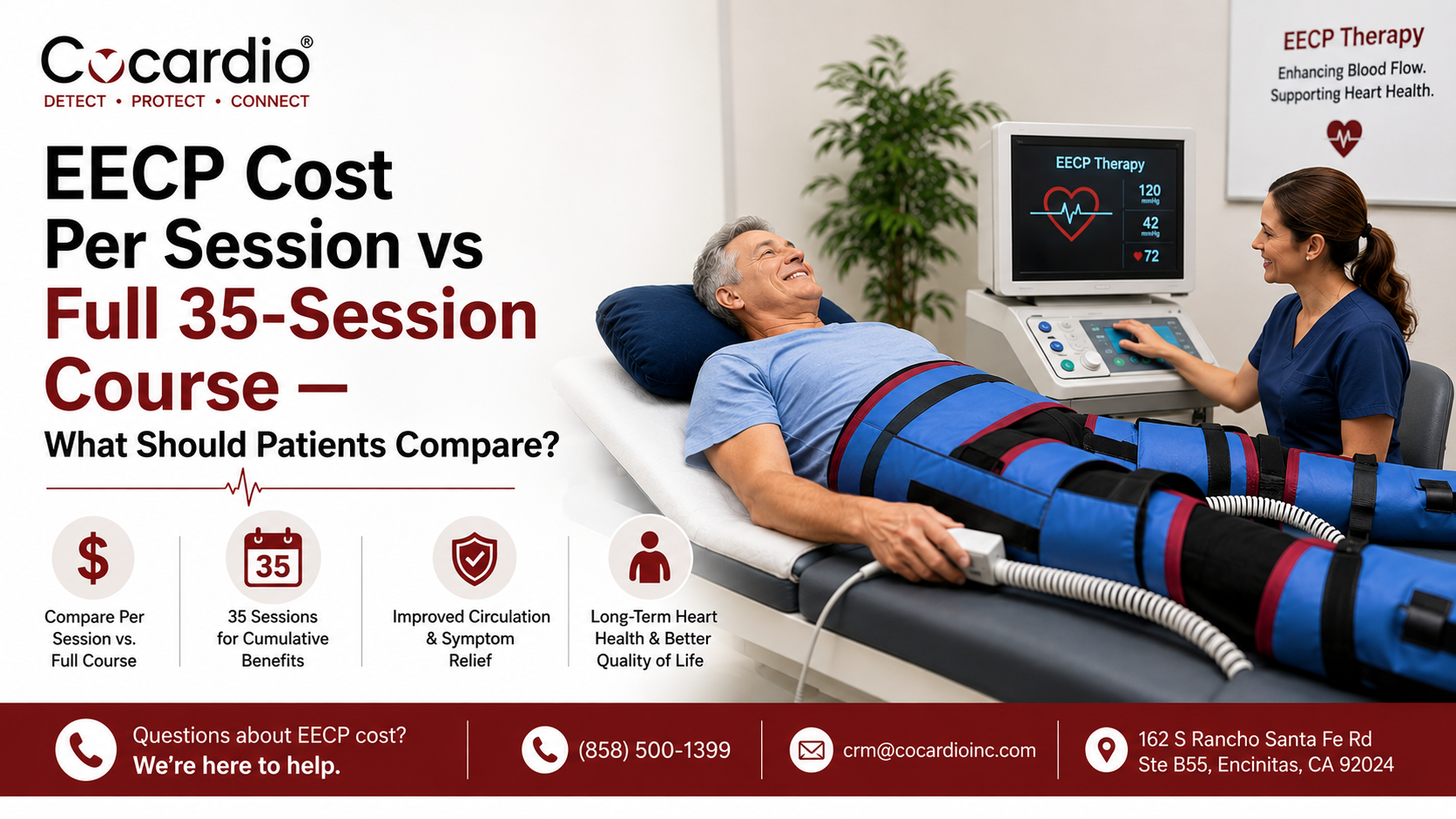
Understanding the price of EECP can be confusing when one provider discusses a per-session charge while another provides an estimate for an entire treatment course. Because a conventional EECP program commonly involves about 35 one-hour sessions, patients need to know exactly what is included before comparing prices. EECP therapy cost can also vary according to insurance coverage, medical necessity, provider fees, initial evaluations, and individual treatment circumstances. Looking only at the advertised price of a single appointment may therefore give an incomplete picture of the potential financial commitment. Patients should compare the total expected treatment expense, coverage requirements, and clinical services included rather than choosing a provider solely because one session appears less expensive.
What Does EECP Therapy Cost Include?
The EECP therapy cost should be evaluated in the context of the complete recommended treatment plan rather than as an isolated hourly price. Depending on the provider and the patient's circumstances, an estimate may cover individual treatment sessions, the complete course, clinical monitoring, or other associated services. Patients should ask whether an initial evaluation is billed separately and whether additional testing is required before treatment begins. Insurance coverage can significantly affect out-of-pocket responsibility, so benefits and medical-necessity requirements should be verified in advance whenever possible. A clear written explanation of expected charges makes it easier to compare providers accurately and avoid assumptions about what a quoted price includes.
Why Is EECP Commonly Delivered Over 35 Sessions?
A conventional EECP course commonly consists of approximately 35 one-hour treatments, often scheduled five days per week for seven weeks. This schedule reflects the treatment exposure widely used in clinical practice and research involving patients with chronic stable or refractory angina. The therapy is intended to create repeated hemodynamic effects over time rather than deliver its potential benefits through a single isolated session. Some patients may notice symptomatic changes before completing the course, while others may experience improvement later or have a more limited response. Patients should follow the treatment schedule recommended by their healthcare team rather than independently reducing the number of sessions to lower the overall expense.
Per-Session Pricing vs Full-Course Pricing
A per-session price tells patients what one treatment appointment costs, but it may not reveal what they could ultimately pay across a complete course. For example, patients need to determine whether evaluations, monitoring, rescheduled appointments, or other clinical services are included or charged separately. A full-course estimate may make budgeting easier, but patients should still ask exactly which services are covered by that figure. EECP therapy cost comparisons are most useful when every provider is being evaluated on the same set of services and the same approximate treatment duration. Asking for clarification before treatment begins can prevent a seemingly inexpensive per-session option from becoming more costly than expected.
Why the Cheapest EECP Session May Not Be the Best Comparison
Price matters, but it should not be the only factor when selecting an EECP provider. Proper patient screening, cardiovascular assessment, treatment monitoring, equipment, staff experience, and communication with the patient's broader healthcare team can all affect the overall treatment experience. Patients should also understand how a provider handles missed appointments, treatment interruptions, questions about symptoms, and changes in clinical status. EECP therapy cost should therefore be considered alongside the quality and completeness of the clinical program being offered. A lower advertised price provides limited value if important services are excluded or the patient has not been appropriately evaluated for treatment.
What Happens During Each EECP Session?
During treatment, the patient lies on a table while pneumatic cuffs are placed around the lower body and synchronized with the heartbeat. The cuffs inflate sequentially during diastole, when the heart relaxes, and rapidly deflate immediately before the heart contracts. This counterpulsation is intended to increase diastolic blood flow and reduce the workload against which the heart pumps. External counterpulsation therapy is performed without coronary catheterization, surgical incisions, or implantation of a medical device. Understanding what occurs during each appointment helps explain why patients are paying for a structured treatment process rather than simply renting equipment for an hour.
Is EECP Mainly Used for Chronic Angina?
EECP is most commonly associated with treatment of appropriately selected patients who have chronic stable or refractory angina. Patients researching EECP therapy for angina may have symptoms that remain limiting despite appropriate medical treatment or may not be candidates for additional coronary revascularization. The objective is generally to reduce angina burden, improve exercise tolerance, and help patients perform everyday activities with fewer symptoms. Individual outcomes vary, and EECP cannot guarantee that every patient will become completely free of chest pain. Clinical suitability should therefore be established before a patient commits financially to a complete treatment course.
Does Insurance Cover the Full 35-Session EECP Course?
Insurance coverage for EECP depends on the patient's plan, diagnosis, medical history, and applicable medical-necessity requirements. Some qualifying patients with chronic stable angina may have coverage, but patients should never assume that all 35 sessions will automatically be paid in full. Deductibles, coinsurance, copayments, network requirements, and authorization policies can influence the final out-of-pocket amount. EECP therapy cost can therefore differ substantially between two patients receiving a similar treatment schedule at the same facility. Verifying benefits before beginning therapy can provide a much more realistic picture of financial responsibility.
Questions to Ask Your Insurance Provider Before Treatment
Patients should ask whether EECP is covered for their specific diagnosis and whether prior authorization or documentation of previous treatment is required. It is also important to determine whether the chosen treatment facility is considered in-network and whether a deductible must be met before coverage begins. Ask whether there is a copayment or coinsurance amount for each session because even a relatively small per-visit responsibility can accumulate across 35 appointments. Patients should also determine whether there are limits on the number of sessions covered and what happens if additional treatment is recommended later. These questions can help turn a general EECP therapy cost estimate into a more meaningful calculation of expected out-of-pocket spending.
How Should Self-Pay Patients Compare EECP Prices?
Self-pay patients should request a clear estimate that distinguishes the cost of one session from the expected price of the recommended full course. Ask whether consultations, cardiovascular assessments, treatment monitoring, or other services are included in the quoted amount. Patients should also clarify the provider's policies for missed appointments, cancellations, treatment interruptions, and any sessions that may need to be rescheduled. EECP therapy cost should be evaluated alongside the clinical experience and level of supervision provided throughout the program. A transparent estimate gives patients a better basis for comparing options without assuming that every treatment center structures its fees in the same way.
Are There Additional Costs Beyond the EECP Sessions?
Depending on the patient's circumstances, there may be expenses associated with evaluation or testing before treatment begins. These services are not necessarily included in a quoted per-session rate, which is why patients should ask for clarification before making comparisons. Transportation and the time commitment required to attend approximately five appointments per week can also represent practical costs even though they are not medical charges. Patients traveling a considerable distance may want to factor these expenses into the overall financial and logistical decision. Comparing the complete treatment commitment can therefore be more useful than focusing exclusively on the price shown for one session.
EECP Cost Should Be Compared With the Treatment Goal
Patients should understand why EECP has been recommended before deciding whether the financial commitment makes sense for their situation. For selected patients, EECP therapy for angina may be considered when chronic stable or refractory symptoms remain despite appropriate medical management. The treatment goal may include fewer episodes of angina, improved exercise tolerance, or greater ability to complete everyday activities without symptoms. EECP therapy cost should therefore be considered in relation to the clinical objective, expected treatment course, and available alternatives discussed with the patient's healthcare team. Cost alone cannot determine whether EECP is medically appropriate or whether an individual patient will respond to treatment.
What About EECP and Coronary Artery Disease?
Patients researching eecp for coronary artery disease prevention should understand that EECP is not a procedure that mechanically removes plaque from coronary arteries. Its established clinical use is more closely associated with symptom management for selected patients with chronic stable or refractory angina. Managing coronary artery disease also requires attention to cholesterol, blood pressure, diabetes, smoking, physical activity, diet, and medications when prescribed. Patients should not discontinue established cardiovascular treatment because they are considering or receiving EECP. The financial decision about EECP should therefore be made within the context of a comprehensive cardiovascular care plan.
Can You Pay for Only a Few EECP Sessions?
Patients may understandably wonder whether completing fewer appointments could reduce EECP therapy cost while still providing the desired benefit. However, the conventional course has generally been studied and delivered as approximately 35 hours of treatment rather than a few isolated sessions. Although some patients may notice changes before reaching session 35, early improvement does not establish that a shortened course will provide the same outcome. Decisions about modifying or discontinuing treatment should be made with the healthcare professional supervising the patient's care. Patients should discuss financial concerns before starting so they understand the anticipated commitment and available options.
What If You Miss a Session During the Seven-Week Course?
Missing an occasional appointment does not necessarily mean that the treatment course must begin again from the first session. Providers can often reschedule an appointment so that the patient completes the prescribed total treatment hours, depending on individual circumstances. Patients should notify the treatment center when illness, travel, or another issue makes attendance difficult rather than simply abandoning the remaining sessions. It is also worth asking in advance whether rescheduling changes the financial estimate or creates additional fees. Understanding these policies can help patients compare providers more accurately before beginning treatment.
How Do You Compare EECP Providers?
Start by determining whether each provider performs an appropriate evaluation before recommending treatment and how patients are monitored during the course. Ask how many sessions are being recommended, what each session includes, and whether the quoted EECP therapy cost represents one appointment or the entire expected program. Patients should also consider accessibility, scheduling, staff communication, insurance support, and how easily they can ask questions when symptoms or concerns arise. Searching for ECP therapy near me can help identify a convenient option, but location and price should not replace clinical suitability and quality of care. A well-informed comparison considers the complete patient experience from initial assessment through completion of the treatment course.
Use a Patient Guide Before Comparing Your Options
Patients who are new to EECP may find it difficult to know which questions to ask during an initial consultation. The Complete EECP patient guide provides an overview of treatment expectations, angina, coronary artery disease, safety considerations, the typical treatment course, and cost-related questions. Reviewing this information beforehand can make discussions with a provider more productive and help patients understand why 35 sessions are commonly recommended. It can also help patients distinguish between realistic clinical expectations and claims that go beyond the established role of EECP. Informed patients are better prepared to compare both the medical and financial aspects of treatment.
What Should You Ask Before Starting a 35-Session Course?
Before committing to treatment, ask why EECP is being recommended for your particular condition and what realistic improvements the provider expects to monitor. Confirm the planned number and duration of sessions, how missed appointments are handled, and whether the complete schedule is practical for you. Request information about insurance verification, estimated patient responsibility, and any separate charges that may apply before or during treatment. Patients should also ask what symptoms should be reported immediately and how treatment progress will be evaluated across the seven-week course. These questions make EECP therapy cost only one part of a more complete and clinically meaningful decision.
Talk With CoCardio About EECP Cost and the Full Treatment Course
Comparing one EECP session with the complete 35-session course is useful only when patients understand what each estimate includes. CoCardio can help patients learn about the typical treatment schedule, treatment expectations, insurance considerations, and questions to consider when evaluating potential out-of-pocket expenses. Individual costs and coverage can vary, so a personalized discussion is more useful than assuming that one advertised figure applies to every patient. Patients should also determine whether EECP is clinically appropriate before making decisions based primarily on price. To discuss EECP treatment, scheduling, and cost considerations with CoCardio, call +1 (858) 500-1399.
Medical Disclaimer: This article is for general educational purposes only and does not provide medical advice, diagnosis, treatment recommendations, insurance guarantees, or individualized cost estimates. EECP is not appropriate for every patient, individual outcomes vary, and insurance coverage depends on the patient's specific plan and eligibility. Patients should consult qualified healthcare professionals regarding treatment decisions and verify coverage directly with their insurer or treatment provider. New, severe, or worsening chest pain requires prompt medical evaluation, and symptoms that may indicate a heart attack require immediate emergency medical care.
Comments
Log in or sign up to join the conversation.