

Four companies. Four moats. Four businesses a competitor cannot copy with a bigger budget.
Alphabet, Costco, Visa and Microsoft all sit inside my top 10 holdings. None of them earned that spot with a hot quarter. Each one earned it because something protects its profits from the rest of the world.
Morningstar calls that protection an economic moat. I call it the reason I can hold a stock through two bad years and still sleep at night.
There are seven moats worth knowing. Here they are, and here is how four of my largest holdings use them.
*Disclosure: I own Alphabet, Costco, Visa and Microsoft. This is education, not advice. Do your own due diligence.
What Is an Economic Moat?
An economic moat is a durable competitive advantage that protects a company’s profits from competitors. Morningstar identifies seven types.
A moat does not make a business invincible. It buys time. Time to hold prices, protect margins, and keep earning while a competitor spends years and billions trying to catch up. Here are the seven.
Network effects. The more people use the product, the better it gets, and the more people use it. Facebook (META) is the textbook case. More users create more content, more content pulls more reactions, more reactions bring more advertisers, and the flywheel spins on its own. At some point everyone is already there, and nobody wants to start from zero somewhere else.
Low-cost producer. Scale pushes the cost of operation down. That lets a company charge less and still earn a better margin than the competition. Jeff Bezos said it best. Your margin is my opportunity.
Capital intensity. Some businesses cost billions to build. Canadian National Railway is one of my holdings outside the top 10, and building a second CN today is close to impossible. Buy the land, lay the track, maintain the network. Nobody starts that from scratch. If you want more rail, you buy a railroad. Utilities share the same trait.
Switching costs. The cost is not only in dollars. It shows up in time and energy. Change your payroll system and you pay for the software once, then you pay again in training, migration, and mistakes. If the current system works, you stay. Automatic Data Processing (ADP) lives on this moat.
Brand power. If you want to watch Star Wars, it has to be Star Wars. No substitute exists. Coca-Cola (KO) works the same way. Someone hands you a Pepsi (PEP) and you notice.
Intellectual property and trade secrets. Big pharma is the clearest example. A blockbuster drug arrives with patents, and those patents buy years of protected profit before the copies show up. Strong moat, with an expiry date attached.
Regulatory protection. Canadian banks sit here. Try starting one. Regulated utilities too. They get a territory, and nobody else can sell power inside it. You answer to a regulator, and in exchange you get a wall around your market.
I went deeper on all seven in two earlier articles, one on switching costs and the network effect, and one on intangibles, cost advantages and scale.
The best businesses stack several of these at once. That is what the next four companies have in common.
Does an Economic Moat Guarantee Better Returns?
No. A moat protects the business, not the share price. A company can hold a wide moat and still deliver flat returns for years.
CNR has an advantage few competitors can attack. It was also dead money for about three years. Microsoft has several moats. It has had a rough 12 to 18 months.
Neither company lost its advantage. The market decided to pay less for it.
That is the part investors get wrong. A moat is not a performance promise. It is a reason to stay patient when the price says otherwise. When the thesis holds, and the dividend triangle holds, a slow stretch is a waiting period, not a sell signal.
Alphabet (GOOGL): Network Effects That Feed Themselves
Alphabet is my tenth largest holding, and it might carry the deepest moat stack of the four.
Start with the network effect. Every search feeds Google more data. More data makes the results better. Better results bring more searches. The loop funds itself, and the advertising layer sits on top of it all.
YouTube adds switching cost and brand power at the same time. If you stop publishing on YouTube, where do you go for the same reach? There is no answer. Creators are held there by the audience, and advertisers follow the audience.
Then add the intangibles. Patents, research, and the know-how of running infrastructure at that scale. Put it together and you understand why this is one of the largest companies in the world.
One caveat. Alphabet is new to the dividend game. The first payment landed in 2024, so there is no five-year dividend record to lean on. What you get instead is a revenue line running above $446 billion on a trailing basis, earnings per share climbing without a pause since 2022, and a dividend that has already been raised twice in its short life. I own it for the business and the growth, not for the yield.
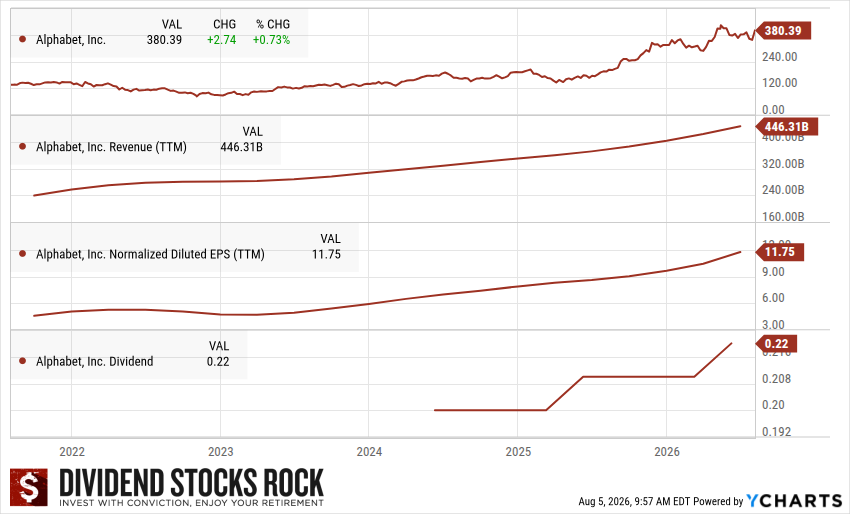
Alphabet’s 5-year dividend triangle chart.
Costco (COST): The Low-Cost Producer That Locks the Door Behind You
Costco stacks low-cost producer economics, a membership that keeps customers in, and the Kirkland Signature brand into one of the widest moats in retail.
Costco is my ninth largest holding, and the business model is a clinic in stacking moats.
The low-cost engine comes first. Costco carries roughly 4,000 items where a typical superstore carries 30,000. That concentration makes Costco the largest buyer of a given product for many of its suppliers, and the largest buyer negotiates the best price. Members get the savings. Costco gets the traffic.
The switching cost is the membership itself. You paid to shop there, so you shop there. Renewal rates run above 92% worldwide. Costco raised its fees in 2024, to $65 for Gold Star and $130 for Executive, and members stayed.
Brand power arrives through Kirkland Signature. Building private label products that compete with national brands at a lower price was a smart move that keeps paying. It protects margin and gives members one more reason to come back.
The dividend triangle tells a mixed story. Revenue growth of 9.50% and earnings growth of 13.35% over five years both look healthy. The dividend line is where it gets confusing. You will see a spike on the chart in early 2024, and a five-year dividend growth rate that reads negative. That is the $15 special dividend distorting the math, not a dividend cut. The regular dividend has climbed for 20 straight years.
The moat is not the risk here. The valuation is. The market prices Costco for continued perfection, and discounts are rare.
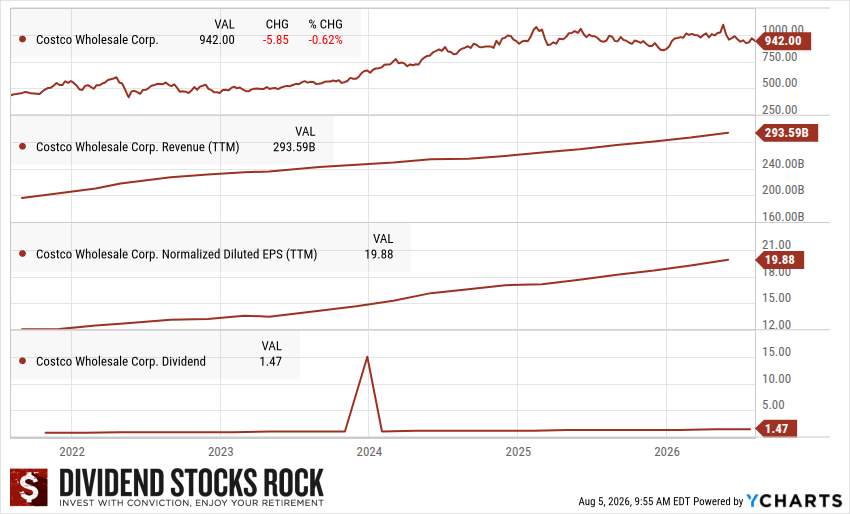
Costco’s 5-year dividend triangle chart.
Visa (V): A Tollbooth on Global Commerce
Visa’s moat is the network effect plus the capital and technology needed to move money across 200 countries without dropping a transaction.
Visa is my eighth largest holding, and it operates in something close to a duopoly. Yes, other cards exist. In practice, Visa and Mastercard (MA) are the two networks that can move money anywhere on earth.
The network effect runs both ways. Merchants accept Visa because cardholders carry it. Cardholders carry it because merchants accept it. Visa handles more than $15 trillion in annual volume across 200+ countries, with more than 14,500 financial institutions and over 50 million merchants on the network.
The capital intensity is the part people miss. Building the security and the infrastructure to clear 65,000 transactions per second, without losing a dollar in transit, is not a software project. It is decades of investment. Add the brand and you have a tollbooth that is hard to route around.
Now the honest part. Regulation is not a moat for Visa. It is a threat. The U.S. Department of Justice filed an antitrust suit focused on debit. The EU keeps interchange caps in place. European governments are working on payment systems built to reduce the dependence on both networks. Everyone wants a slice of that pie.
The dividend triangle is strong. Revenue growth of 14.15%, earnings growth of 17.90%, and dividend growth of 14.85% over five years. Here is the part I like most. Visa turns more than $15 trillion of payment volume into roughly $44 billion of revenue. It takes a thin slice of an enormous flow, and that slice compounds. The yield is small. The growth is not.
I bought Visa in 2017 at what was then an all-time high, at a valuation everyone called stretched. I still own it. The valuation was never the point. Nobody was going to rebuild that payment network, at any price.
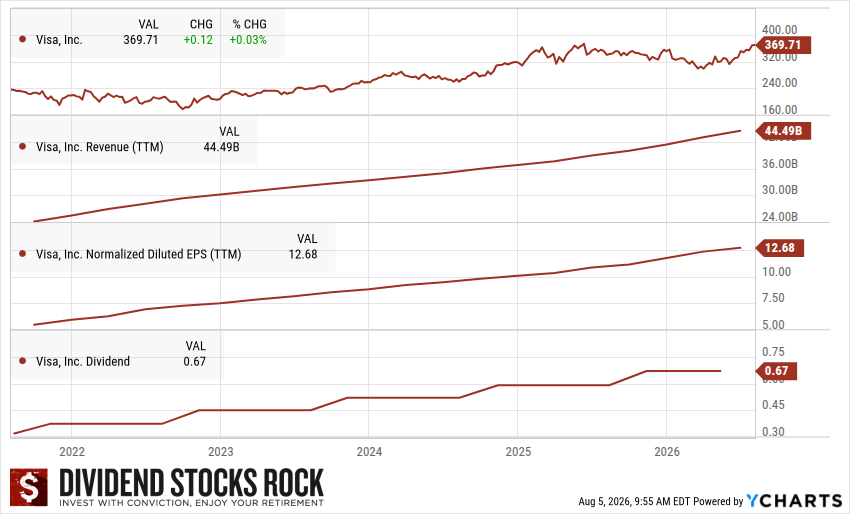
Visa’s 5-year dividend triangle chart.
Microsoft (MSFT): Switching Costs You Cannot Escape
Microsoft’s moat is switching costs, brand power, and the capital required to compete across software, cloud and AI at the same time.
Microsoft is my seventh largest holding. It used to sit in my top three. The last 12 to 18 months have been a tough ride, and that is the best proof I can offer that a moat does not guarantee outperformance.
The switching cost is the strongest of the three. Try removing Windows and Office 365 from a company, or from your own computer. I have thought about it. I am still using both. Office, Azure, Dynamics and SQL Server sit inside the plumbing of corporate systems everywhere, and pulling one out means rebuilding around it.
Brand power comes next, then capital intensity. Azure alone runs above $75 billion in annual revenue. Few companies can fund a fight on that many fronts at once.
I do not see a real network effect here. Selling a lot of software and hosting a lot of cloud workloads is scale, not a flywheel. Switching costs, brand, and capital intensity are the three that matter for Microsoft.
The dividend triangle holds up. Revenue growth of 13.60%, earnings growth of 15.80%, and dividend growth of 10.20% over five years. The market’s worry is the AI spending and whether the return shows up. That is a valuation debate, not a moat debate.
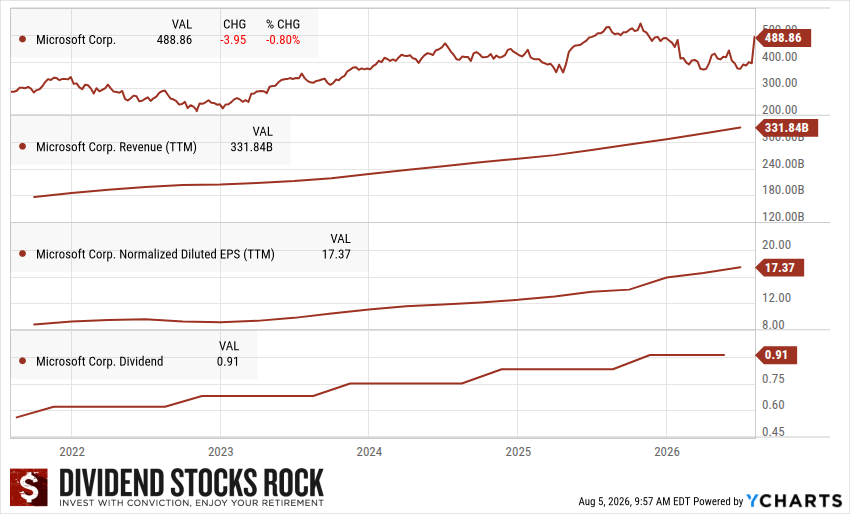
Microsoft’s 5-year dividend triangle chart.
How Do You Find the Moat in Your Own Portfolio?
Name the advantage in one sentence, then ask what it would cost a competitor to copy it. If you cannot answer both, you do not own a moat.
Here is the exercise I run on every holding.
Name the moat in one sentence. If it takes a paragraph, you are describing a story, not an advantage.
Price the copy job. What would a well-funded competitor need to spend, and how many years would it take? Billions and a decade is a moat. A better marketing campaign is not.
Check that the moat shows up in the numbers. A real advantage protects margins and shows up in the dividend triangle. Revenue growth, earnings growth, dividend growth. If a company claims a moat and the triangle is flat, the claim is thin.
Watch for erosion. Regulators, technology shifts and patent expiries end moats. Visa’s regulatory pressure is a live example. Keep an eye on it.
Do not expect the moat to move the stock this year. It protects the business. The market sets the price on its own schedule.
That last rule is how I hold Microsoft through a bad 18 months without touching the sell button. The wall is still standing. The market is in a mood.



Comments
Log in or sign up to join the conversation.