

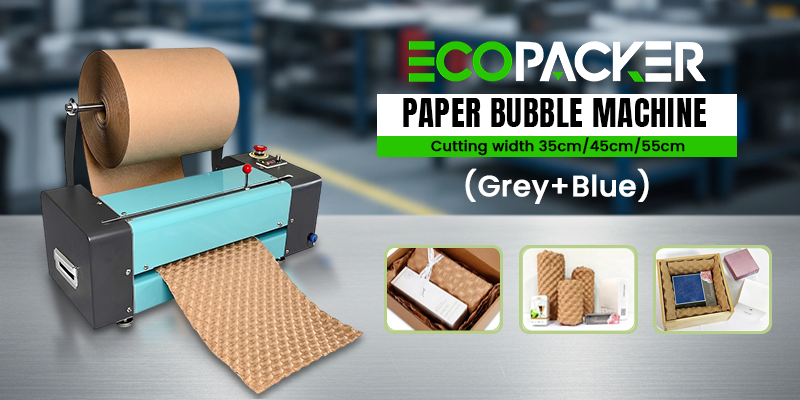
Package handling is an integral aspect of modern businesses since it determines the safety of products, the amount of labor required, the processing time, and the amount of material to be used. Although package handling manually seems convenient for businesses, especially the smaller ones, repeated tasks tend to become slower and unreliable as the volume of orders increases. With an Ecopackaging Machine, the process of package handling takes an organized form whereby businesses are able to handle package material effectively without relying heavily on repeated tasks. In the comparison between these two approaches, more than the cost involved should be considered.
Manual Packaging: Flexible but Labor-Intensive
Manual packaging entails the activity of measuring, folding, cutting, wrapping, and preparing the materials used, based on the item to be packed. It is suitable in cases where the volume of packaging is minimal and when the product size is changing. However, high production demands may pose challenges to manual operations.
Key points:
Slower processing: Each package requires individual handling, which can restrict daily output.
Higher labor dependency: More workers may be needed as order volumes increase.
Inconsistent results: Packaging quality can vary between operators.
Material wastage: Incorrect cutting or folding may result in unnecessary cardboard consumption.
Worker fatigue: Repetitive packaging activities can become tiring during long shifts.
Manual packaging still has value for customized orders and businesses that process a limited number of products. However, companies with regular packaging workloads may benefit from a more automated workflow.
Eco Packer Machine: Efficiency and Operational Benefits
An Ecopackaging Machine is designed to make packaging preparation faster and more systematic. Instead of depending entirely on manual cutting and preparation, businesses can use machinery to process packaging materials according to operational requirements. This can help improve throughput while creating greater consistency across packaging tasks.
Important advantages include:
Faster processing: Automated operations can handle repetitive packaging preparation more efficiently.
Consistent output: Machines provide more uniform results compared with manual handling.
Reduced labor pressure: Employees can spend less time on repetitive packaging activities.
Better workflow: Packaging preparation can become easier to integrate into production and dispatch operations.
Scalability: Businesses can increase packaging capacity without increasing manual effort at the same rate.
Features such as automatic wrapping can further reduce repetitive handling when products require consistent protective coverage. The actual productivity improvement depends on the machine model, packaging material, product dimensions, and daily workload.
Cost Comparison: Looking Beyond the Purchase Price
The cost difference between manual and automated packaging should be evaluated over the long term. Manual packaging generally requires lower initial investment because businesses can begin with basic tools and labor. However, recurring wages, training, rework, material waste, and productivity limitations can increase operating expenses.
On the other hand, eco packaging machinery requires an initial investment and may involve maintenance and operator training. Its financial advantage becomes more noticeable when packaging volumes are consistently high.
Businesses should evaluate:
Labor cost per package
Material consumption and wastage
Daily packaging capacity
Machine maintenance requirements
Employee productivity
Expected return on investment
A cardboard perforator machine can also support efficient material preparation by creating controlled perforations that make cardboard easier to shape and reuse. This can reduce unnecessary material handling and improve packaging flexibility.
Sustainability: Why Packaging Method Matters
Environmental performance is becoming an important consideration for businesses choosing packaging processes. Manual packaging can use recyclable materials, but sustainability also depends on how efficiently those materials are cut, processed, and consumed. Automated systems can help businesses maintain greater control over material usage.
Eco friendly packaging machines can support sustainability by improving material utilization and reducing unnecessary packaging waste. When recyclable cardboard is processed efficiently, businesses may be able to create protective packaging without relying heavily on additional plastic materials.
Another advantage is process consistency. Better control over packaging dimensions can reduce oversized packaging, which may lower material consumption and improve storage and transportation efficiency. A cardboard perforator machine can contribute to this approach by helping businesses transform suitable cardboard into useful protective packaging material.
Which Packaging Method Should Businesses Choose?
The right option depends mainly on packaging volume, budget, product variety, and future growth plans. Manual packaging can remain practical for small operations with low and irregular demand. Businesses handling hundreds or thousands of packages regularly may find automation more beneficial.
Before investing, companies should compare their present packaging costs with projected machine operating costs. They should also consider available floor space, maintenance support, operator requirements, and compatibility with existing packaging materials.
Eco friendly packaging machines can become particularly useful for organizations that want to combine productivity improvements with more responsible material usage. Automation does not necessarily mean removing human involvement; instead, it can allow employees to focus on quality control, order management, and other higher-value activities.
Conclusion
It becomes very clear through the comparison of the two packaging approaches that there exists a close connection among efficiency, cost and sustainability. Whereas the manual approach is flexible and involves little investments, the Ecopackaging Machine will offer efficiency, consistent production and scalability. For those companies seeking to have an efficient and sustainable packaging process, it is essential to appreciate the potential of ecopacker.co.in.
FAQs
1. Is automated packaging better than manual packaging?
For high-volume operations, automation can improve speed, consistency, and labor efficiency. Manual methods may still be suitable for low-volume or highly customized packaging.
2. Does automation reduce packaging costs?
It can reduce long-term costs by lowering repetitive labor requirements, improving productivity, and minimizing material waste. The results depend on workload and machine utilization.
3. What is eco packaging machinery used for?
It is used to improve packaging preparation and processing while supporting efficient material utilization and more sustainable packaging practices.
4. Can automated systems use recycled cardboard?
Many packaging systems are designed to work with cardboard and other suitable materials. Businesses should confirm material compatibility with the specific equipment before purchasing.
5. Why are sustainable packaging machines becoming important?
They can help businesses reduce material waste, improve operational efficiency, and support environmentally responsible packaging practices while meeting increasing packaging demands.
Comments
Log in or sign up to join the conversation.