

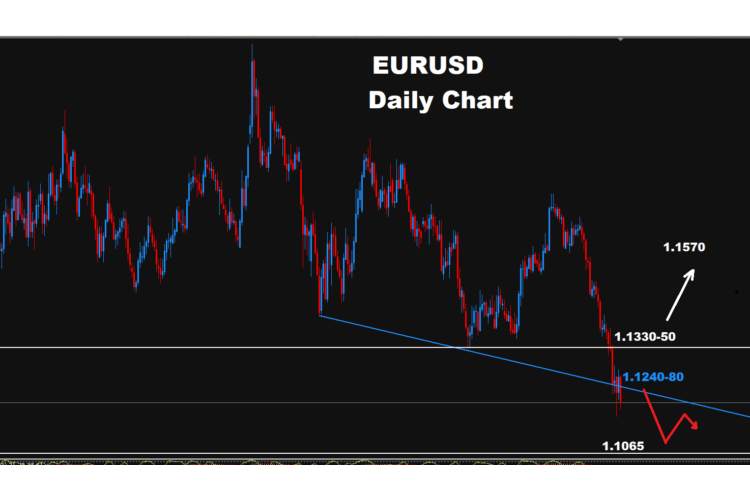
The EURUSD has fallen to lows not seen since early 2025 as last year’s prolific gains unwind amid a divergence between the Fed and the ECB. That trend could be affirmed this week, as the ECB meeting takes place a day after the Fed’s and the Eurozone central bank is widely expected to keep rates unchanged.
What markets will be looking at is the tone from the central bank, and particularly President Christine Lagarde’s comments. After being one of the more hawkish central banks, hiking aggressively as inflation from higher energy prices manifested, the ECB has turned much more dovish. The question now is how dovish the messaging will be, as regulators try to strike a balance between inflation pressures and growth concerns.
What’s Behind the Headlines
Social unrest, particularly in France, has drawn considerable attention given its dramatic nature, but an underlying issue is a greater concern for investors and the ECB. After two rate hikes earlier in the year, fragmentation in the shared economy has accelerated as the periphery and central countries face different economic scenarios. Any action (or inaction) by the central bank threatens to widen this problem.
The Eurozone is facing a combined problem of fiscal risk (the “French headwind”) and a rising Middle East premium. The latter is actually a US issue, because after Europe shifted its fossil fuel purchases away from Russia, the US has stepped into the gap and now supplies the continent with most of its fuel. The war in the Middle East has pushed up fuel prices, raising costs while depressing economic activity, a particularly dangerous situation for central banks called “stagflation”.
How the ECB Will Deal With Fragmentation
To compound the problem for the ECB, the situation is not even across the economy it regulates. Higher fuel prices have hurt the core, especially Germany, which is highly reliant on lower energy prices to support its industry. Meanwhile, service-oriented periphery countries are seeing surging growth as countries like Italy and Spain source and process fuel, selling distillates back to America.
This means the ECB faces the threat of inflation in the periphery and stagnation in the core. It therefore has to choose whether to remain hawkish to control inflation, thereby exacerbating the already troubled situation in France, which is facing rising borrowing costs amid mounting debt. Or, if the ECB turns dovish, it can provide some relief to France, Germany and Belgium, but at the cost of potentially runaway inflation in the periphery.
What the Market Is Looking For
How the ECB tries to balance those issues will be decisive in how the market reacts to Thursday’s rate decision at the ECB meeting. The market is pricing practically zero chance of a hike, but still sees 70% odds of a hike in December. That leaves plenty of room for the market to react no matter what happens.
If the ECB tries to split the difference, it could end up providing the most negative scenario for the Euro. Investors are worried about rising yields and inflation at the same time, so if the central bank doesn’t sound convincing in its efforts to tackle both issues, investors could return to the greenback. The market is expecting Lagarde to make the case for a December hike at the ECB meeting, which could support the Euro. If not, then the shared currency could fall even further.
Comments
Log in or sign up to join the conversation.