

The US Dollar (via DXY Index) has failed to break through the weekly highs established yesterday, setting up the development of an inside day candlestick pattern. To little surprise, EUR/USD, as 57.6% of the DXY Index, is also carving out an inside day candlestick.
A quick recall of recent price action helps put these inside day bars in proper context. Inside days are typically viewed as pauses or potential turning points in trends, meaning that the US Dollar's recent bullish run - and the Euro's bearish slide - is entering a critical juncture.
DXY Index Price: Daily Timeframe (July 2017 to June 2018) (Chart 1)
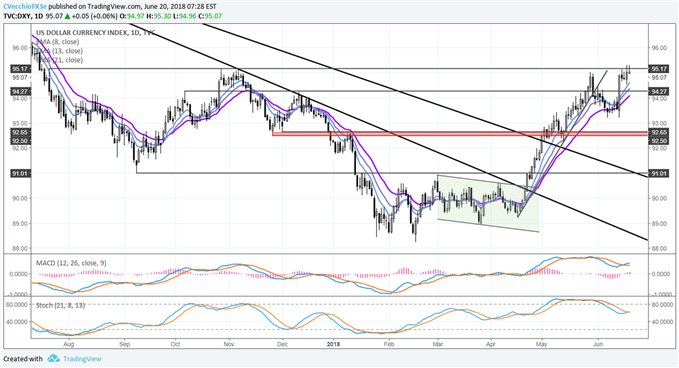
The DXY Index continues to contend with 95.17 - the high from the July 20, 2017, bearish outside engulfing bar, as well as the October and November 2017 swing highs. But until a daily close through 95.17 is achieved, traders may be best suited to be a bit more patient approaching new long USD-pair trades; the inside day bar that is forming suggests that recent buy signals issued by MACD and Slow Stochastics may be 'false starts.'
Elsewhere, in light of a rather absent economic calendar for the third day in a row, traders should continue to keep their attention honed in on the newswire (when they're not watching the World Cup). Later today, the British Pound will take the spotlight as the UK's House of Commons will be voting on a bill to determine whether or not Parliament has a say in the Brexit negotiations.
Similar to the vote held last week, concerns are afoot that the passage of the amendment would bind UK Prime Minister Theresa May's hands with respect to the negotiations, raising the possibility of a no-deal, or hard Brexit, outcome. The uncertainty around the Brexit negotiations has, in turn, undercut August BOE rate hike odds, which have fallen to 45% today from their peak of 62% in the first week of June.


Comments
Log in or sign up to join the conversation.