

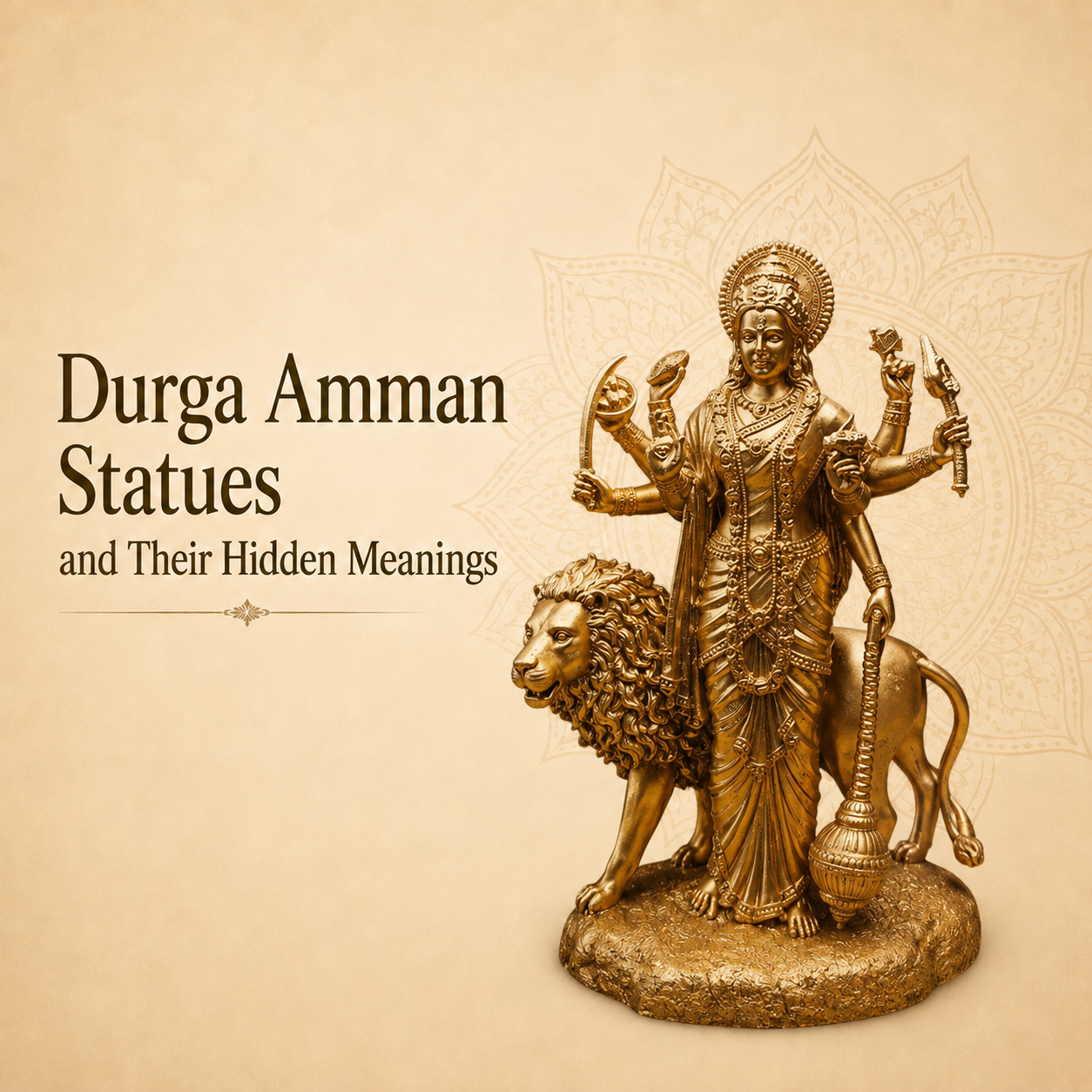
Few images in Indian art carry as much visual and spiritual weight as the sculpted form of Durga Amman. Whether crafted from clay for a festival pandal, cast in bronze for a temple sanctum, or carved in stone centuries ago, every element of a Durga sculpture is deliberate. Nothing is decorative for its own sake. The weapons, the posture, the animals, even the colors all carry layers of meaning built up over thousands of years of devotion and artistic tradition. This piece walks through the major symbolic elements of Durga sculptures, and closes with a look at two important dimensions of how these forms come into being: idol-making traditions and the special place of bronze in Durga iconography.
The Ten or More Arms
Durga is almost always shown with multiple arms. Commonly ten, though depictions with eight, twelve, or eighteen also exist. Each hand holds a weapon or object gifted to her by a different god, symbolizing the combined power of the entire pantheon channeled into a single protective force. The arms radiating outward in a circle also suggest omnipresence. The idea that the goddess's protection extends in every direction at once, and that she is never without the means to act.
The Weapons She Carries
Every weapon in Durga's hands tells its own story:
Trishul (trident) from Shiva – Representing the destruction of ego, ignorance, and desire.
Chakra (discus) from Vishnu – Symbolizing the cyclical nature of time and cosmic order.
Sword from various deities – Cutting through illusion and falsehood.
Bow and arrows – Focus, discipline, and precise action against evil.
Conch shell – The primal sound of creation.
Lotus – Purity and spiritual unfolding, even amid worldly struggle.
Thunderbolt (vajra) from Indra – Unbreakable resolve.
Together, the weapons transform Durga into a composite of divine strength rather than a single deity acting alone. She is, in a sense, the united will of the gods made visible.
The Lion or Tiger Vahana
Durga's mount, usually a lion (sometimes rendered as a tiger in regional traditions), represents raw power, courage, and untamed instinct brought under control by higher consciousness. That she rides rather than fights the beast shows mastery over primal forces rather than their suppression. Strength disciplined by wisdom.
Mahishasura, the Slain Demon
At the base of most Durga sculptures lies Mahishasura, the buffalo demon, often shown in the act of being pierced by her trident as he attempts to emerge from the buffalo's severed neck in human form. This is the sculptural heart of the Durga Puja narrative: the triumph of dharma over adharma, order over chaos. The shape-shifting demon represents deception and the many disguises that evil can take, while Durga's calm, composed expression even mid-battle signifies that righteous power need not be born of rage.
Facial Expression and Posture
Unlike many warrior depictions in world art, Durga's face is typically serene, almost meditative, even as she slays a demon. This contrast between calm expression and violent action is intentional: it communicates that her power comes from inner stability and dharmic clarity, not from anger. Her posture poised, balanced, often in a subtle dance-like stance reflects control rather than chaos.
Color Symbolism
Durga is traditionally depicted with skin in shades of gold, red, or occasionally deep blue, depending on the region and tradition. Gold suggests prosperity and divine radiance; red signals active power and the energy of creation and destruction; blue, when used, links her to cosmic infinity. Her garments, often red, symbolize both auspiciousness and the fierce, active side of feminine energy (Shakti).
The Idol
The word "idol" as used for Durga is best understood through the Sanskrit term murti. A sacred embodiment rather than a mere statue. Idol-making is itself a devotional act. In regions like Kumartuli in Kolkata, artisans follow a process passed down through generations: building a straw-and-bamboo armature, layering it with river clay (often including clay from the banks of the Ganga, considered sacred), shaping the form over weeks, and finally painting and adorning the eyes last. A ritual step called chokkhu daan, or "the gift of sight," believed to awaken the idol spiritually. This idol is typically made to be immersed (visarjan) at the end of the festival, symbolizing the goddess's return to her cosmic abode and the cyclical, impermanent nature of material form itself.
Bronze
Durga Amman Statues
While clay idols are common during festivals, bronze holds an older and special place in Durga art, especially in temples and collections, where lasting quality matters. Bronze idol making uses the lost-wax casting method, an ancient technique still practiced in parts of South India, Odisha, and West Bengal. A wax model is first sculpted in full detail, covered in clay, then heated so the wax melts away, leaving a mold. Into this mold, molten bronze often panchaloha, a traditional five-metal alloy of copper, zinc, tin, silver, and gold is poured to create the bronze idol. Because the wax model is destroyed in the process, each bronze idol is one of a kind, even when made from a similar design. Bronze idols are valued for their durability and their ability to hold fine detail jewelry, weapon carvings, and facial expressions for centuries, which is why many of the oldest surviving Durga Amman statues studied today are bronze idols rather than clay or wood. The bronze idol, dense and long-lasting, has come to symbolize the eternal, unchanging side of the goddess.
At IdolBronze Chennai, we craft beautiful bronze idols and Durga Amman statues using traditional techniques, available at our T.Nagar and Ambattur branches. Visit us to explore our bronze idol collection in Chennai.
Comments
Log in or sign up to join the conversation.