

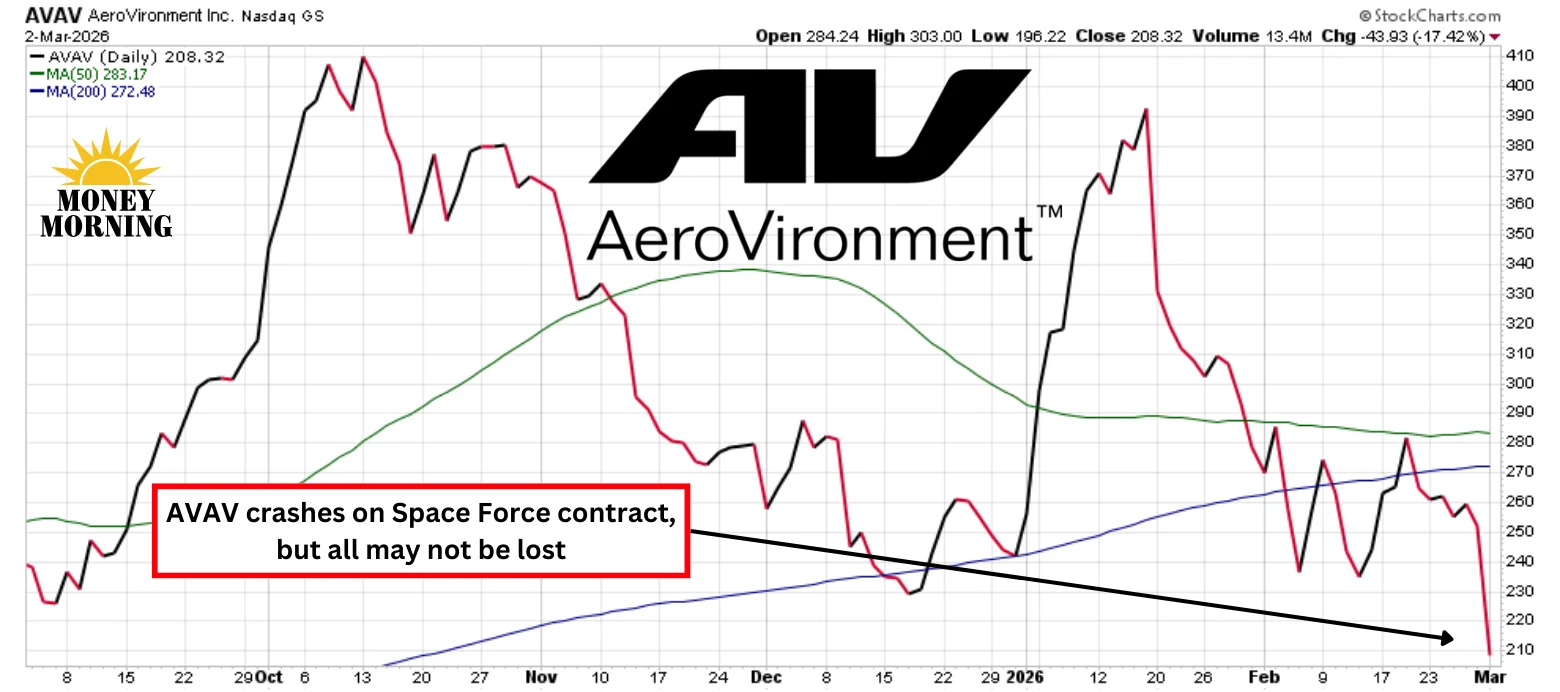
Drone maker AeroVironment (AVAV) was primed for a massive boost from the U.S.-Israeli war with Iran that erupted on Saturday. With U.S. forces targeting Iranian missile sites, naval assets, and nuclear facilities, AVAV's combat-proven Switchblade loitering munitions and reconnaissance drones like Puma and Raven would have been in high demand, showcasing their precision strike capabilities amid escalating drone warfare. These systems, already battle-tested in Ukraine, could have driven surging orders as the Pentagon ramps up unmanned operations to minimize troop risks.
However, the U.S. Space Force's announcement to recompete the Satellite Communication Augmentation Resource (SCAR) program – AVAV's largest contract – derailed the momentum. The move threatens to wipe out $1 billion to $1.4 billion from AVAV's $2.8 billion backlog, sending shares plummeting 17% in a single day.
AVAV's Positioning in the Military Drone Arsenal
AeroVironment has solidified its role as a key player in the U.S. military's shift toward unmanned systems. The company leads in loitering munitions with its Switchblade series, which provides precision strikes from portable launchers, ideal for targeting high-value assets like Iranian missile launchers or command centers. AVAV's small unmanned aircraft systems (sUAS), including the Puma for long-range reconnaissance and the P550 for autonomous Group 2 operations, enhance situational awareness in contested environments.
Through its 2025 acquisition of BlueHalo, AVAV expanded into space and counter-UAS tech, including the BADGER phased-array antennas for SCAR, which augments satellite communications for geosynchronous orbits. This positions AVAV at the intersection of air, space, and cyber domains, aligning with the Pentagon's "generational shift" to drone-centric warfare. Amid the Iran conflict, AVAV's tech supports rapid, low-risk engagements, with recent $186 million Army orders for upgraded Switchblades underscore its relevance.
A Scar on the Opportunity
The Space Force is recompeting SCAR to address supply chain vulnerabilities, shift from cost-plus to fixed-price contracts, and introduce multiple vendors for resiliency and surge production. Originally awarded to BlueHalo in 2022 for $1.4 billion, the program aims to modernize aging satellite ground stations with transportable phased arrays, but evolving requirements demand a simpler, commercial model to cut costs and boost capacity.
For AVAV, this means a January stop-work order halted BADGER deliveries, risking backlog erosion and profitability if competitors like new entrants undercut bids. Wall Street reacted harshly with Raymond James issuing a rare triple-downgrade to Underperform, citing credibility damage and contract risks. However, analysts at Jefferies and BTIG called the selloff overdone, maintaining Buy ratings with targets of $390 to $415, arguing SCAR represents only 5% to 8% of FY2026 revenue and AVAV could retain a portion.
Bottom Line
Relying on government contracts offers AeroVironment revenue visibility and stability, fueling its growth to projected $1.95 billion to $2 billion in FY2026 sales. Yet, it exposes the company to shifting priorities, as seen with SCAR's recompete amid Pentagon pushes for efficiency. This could be a major setback, potentially delaying deliveries and squeezing margins. Live by the sword, die by the sword.
Still, AVAV's core drone business remains robust, and it may recoup lost revenue through partial wins or new Iran-related orders, positioning it for recovery if execution holds.



Comments
Log in or sign up to join the conversation.