

The dragon jacket has become a staple of the embroidered apparel world, blending centuries of Japanese craft heritage with the restless energy of contemporary streetwear. From the post-war sukajan workshops of Yokosuka to the global fashion market today, the dragon motif has always been the centrepiece — and for good reason. No other embroidery subject carries the same visual weight, mythological depth, or cross-cultural recognition. Whether you're drawn to the ryū of Japanese Shinto tradition or the sinuous forms of the Chinese lóng, understanding what separates a well-executed dragon jacket from a mass-market facsimile starts here. For a closer look at what authentic execution looks like, the authentic dragon embroidery on sukajan jackets page covers the craft in detail.
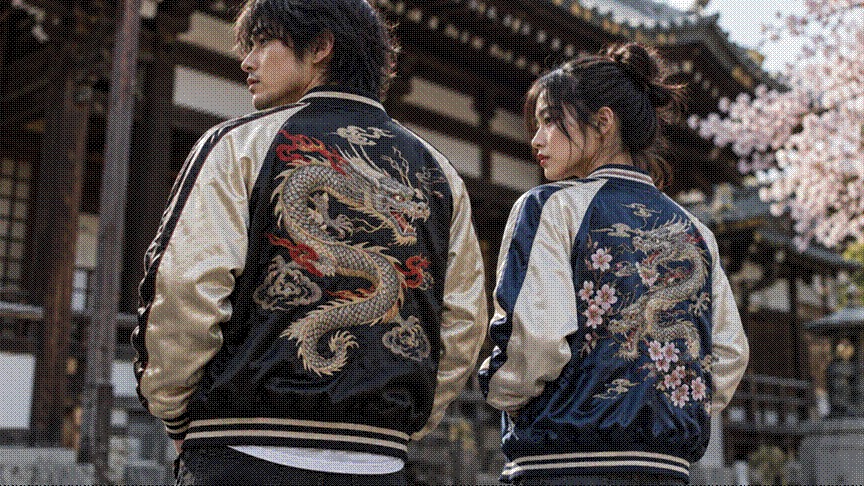
Chain-stitch dragon embroidery: the dimensional surface that defines a well-made sukajan jacket.
Understanding the Dragon Motif
The dragon holds a unique position in both Japanese and Chinese visual culture — and knowing the difference matters when you're evaluating a jacket. In Japan, the ryū is a water deity: serpentine, three-clawed, associated with rivers, rain, and celestial power. It is depicted in long, curved lines that suggest fluid movement rather than aggression. This is the dragon you see coiling across the back of a sukajan, its body spiralling from shoulder to hem in a single continuous sweep.
The Chinese lóng, by contrast, is five-clawed and explicitly imperial — a symbol of authority and good fortune, typically shown in a more frontal, heraldic composition with clouds around it. Many Western “Japanese-inspired” dragon jackets actually use Chinese dragon imagery, either out of confusion or because the bolder, symmetrical composition is easier to execute in machine embroidery. If provenance matters to you, look at the claw count and body posture: three claws with a fluid S-curve body = ryū; five claws with clouds and a symmetrical pose = lóng.
Historical Roots of the Dragon Jacket
The dragon jacket's modern form traces directly to the sukajan — the Japanese souvenir jacket developed in Yokosuka during the late 1940s and early 1950s. American servicemen stationed in Japan after World War II commissioned local artisans to produce satin-backed jackets embroidered with Japanese imagery: dragons, tigers, eagles, geisha, pagodas. The pieces were compact cultural artefacts, made to be taken home as proof of time spent in Japan. The dragon was the most popular motif from the beginning — recognisable, dramatic, and capable of filling a jacket back in a way nothing else quite matched.
Contemporary makers who study that original tradition understand that construction was as important as the embroidery. Sukajan jackets used reversible designs — a map of Japan on one side, embroidery on the other — with a satin or rayon outer shell specifically chosen for how it caught the light. For anyone considering a purchase today, a sukajan buyer's guide explains the key construction signals that distinguish genuine Japanese craft from licensed copies.
Modern Adaptations and Trends
Today's dragon jacket market ranges from affordable printed bombers to painstakingly embroidered sukajan pieces with weeks of stitching time behind them. The silhouette has expanded beyond the traditional reversible bomber — dragon motifs now appear on varsity jackets, oversized windbreakers, and even workwear-inspired duck-canvas shells. The unifying thread is the dragon as a totem of strength: in Japanese streetwear, in K-pop styling, and in luxury fashion's periodic rediscovery of Asian heritage motifs.
The embroidered end of the market has benefited from renewed interest in Japanese craft. Brands working in this space typically use Tajima programmable chain-stitch machines — descendants of the same equipment used in the Yokosuka workshops — which reproduce the complex shading and dimensional depth of hand embroidery at accessible price points. Those interested in the full range of Japanese dragon clothing designs will find a rich companion resource tracing how embroidery choices evolved from the original Yokosuka commissions to today's global market.
Embroidery vs Print on a Dragon Jacket
The quality difference between embroidery and print is not cosmetic — it is structural. According to the Victoria and Albert Museum's Japanese textile collection, Japanese embroidery techniques evolved over centuries to create designs that remain vivid and dimensional through decades of wear. Chain stitch builds each thread loop from the previous one, producing a raised surface that catches light at multiple angles: the dragon appears to shift as the jacket moves. Satin stitch fills large areas with dense, parallel threads that mimic the sheen of painted lacquer.
Screen print and heat-transfer finishes work by fixing pigment to the fabric surface. They achieve sharper detail at lower cost, but the pigment layer degrades with repeated washing: colours fade, edges crack, and fine lines blur. On a satin shell — already prone to surface marking — a cracking print is difficult to ignore. Embroidery is colour-stable because the thread is the colour source, not a film applied over it. On a dragon motif in particular, where fine scales, whiskers, and eye detail matter, the difference is visible at a glance.
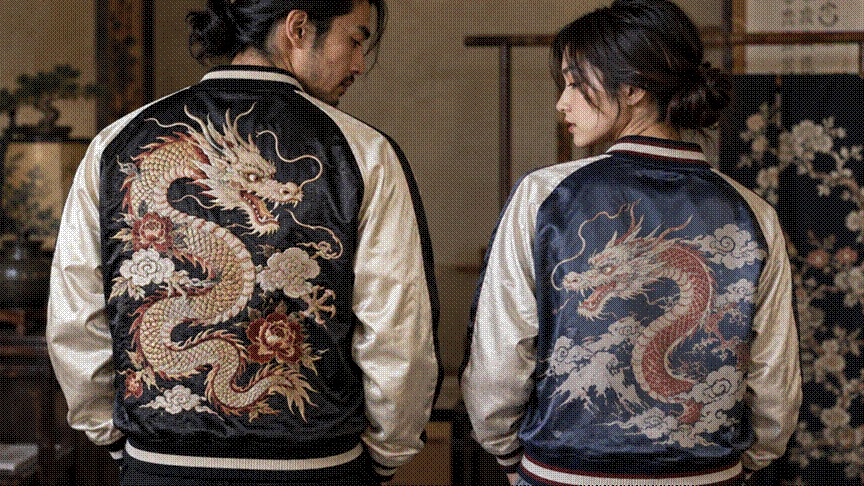
Embroidery vs print: the structural difference that determines how a dragon jacket ages.
How to Style a Dragon Jacket
The most common mistake with a dragon jacket is overloading the outfit. The embroidery is designed to be the focal point; everything else should step back. A plain white T-shirt underneath, dark slim trousers or straight-leg jeans, and clean low-profile sneakers give the jacket room to work. The composition is essentially the same one that worked in 1950s Yokosuka — the jacket does the talking, and the basics underneath make sure it is heard.
For cooler weather, layer a plain crewneck sweater between the jacket and a plain tee — the jacket still sits on top as the statement piece. Avoid patterned or graphic tees, which compete with the embroidery. Colour coordination is straightforward: the black or navy ground of most dragon jackets pairs naturally with dark neutrals, and the gold or red accent threads in the embroidery give you latitude to introduce a single warm accent in footwear or bag.
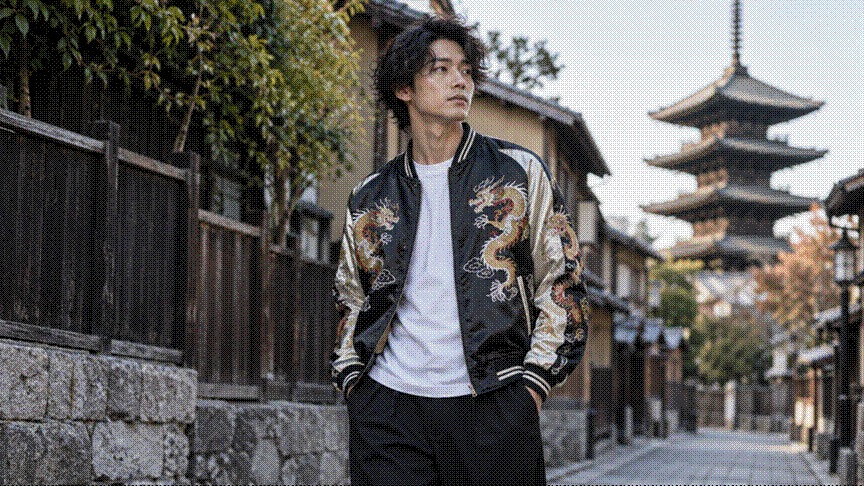
Minimal basics let the dragon jacket lead — the same principle that made sukajan a global streetwear staple.
Frequently Asked Questions
What is a dragon jacket?
A dragon jacket is an embroidered or printed outerwear piece centred on a dragon motif, most commonly found on sukajan-style souvenir jackets and bomber silhouettes. Rooted in post-World War II Japanese craft culture — particularly in Yokosuka, where US servicemen commissioned local artisans — the dragon became the defining motif of the form. Today it signals cultural depth and streetwear credibility in equal measure.
What is the difference between Japanese and Chinese dragon motifs?
Japanese ryū are three-clawed, serpentine water deities depicted in curved, fluid lines associated with rivers and celestial power. Chinese lóng, by contrast, are five-clawed airborne creatures symbolising imperial authority, often shown amid clouds in a frontal, symmetrical composition. On a sukajan jacket, the distinction matters: Japanese dragon embroidery favours elongated, spiralling body forms, while Chinese-influenced versions tend toward a more heraldic pose.
Is embroidery better than print on a dragon jacket?
Embroidery produces a tactile, three-dimensional surface that holds its definition through years of wear — the threads remain colour-fast because the pigment is structural, woven into the fabric rather than applied over it. Screen-print finishes degrade faster: colours fade and edges crack with repeated washing. On a satin or rayon shell, embroidery also reflects light differently at each angle, amplifying the sense of movement in the dragon motif.
How do I style a dragon jacket?
Keep the rest of the outfit minimal — dark slim trousers or straight-leg jeans, a plain white or black crew-neck underneath, and low-profile sneakers. The dragon motif is bold enough that competing graphics or busy patterns undercut rather than complement it. For a smarter occasion, swap the sneakers for Chelsea boots and carry a plain tote. Stick to one accent colour drawn from the embroidery thread palette — gold or red typically.
Where can I find an authentic dragon jacket?
Look for brands that source embroidery from Japan-trained ateliers or use Tajima chain-stitch machines — the equipment used by heritage sukajan workshops in Yokosuka. Avoid listings where the dragon is a patch or heat-transfer apliqué rather than a stitched-in design. Check product descriptions for thread type and shell material: satin or high-grade rayon are the traditional bases. A credible brand will show close-up embroidery photography, not only lifestyle shots.
How should I care for an embroidered jacket?
Turn the jacket inside out before washing to protect the embroidery threads from abrasion. Hand-wash in cold water with a gentle, pH-neutral detergent, avoiding any wringing of the satin shell. If machine-washing is unavoidable, use a mesh laundry bag on a delicate cycle. Air-dry flat or on a padded hanger away from direct sunlight. Never iron directly over embroidery — use a pressing cloth or steam from a safe distance.
Final Thought
The dragon jacket rewards those who take the time to understand what they are actually looking at. Whether it is a three-clawed ryū in chain stitch on a reversible sukajan, or a more freely interpreted dragon motif on a contemporary bomber, the piece works because the dragon itself carries weight — mythological, cultural, and visual. At its best, the dragon jacket is not a fashion statement that dates; it is craft worn as clothing.
About the Author
Kenji Watanabe is a fashion historian and textile specialist with a focus on post-war Japanese craft traditions. He has studied sukajan production techniques in workshops across Yokosuka and contributed research on embroidery motif evolution to museum archives in Japan and the United Kingdom.
Comments
Log in or sign up to join the conversation.