

The pace at which carbon dioxide accumulates in the Earth's atmosphere has been falling since peaking in January 2025. New data on the changing concentration of CO₂ in the air however suggests that long trend may be ending.
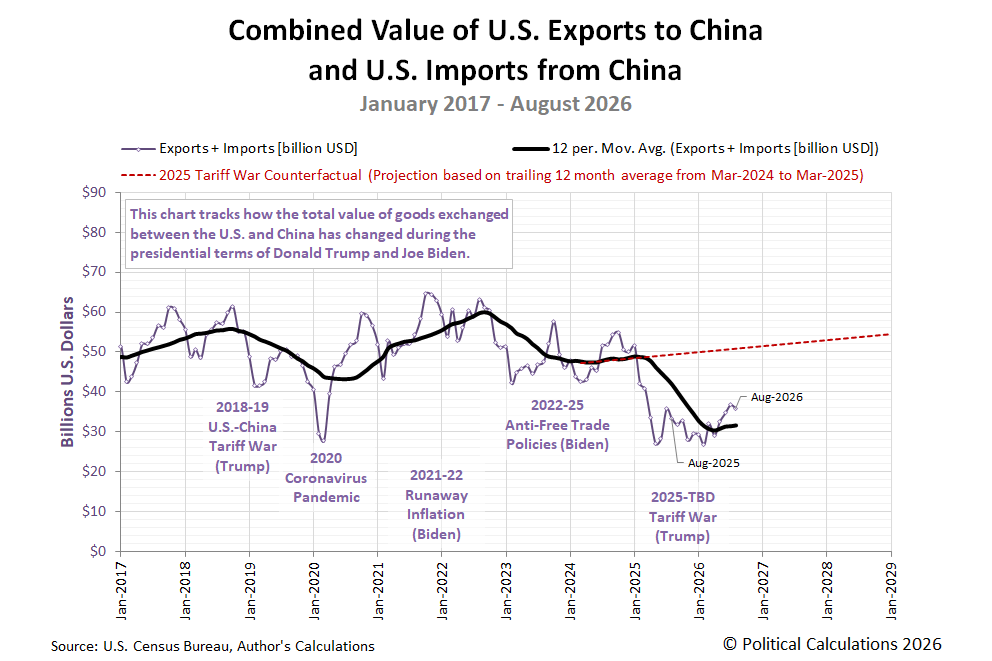
The decline since the January 2025 peak has largely coincided with the negative impact of the U.S.-China tariff war, which has contributed to the slowing of China's economy in the period since. Because China is, by far and away, the world's largest source of carbon dioxide emissions, changes in those emissions can provide a window in the relative health of its economy.
In August 2026, data reported by the remote Mauna Loa Observatory indicates the downward trend in the accumulation rate of CO₂ in the Earth's air has begun to slow. This new data points to a positive change in momentum for China's economy that follows an increase in trade between the U.S. and China, which we've observed in the form of an increase in goods exported from China to the U.S. since April 2026. The combination of this increase in trade with the positive change in momentum for CO₂ emissions indicates China's economic output is picking up.
The following chart shows the downward trend in the pace of carbon dioxide accumulation in the atmosphere is decelerating.
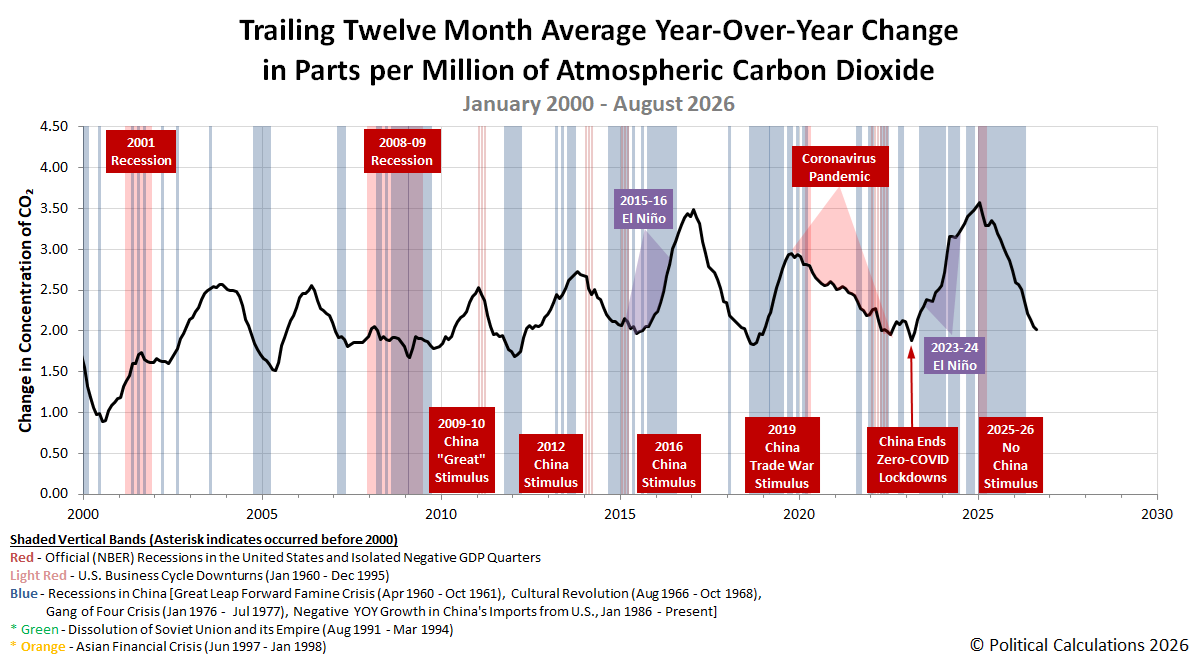
The deceleration in the downward trend is taking place near the levels where reversals in downward economic momentum have been observed during the last twenty years.
On a final note, our featured secondary (inset) chart is taken from the United Nations Environmental Programme's 2025 Emissions Gap Report. We're featuring it because the upper chart shows China's very much larger than every other nation's emissions of greenhouse gases, which is predominantly made of up carbon dioxide emissions.
But there's a surprise in the lower chart of the figure: the U.S. no longer holds the top rank for per capita greenhouse gas (GHG) emissions! The UN's data suggests the Russian Federation's per capita GHG emissions have overtaken the U.S. for the top spot.
References
National Oceanographic and Atmospheric Administration. Earth System Research Laboratory. Mauna Loa Observatory CO2 Data. [Online Data]. Updated 5 September 2026.

Comments
Log in or sign up to join the conversation.